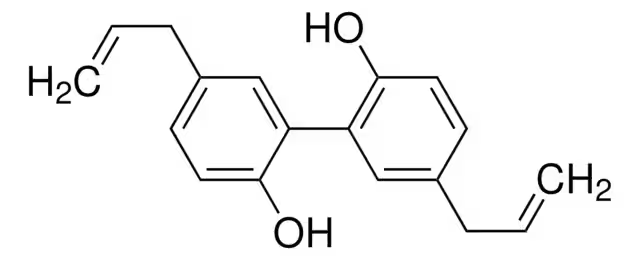
CAS Number528-43-8
SynonymsMAGNOLIABARKEXTRACT; DEHYDRODICHAVICOL; Honokiol std.; 5,5'-Diallyl-2,2'-biphenyldiol; Magnolol; 1U2R DQ CR BQ E2U1; MFCD00016658; 2-(2-hydroxy-5-prop-2-enylphenyl)-4-prop-2-enylphenol; 2,2'-Bichavicol; 5,5'-Diallyl-[1,1'-biphenyl]-2,2'-diol; 5,5'-Diallyl-2,2'-dihydroxybiphenyl; 5,5′-Diallyl-2,2′-biphenyldiol; Maglol; 5,5'-diallyl-biphenyl-2,2'-diol; 2,2'-Dihydroxy-5,5'-diallylbiphenyl; 5,5'-Diallylbiphenyl-2,2'-diol; 5,5'-Di-2-propenyl-[1,1'-biphenyl]-2,2'-diol; 5,5'-Di(2-propèn-1-yl)-2,2'-biphényldiol
Molecular FormulaC18H18O2
Molecular Weight266.33
Purity≥90 (HPLC)%
Density1.1±0.1 g/cm3
Boiling Point401.0±40.0 °C at 760 mmHg
Melting Point99 - 101ºC
AppearanceSolid;White to Almost white powder to crystal
Symbol
Signal WordWarning
| Chemical & Physical Properties | |
|---|---|
| CAS Number | 528-43-8 |
| Catalog No. | 2A-9022529 |
| Chinese Name | 厚朴酚 |
| Synonyms | MAGNOLIABARKEXTRACT; DEHYDRODICHAVICOL; Honokiol std.; 5,5'-Diallyl-2,2'-biphenyldiol; Magnolol; 1U2R DQ CR BQ E2U1; MFCD00016658; 2-(2-hydroxy-5-prop-2-enylphenyl)-4-prop-2-enylphenol; 2,2'-Bichavicol; 5,5'-Diallyl-[1,1'-biphenyl]-2,2'-diol; 5,5'-Diallyl-2,2'-dihydroxybiphenyl; 5,5′-Diallyl-2,2′-biphenyldiol; Maglol; 5,5'-diallyl-biphenyl-2,2'-diol; 2,2'-Dihydroxy-5,5'-diallylbiphenyl; 5,5'-Diallylbiphenyl-2,2'-diol; 5,5'-Di-2-propenyl-[1,1'-biphenyl]-2,2'-diol; 5,5'-Di(2-propèn-1-yl)-2,2'-biphényldiol |
| Molecular Formula | C18H18O2 |
| Molecular Weight | 266.33 |
| Purity | ≥90 (HPLC) |
| Density | 1.1±0.1 g/cm3 |
| Boiling Point | 401.0±40.0 °C at 760 mmHg |
| Melting Point | 99 - 101ºC |
| Appearance | Solid;White to Almost white powder to crystal |
| Storage Condition | Store in a cool, dry, well-ventilated warehouse at |
| Application | Magnolol is a lignan isolated from the bark of Magnolia officinalis. It is a dual agonist of RXRα and PPARγ, with EC50 values of 10.4 µM and 17.7 µM respectively. |
| HTC | 2907299090 |
| PubChem ID | 24896843 |
| MDL Number | MFCD00016658 |
| SMILES | Oc1ccc(CC=C)cc1-c2cc(CC=C)ccc2O |
| InChI | 1S/C18H18O2/c1-3-5-13-7-9-17(19)15(11-13)16-12-14(6-4-2)8-10-18(16)20/h3-4,7-12,19-20H,1-2,5-6H2 |
| InChI Key | VVOAZFWZEDHOOU-UHFFFAOYSA-N |
| NACRES Code | NA.25 |
| UNSPSC | 12352100 |
| Hazard Symbols | 9.0 |
| MSDS | msds/22529_1_528_43_8.pdf |
| Bioactivity | Magnolol, a natural lignan isolated from the stem bark of Magnolia officinalis, is a dual agonist of both RXRα and PPARγ, with EC50 values of 10.4 µM and 17.7 µM, respectively. Related Catalog Signaling Pathways >> Autophagy >> Autophagy Signaling Pathways >> Metabolic Enzyme/Protease >> RAR/RXR Research Areas >> Cancer Research Areas >> Inflammation/Immunology Research Areas >> Cardiovascular Disease Research Areas >> Neurological Disease Natural Products >> Phenylpropanoids Target RXRα:10.4 μM (EC50) PPARγ:17.7 μM (EC50) In Vitro Magnolol is a dual agonist of both RXRα and PPARγ, with EC50 values of 10.4 µM and 17.7 µM, respectively. Magnolol (26.2-80 µM) binds to RXRαLBD and PPARγLBD in a dose dependent manner, with Kd values of 45.7 µM and 1.67 µM, respectively. Magnolol (1-20 µM) induces the transcription of PPRE in a dose-dependent manner, but shows no activity on RXRE transcription[1]. Magnolol (1, 3, 10 µM) enhances adipocyte differentiation of both 3T3-L1 pre-adipocystes and C3H10T1/2 pluripotent stem cells in the presence of insulin. Magnolol (10 μM) upregulates mRNA expression of marker genes for adipocyte differentiation. Magnolol (1, 10 μM) shows an increase in basal and insulin-stimulated glucose uptake in differentiated 3T3-L1 adipocytes[2]. In Vivo Magnolol (5-15 mg/kg, p.o.) significantly attenuates the phenotypic severity of dextran sulfate sodium (DSS)-induced colitis in mice. Magnolol (10, 15 mg/kg, p.o.) attenuates histopathological changes and myeloperoxidase activity in the colon of DSS-treated mice, decreases DSS-induced high levels of proinflammatory cytokines TNF-α, IL-1β and IL-6 in the colonic tissues. Magnolol (10 mg/kg, p.o.) also reverses abnormality of serum metabolome, and regulates tryptophan metabolic pathway in mice[3]. Kinase Assay Binding affinities of magnolol towards purified RXRαLBD and PPARγLBD are analyzed using Biacore 3000 instrument. Proteins are covalently immobilized to CM5 chip using a standard amine-coupling procedure in 10 mM sodium acetate buffer (pH 4.2). The chip is equilibrated with a continuous flow of running buffer (10 mM HEPES, pH 7.4, 150 mM NaCl, 3 mM EDTA, 0.005% (v/v) surfactant P20) for 2 hours. Subsequently, magnolol in a gradient of concentrations are injected into the channels at a flow rate of 20 µL/min for 60 seconds, followed by disassociation for 120 seconds. For the coactivator SRC1 recruitment assays, biotin-labelled SRC1 is immobilized to SA chip. Different concentrations of Magnolol are incubated with 5 µM RXRαLBD or PPARγLBD for 1 hour, and then injected to the channel at a flow rate of 20 µL/min for 60 s, followed by disassociation for 120 s[1]. Cell Assay For differentiation of 3T3-L1 pre-adipocytes, at 2 days after confluence (defined as day 0), cells are incubated in differentiation medium containing 0.5 mM IBMX, 10 μg/mL insulin and 0.25 μM DEX in DMEM containing 10% fetal bovine serum (FBS). After 2 days, the cell culture medium is changed to DMEM containing 10 μg/mL insulin and 10% FBS. The medium is replaced again with fresh DMEM containing 10% FBS after 2 days. Adipocytes are used 6-8 days after the initiation of differentiation. In adipogenesis studies, 3T3-L1 pre-adipocytes and C3H10T1/2 pluripotent stem cells grown in DMEM supplemented with 10% bovine calf serum (day 0) are treated with insulin (1 μg/mL) with/without Magnolol in 10% FBS contained DMEM at the indicated concentration for 9 days. Fresh medium containing insulin (1 μg/mL) and 10% FBS with/without magnolol is replenished every 3 days[2]. Animal Admin Experimental colitis mice model is induced by routine administration of dextran sulfate sodium (DSS) solution dissolved in drinking distilled water at a concentration of 2.0% (w/v) ad libitum for 5 consecutive days. Distilled water is given to mice in the normal group for the same period. The body weight of each mice is recorded daily in the morning (9:00 a.m.). On day 6, the mice with significant body weight loss, diarrhea, and gross bleeding are considered as experimental candidates of colitis. All the mice with comparable disease index are then randomly divided into 5 groups (n = 8/group): (1) DSS model group, intragastric administrated with saline; (2) positive control group, intraperitoneal injected with infliximab (5 mg/kg); (3) low dose treatment group, intragastric administrated with Magnolol (5 mg/kg); (4) medium dose treatment group, intragastric administrated with Magnolol (10 mg/kg); (5) high dose treatment group, intragastric administrated with Magnolol (15 mg/kg). The mice in control group receives drinking water without DSS throughout the entire experimental period and intragastric administrated with saline[3]. References [1]. Zhang H, et al. Molecular determinants of magnolol targeting both RXRα and PPARγ. PLoS One. 2011;6(11):e28253. [2]. Choi SS, et al. Magnolol enhances adipocyte differentiation and glucose uptake in 3T3-L1 cells. Life Sci. 2009 Jun 19;84(25-26):908-14. [3]. Zhao L, et al. Magnolol, a Natural Polyphenol, Attenuates Dextran Sulfate Sodium-Induced Colitis in Mice. Molecules. 2017 Jul 20;22(7). pii: E1218. Chemical & Physical Properties Density 1.1±0.1 g/cm3 Boiling Point 401.0±40.0 °C at 760 mmHg Melting Point 99 - 101ºC Molecular Formula C18H18O2 Molecular Weight 266.334 Flash Point 184.5±21.9 °C Exact Mass 266.130676 PSA 40.46000 LogP 3.94 Vapour Pressure 0.0±1.0 mmHg at 25°C Index of Refraction 1.602 InChIKey VVOAZFWZEDHOOU-UHFFFAOYSA-N SMILES C=CCc1ccc(O)c(-c2cc(CC=C)ccc2O)c1 Storage condition 2-8°C |
| Use of | Magnolol, a natural lignan isolated from the stem bark of Magnolia officinalis, is a dual agonist of both RXRα and PPARγ, with EC50 values of 10.4 µM and 17.7 µM, respectively. Properties Name Magnolol Synonym More Synonyms Magnolol Biological Activity Description Magnolol, a natural lignan isolated from the stem bark of Magnolia officinalis, is a dual agonist of both RXRα and PPARγ, with EC50 values of 10.4 µM and 17.7 µM, respectively. Related Catalog Signaling Pathways >> Autophagy >> Autophagy Signaling Pathways >> Metabolic Enzyme/Protease >> RAR/RXR Research Areas >> Cancer Research Areas >> Inflammation/Immunology Research Areas >> Cardiovascular Disease Research Areas >> Neurological Disease Natural Products >> Phenylpropanoids RXRα:10.4 μM (EC50) PPARγ:17.7 μM (EC50) References [1]. Zhang H, et al. Molecular determinants of magnolol targeting both RXRα and PPARγ. PLoS One. 2011;6(11):e28253. [3]. Zhao L, et al. Magnolol, a Natural Polyphenol, Attenuates Dextran Sulfate Sodium-Induced Colitis in Mice. Molecules. 2017 Jul 20;22(7). pii: E1218. Chemical & Physical Properties Molecular Formula C18H18O2 Exact Mass 266.130676 PSA 40.46000 Index of Refraction 1.602 InChIKey VVOAZFWZEDHOOU-UHFFFAOYSA-N |
| Tax Rebate | 9.0% |
| Supervision | A. Customs clearance form for inbound goods B. Customs clearance form for outbound goods |
| Inspection | R. Imported food hygiene supervision and inspection S. Export food hygiene supervision and inspection M. Imported commodity inspection N. Exported commodity inspection |
| Transport Info | Shipping Name: UN |
| MSDS Transport Info | Module 14. Shipping information 14.1 UN dangerous goods number European Land Transport Danger Regulations: 3077 International Maritime Transport Danger Regulations: 3077 International Air Transport Danger Regulations: 3077 14.2 United Nations shipping name European land transport hazard regulations: ENVIRONMENTALLY HAZARDOUS SUBSTANCE, SOLID, N.O.S. (Magnolol) IMDG Code: ENVIRONMENTALLY HAZARDOUS SUBSTANCE, SOLID, N.O.S. (Magnolol) International air transport hazard regulations: Environmentally hazardous substance, solid, n.o.s. (Magnolol) 14.3 Transport hazard categories European land transport Dangerous Regulations: 9 International sea transport Dangerous Regulations: 9 International air transport Dangerous Regulations: 9 14.4 Package group European Land Transport Danger Regulations: III International Maritime Transport Danger Regulations: III International Air Transport Danger Regulations: III 14.5 Environmental hazards European Land Transport Dangerous Regulations: Yes International Maritime Transport Dangerous Regulations International Air Transport Dangerous Regulations: Yes Marine Pollutants (Yes/No): Yes 14.6 Special reminder to users further information Dangerous goods are individually packaged, with liquids exceeding 5 liters or solids exceeding 5 kilograms. The outer packaging of each independent package and the combined independent inner package must have EHS on it. Identification (according to European ADR Regulation 2.2.9.1.10, IMDG Regulation 2.10.3), |
| Related Products in Specialty Chemicals | ||
|---|---|---|
| 2-Furoyl chloride | 527-69-5 | 2A-9022522 |
| 4-Amino-2-sulfobenzoic acid | 527-76-4 | 2A-9022525 |
| 2-Methylbenzamide | 527-85-5 | 2A-9022526 |
| 2',3',4'-Trihydroxyacetophenone | 528-21-2 | 2A-9022527 |
| 1,2-Dinitrobenzene | 528-29-0 | 2A-9022528 |
| D-(+)-Cellobiose | 528-50-7 | 2A-9022533 |
| Allylisopropylacetylurea | 528-92-7 | 2A-9022537 |
| Ammonium salicylate | 528-94-9 | 2A-9022538 |
| 2-Iodoanisole | 529-28-2 | 2A-9022542 |
| 1,2,3,4-Tetrahydro-1-naphthol | 529-33-9 | 2A-9022543 |
| Browse all Specialty Chemicals products » | ||
Phone:
630-322-8886
630-322-8887
Email:
Office Locations:
Chicago, IL, USA
San Francisco, CA, USA


 EN
EN


 SDS
SDS