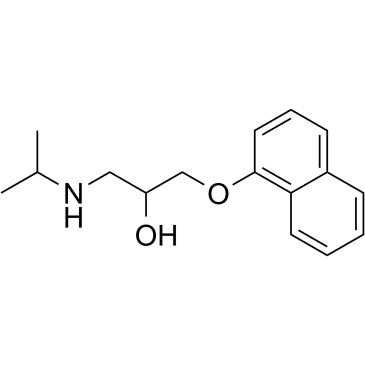
CAS Number525-66-6
SynonymsDisoprivan; Propranolol; Fresofol; 2,6-diisopropylphenol; Propofolum; Disoprofol; Diprivan; 2-hydroxy-1,3-diisopropylbenzene; propofol; 2,6-i-Pr2-C6H3-OH; Diisopropylphenol
Molecular FormulaC16H21NO2
Molecular Weight259.34300
Purity98.00%
Density1.093 g/cm3
Boiling Point434.9ºC at 760 mmHg
Melting Point163-164ºC
AppearanceWhite, odorless crystalline powder
| Chemical & Physical Properties | |
|---|---|
| CAS Number | 525-66-6 |
| Catalog No. | 2A-9022503 |
| Chinese Name | 心得安(普萘洛尔) |
| Synonyms | Disoprivan; Propranolol; Fresofol; 2,6-diisopropylphenol; Propofolum; Disoprofol; Diprivan; 2-hydroxy-1,3-diisopropylbenzene; propofol; 2,6-i-Pr2-C6H3-OH; Diisopropylphenol |
| Molecular Formula | C16H21NO2 |
| Molecular Weight | 259.34300 |
| Purity | 98.00 |
| Density | 1.093 g/cm3 |
| Boiling Point | 434.9ºC at 760 mmHg |
| Melting Point | 163-164ºC |
| Appearance | White, odorless crystalline powder |
| Storage Condition | Room Temperature |
| Application | Propranolol Propranolol is a non-cardioselective beta-blocker. Propranolol has membrane stabilizing properties but does not have intrinsic sympathomimetic activity. Propranolol is used to control hype |
| HTC | 2922210000 |
| SMILES | CC(C)NCC(O)COc1cccc2ccccc12 |
| InChI | InChI=1S/C16H21NO2/c1-12(2)17-10-14(18)11-19-16-9-5-7-13-6-3-4-8-15(13)16/h3-9,12,14,17-18H,10-11H2,1-2H3 |
| InChI Key | AQHHHDLHHXJYJD-UHFFFAOYSA-N |
| Use of | Propranolol is a noncardioselective β-blocker. Propranolol has membrane-stabilizing properties, but does not own intrinsic sympathomimetic activity. Propranolol hydrochloride is used to control hypertension, pheochromocytoma, myocardial infarction, cardiac arrhythmias, angina pectoris, and hypertrophic cardiomyopathy[1]. Properties Name propranolol Synonym More Synonyms propranolol Biological Activity Description Propranolol is a noncardioselective β-blocker. Propranolol has membrane-stabilizing properties, but does not own intrinsic sympathomimetic activity. Propranolol hydrochloride is used to control hypertension, pheochromocytoma, myocardial infarction, cardiac arrhythmias, angina pectoris, and hypertrophic cardiomyopathy[1]. Related Catalog Research Areas >> Cardiovascular Disease Signaling Pathways >> Others >> Others Research Areas >> Neurological Disease References [1]. Al-Majed AA, et al. Propranolol. Profiles Drug Subst Excip Relat Methodol. 2017;42:287-338. Chemical & Physical Properties Molecular Formula C16H21NO2 Exact Mass 259.15700 PSA 41.49000 LogP 2.96840 Index of Refraction 1.5500 (estimate) InChIKey AQHHHDLHHXJYJD-UHFFFAOYSA-N Toxicological Information CHEMICAL IDENTIFICATION RTECS NUMBER : CHEMICAL NAME : 2-Propanol, 1-(isopropylamino)-3-(1-naphthyloxy)- CAS REGISTRY NUMBER : LAST UPDATED : DATA ITEMS CITED : MOLECULAR FORMULA : C16-H21-N-O2 MOLECULAR WEIGHT : WISWESSER LINE NOTATION : L66J BO1YQ1MY1&1 HEALTH HAZARD DATA ACUTE TOXICITY DATA TYPE OF TEST : TDLo - Lowest published toxic dose ROUTE OF EXPOSURE : SPECIES OBSERVED : Human - woman DOSE/DURATION : TOXIC EFFECTS : Nutritional and Gross Metabolic - other changes TYPE OF TEST : TDLo - Lowest published toxic dose ROUTE OF EXPOSURE : SPECIES OBSERVED : Human - woman DOSE/DURATION : 3200 ug/kg/2D-I TOXIC EFFECTS : Endocrine - hypoglycemia TYPE OF TEST : TDLo - Lowest published toxic dose ROUTE OF EXPOSURE : SPECIES OBSERVED : DOSE/DURATION : 2300 ug/kg/D TOXIC EFFECTS : Behavioral - hallucinations, distorted perceptions TYPE OF TEST : LDLo - Lowest published lethal dose ROUTE OF EXPOSURE : SPECIES OBSERVED : Human - woman DOSE/DURATION : TOXIC EFFECTS : Details of toxic effects not reported other than lethal dose value TYPE OF TEST : LDLo - Lowest published lethal dose ROUTE OF EXPOSURE : SPECIES OBSERVED : Human - child DOSE/DURATION : 800 ug/kg/12H TOXIC EFFECTS : Cardiac - pulse rate increase, without fall in BP Vascular - BP lowering not characterized in autonomic section Lungs, Thorax, or Respiration - acute pulmonary edema TYPE OF TEST : TDLo - Lowest published toxic dose ROUTE OF EXPOSURE : SPECIES OBSERVED : Human - child DOSE/DURATION : TOXIC EFFECTS : Behavioral - convulsions or effect on seizure threshold Cardiac - arrhythmias (including changes in conduction) TYPE OF TEST : TDLo - Lowest published toxic dose ROUTE OF EXPOSURE : SPECIES OBSERVED : Human - man DOSE/DURATION : TOXIC EFFECTS : Endocrine - evidence of thyroid hyperfunction TYPE OF TEST : LDLo - Lowest published lethal dose ROUTE OF EXPOSURE : Intravenous SPECIES OBSERVED : DOSE/DURATION : TOXIC EFFECTS : Details of toxic effects not reported other than lethal dose value TYPE OF TEST : TDLo - Lowest published toxic dose ROUTE OF EXPOSURE : Unreported SPECIES OBSERVED : Human - man DOSE/DURATION : 22857 ug/kg/40D-I TOXIC EFFECTS : Sense Organs and Special Senses (Ear) - change in acuity TYPE OF TEST : LD50 - Lethal dose, 50 percent kill ROUTE OF EXPOSURE : SPECIES OBSERVED : Rodent - rat DOSE/DURATION : TOXIC EFFECTS : Behavioral - convulsions or effect on seizure threshold Behavioral - ataxia TYPE OF TEST : LD50 - Lethal dose, 50 percent kill ROUTE OF EXPOSURE : Intravenous SPECIES OBSERVED : Rodent - rat DOSE/DURATION : TOXIC EFFECTS : Behavioral - convulsions or effect on seizure threshold Behavioral - ataxia TYPE OF TEST : LD50 - Lethal dose, 50 percent kill ROUTE OF EXPOSURE : SPECIES OBSERVED : Rodent - mouse DOSE/DURATION : TOXIC EFFECTS : Autonomic Nervous System - beta-adrenergic blockage TYPE OF TEST : LD50 - Lethal dose, 50 percent kill ROUTE OF EXPOSURE : Intraperitoneal SPECIES OBSERVED : Rodent - mouse DOSE/DURATION : TOXIC EFFECTS : Autonomic Nervous System - beta-adrenergic blockage TYPE OF TEST : LD50 - Lethal dose, 50 percent kill ROUTE OF EXPOSURE : Subcutaneous SPECIES OBSERVED : Rodent - mouse DOSE/DURATION : TOXIC EFFECTS : Details of toxic effects not reported other than lethal dose value TYPE OF TEST : LD50 - Lethal dose, 50 percent kill ROUTE OF EXPOSURE : Intravenous SPECIES OBSERVED : Rodent - mouse DOSE/DURATION : 28100 ug/kg TOXIC EFFECTS : Details of toxic effects not reported other than lethal dose value TYPE OF TEST : LDLo - Lowest published lethal dose ROUTE OF EXPOSURE : SPECIES OBSERVED : Mammal - dog DOSE/DURATION : TOXIC EFFECTS : Sense Organs and Special Senses (Eye) - mydriasis (pupillary dilation) Behavioral - convulsions or effect on seizure threshold Behavioral - ataxia TYPE OF TEST : LDLo - Lowest published lethal dose ROUTE OF EXPOSURE : Intraperitoneal SPECIES OBSERVED : Mammal - dog DOSE/DURATION : TOXIC EFFECTS : Behavioral - convulsions or effect on seizure threshold TYPE OF TEST : LD50 - Lethal dose, 50 percent kill ROUTE OF EXPOSURE : Intravenous SPECIES OBSERVED : Rodent - guinea pig DOSE/DURATION : TOXIC EFFECTS : Details of toxic effects not reported other than lethal dose value TYPE OF TEST : TDLo - Lowest published toxic dose ROUTE OF EXPOSURE : SPECIES OBSERVED : Rodent - rat DOSE/DURATION : TOXIC EFFECTS : Liver - other changes Kidney, Ureter, Bladder - other changes Blood - changes in spleen TYPE OF TEST : TDLo - Lowest published toxic dose ROUTE OF EXPOSURE : SEX/DURATION : female 1-40 week(s) after conception TOXIC EFFECTS : TYPE OF TEST : TDLo - Lowest published toxic dose ROUTE OF EXPOSURE : Multiple routes SEX/DURATION : female 4-40 week(s) after conception TOXIC EFFECTS : Reproductive - Effects on Newborn - Apgar score (human only) Reproductive - Effects on Newborn - other neonatal measures or effects Reproductive - Effects on Newborn - growth statistics (e.g.%, reduced weight gain) TYPE OF TEST : TDLo - Lowest published toxic dose ROUTE OF EXPOSURE : SEX/DURATION : male 6 week(s) pre-mating TOXIC EFFECTS : Reproductive - Paternal Effects - spermatogenesis (incl. genetic material, sperm morphology, motility, and count) TYPE OF TEST : TDLo - Lowest published toxic dose ROUTE OF EXPOSURE : Subcutaneous SEX/DURATION : female 8-20 day(s) after conception TOXIC EFFECTS : Reproductive - Specific Developmental Abnormalities - cardiovascular (circulatory) system Reproductive - Effects on Newborn - growth statistics (e.g.%, reduced weight gain) TYPE OF TEST : TDLo - Lowest published toxic dose ROUTE OF EXPOSURE : Subcutaneous SEX/DURATION : female 8-20 day(s) after conception TOXIC EFFECTS : Reproductive - Effects on Newborn - biochemical and metabolic TYPE OF TEST : TDLo - Lowest published toxic dose ROUTE OF EXPOSURE : Intravenous SEX/DURATION : female 8 day(s) after conception TOXIC EFFECTS : Reproductive - Maternal Effects - uterus, cervix, vagina TYPE OF TEST : TDLo - Lowest published toxic dose ROUTE OF EXPOSURE : Unreported SEX/DURATION : female 10-12 day(s) after conception TOXIC EFFECTS : Reproductive - Effects on Embryo or Fetus - fetal death MUTATION DATA TEST SYSTEM : Rodent - mouse DOSE/DURATION : 74500 ug/kg REFERENCE : MUREAV Mutation Research. (Elsevier Science Pub. B.V., POB 211, 1000 AE Amsterdam, Netherlands) V.1- 1964- Volume(issue)/page/year: 173,207,1986 *** REVIEWS *** TOXICOLOGY REVIEW FAATDF Fundamental and Applied Toxicology. (Academic Press, Inc., 1 E. First St., Duluth, MN 55802) V.1- 1981- Volume(issue)/page/year: 6,395,1986 *** NIOSH STANDARDS DEVELOPMENT AND SURVEILLANCE DATA *** NIOSH OCCUPATIONAL EXPOSURE SURVEY DATA : NOES - National Occupational Exposure Survey (1983) NOES Hazard Code - X4181 No. of Facilities: 17 (estimated) No. of Industries: 2 No. of Occupations: 7 No. of Employees: 1785 (estimated) No. of Female Employees: 355 (estimated) Safety Information HS Code 2922210000 Synthetic Route UNII:07FN14F351 isopropylamine propranolol Literature: Carlsen, Per H.; Aase, Kristin J. Acta Chemica Scandinavica, 1993 , vol. 47, # 6 p. 617 - 619 3-isopropyl-5-(... 91740-63-5 propranolol Literature: Cardillo; Orena; Sandri Journal of Organic Chemistry, 1986 , vol. 51, # 5 p. 713 - 717 129207-75-6 propranolol Literature: Solladie-Cavallo, A.; Bencheqroun, M. Tetrahedron Letters, 1990 , vol. 31, # 15 p. 2157 - 2160 Precursor & DownStream Precursor 5 CAS#:2461-42-9 UNII:07FN14F351 CAS#:75-31-0 isopropylamine CAS#:90-15-3 1-Naphthalenol CAS#:150855-02-0 1-(benzyloxy)-3... DownStream 3 CAS#:10476-53-6 (±)-4-hydroxy... CAS#:70153-33-2 [1-[acetyl(prop... CAS#:81907-82-6 5-hydroxy Propr... |
| Tax Rebate | 13.0% |
| Supervision | A. Customs clearance form for inbound goods B. Customs clearance form for outbound goods |
| Inspection | R. Hygiene supervision and inspection of imported food S. Hygiene supervision and inspection of exported food |
| Transport Info | Product name: Supervision conditions A. Customs clearance form for inbound goods B. Customs clearance form for outbound goods |
| Related Products in Specialty Chemicals | ||
|---|---|---|
| Dimenhydrinate | 523-87-5 | 2A-9022494 |
| Wedelolactone | 524-12-9 | 2A-9022496 |
| N-Hydroxyphthalimide | 524-38-9 | 2A-9022500 |
| 2,2-Diphenylethenone | 525-06-4 | 2A-9022501 |
| 2,7-Diaminofluorene | 525-64-4 | 2A-9022502 |
| Tryptophol | 526-55-6 | 2A-9022509 |
| 2,3-Dibromosuccinic acid | 526-78-3 | 2A-9022512 |
| D(-)-Tartaric acid | 526-83-0 | 2A-9022513 |
| Gluconic acid | 526-95-4 | 2A-9022514 |
| Mucic acid | 526-99-8 | 2A-9022515 |
| Browse all Specialty Chemicals products » | ||
Phone:
630-322-8886
630-322-8887
Email:
Office Locations:
Chicago, IL, USA
San Francisco, CA, USA


 EN
EN


 SDS
SDS