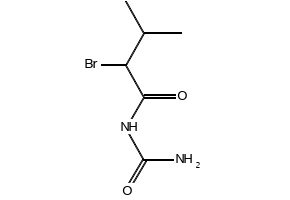
CAS Number496-67-3
SynonymsAlural; EINECS 207-825-7; Bromaral; Bromural; Alluval; Bromoxil; 1-(2-Bromoisovaleryl)urea; Abroval; Bromisoval; bromisovalum; Bromovalerylurea; B.V.U.; Bromoval; Bromyl; MFCD00047873; 2-Bromo-3-methylbutyrylurea; bromvalerylurea
Molecular FormulaC6H11O2N2Br1
Molecular Weight223.07
Purity98.00%
Density1.504g/cm3
Melting Point152 °C
AppearanceSolid;White to Almost white powder to crystal
| Chemical & Physical Properties | |
|---|---|
| CAS Number | 496-67-3 |
| Catalog No. | 2A-9022268 |
| Chinese Name | 1-(2-溴异戊酰)脲 |
| Synonyms | Alural; EINECS 207-825-7; Bromaral; Bromural; Alluval; Bromoxil; 1-(2-Bromoisovaleryl)urea; Abroval; Bromisoval; bromisovalum; Bromovalerylurea; B.V.U.; Bromoval; Bromyl; MFCD00047873; 2-Bromo-3-methylbutyrylurea; bromvalerylurea |
| Molecular Formula | C6H11O2N2Br1 |
| Molecular Weight | 223.07 |
| Purity | 98.00 |
| Density | 1.504g/cm3 |
| Melting Point | 152 °C |
| Appearance | Solid;White to Almost white powder to crystal |
| Water Solubility | Soluble in: methanol |
| Storage Condition | Store sealed and placed in a ventilated, dry envir |
| Application | Bromisoval (BU) has anti-inflammatory effects and has long been used as a sedative and hypnotic. |
| HTC | 2924210090 |
| MDL Number | MFCD00047873 |
| SMILES | CC(C)C(Br)C(=O)NC(N)=O |
| InChI | InChI=1S/C6H11BrN2O2/c1-3(2)4(7)5(10)9-6(8)11/h3-4H,1-2H3,(H3,8,9,10,11) |
| InChI Key | CMCCHHWTTBEZNM-UHFFFAOYSA-N |
| MSDS | msds/22268_1_496_67_3.pdf |
| Bioactivity | Bromisoval has anti-inflammatory effects and has been used as an old sedative and hypnotic. Related Catalog Signaling Pathways >> Others >> Others Research Areas >> Inflammation/Immunology Research Areas >> Neurological Disease In Vitro Bromisoval (BU) suppresses nitric oxide (NO) releasing and proinflammatory cytokine expression in lipopolysaccharide (LPS)-treat BV2 cells, a murine microglial cell line. Bromisoval suppresses LPS-inducing phosphorylation of signal transducer and activator of transcription 1 (STAT1) and expression of interferon regulatory factor 1 (IRF1). The Janus kinase 1 (JAK1) inhibitor filgotinib suppresses the NO release much more weakly than that of Bromisoval, although filgotinib almost completely prevents LPS-inducing STAT1 phosphorylation. Knockdown of JAK1, STAT1, or IRF1 does not affect the suppressive effects of Bromisoval on LPS-inducing NO. A combination of Bromisoval and filgotinib synergistically suppress the NO releasing. The mitochondrial complex I inhibitor rotenone, which does not prevent STAT1 phosphorylation or IRF1 expression, suppresses proinflammatory mediator expression less significantly than Bromisoval. Bromisoval and rotenone reduce intracellular ATP (iATP) levels to a similar extent. A combination of rotenone and filgotinib suppress NO release in LPS-treated BV2 cells as strongly as Bromisoval[1]. In Vivo Bromisoval (Bromvaletone) and carbromal are the most potent central depressants within each series. Depressant activities (ISD50 values) and acute toxicities (LD50 values) in male mice after intraperitoneal injection of Bromisoval are 0.35 (0.30-0.39) and 3.25 (2.89-3.62) mmol/kg, respectively[2]. Kinase Assay Conditioning media are obtained from BV2 cell cultures that have been incubated for 24 h in E2 medium containing 1 μg/ml LPS, with or without Bromisoval (BU) (1-100 μg/mL) or other agents, and subjected to NO determination. To normalize the releasing NO level by the cellular protein contents, cells are solubilized with RIPA buffer (50 mM Tris-HCl, pH 8.0, 150 mM sodium chloride, 0.5% w/v sodium deoxycholate, 0.1% w/v sodium dodecyl sulfate, 1.0% w/v NP-40 substitute) and the protein contents are determined by BCA protein assay reagents[1]. Cell Assay Murine microglial cell line BV2 is used. BV2 cells are maintained in medium supplemented with 10% fetal bovine serum. BV2 cells are seeded onto wells in 4-well culture plates and incubated with LPS for 30 min to 24 h. When the effects of Bromisoval (BU) or other agents are investigated, BV2 cells are incubated with the appropriate agent (e.g. Bromisoval) for 30 min before the addition of LPS[1]. Animal Admin Suspensions of the compounds (including Bromisoval ) in aqueous 0.5% carboxymethyl cellulose are administered intraperitoneally to adult male albino mice weighing 25-35 g. All tests are performed on groups of ten mice[2]. References [1]. Kawasaki S, et al. Effects of hypnotic bromovalerylurea on microglial BV2 cells. J Pharmacol Sci. 2017 Jun;134(2):116-123. [2]. Mrongovius RI, et al. Comparison of the bromureide sedative-hypnotic drugs, bromvaletone (bromisoval) and carbromal, and their chloro analogues in mice. Clin Exp Pharmacol Physiol. 1976 Sep-Oct;3(5):443-7. Chemical & Physical Properties Density 1.504g/cm3 Melting Point 152 °C Molecular Formula C6H11BrN2O2 Molecular Weight 223.06800 Exact Mass 222.00000 PSA 72.19000 LogP 1.69200 Index of Refraction 1.514 InChIKey CMCCHHWTTBEZNM-UHFFFAOYSA-N SMILES CC(C)C(Br)C(=O)NC(N)=O |
| Use of | Bromisoval has anti-inflammatory effects and has been used as an old sedative and hypnotic. Properties Name 2-bromo-N-carbamoyl-3-methylbutanamide Synonym More Synonyms Bromisoval Biological Activity Description Bromisoval has anti-inflammatory effects and has been used as an old sedative and hypnotic. Related Catalog Signaling Pathways >> Others >> Others Research Areas >> Inflammation/Immunology Research Areas >> Neurological Disease In Vivo Bromisoval (Bromvaletone) and carbromal are the most potent central depressants within each series. Depressant activities (ISD50 values) and acute toxicities (LD50 values) in male mice after intraperitoneal injection of Bromisoval are 0.35 (0.30-0.39) and 3.25 (2.89-3.62) mmol/kg, respectively[2]. References [2]. Mrongovius RI, et al. Comparison of the bromureide sedative-hypnotic drugs, bromvaletone (bromisoval) and carbromal, and their chloro analogues in mice. Clin Exp Pharmacol Physiol. 1976 Sep-Oct;3(5):443-7. Chemical & Physical Properties Molecular Formula C6H11BrN2O2 Exact Mass 222.00000 PSA 72.19000 LogP 1.69200 Index of Refraction 1.514 InChIKey CMCCHHWTTBEZNM-UHFFFAOYSA-N SMILES CC(C)C(Br)C(=O)NC(N)=O |
| Tax Rebate | 9.0% |
| Supervision | none |
| Transport Info | Product name: Purity: 98.0% |
| MSDS Transport Info | Module 14. Shipping information United Nations classification: inconsistent with United Nations classification standards UN number: not specified 1-(2-Bromoisovaleryl)urea Modification number: 5 |
| Related Products in Specialty Chemicals | ||
|---|---|---|
| 1,2-Dibenzoylethane | 495-71-6 | 2A-9022256 |
| Piperonyl alcohol | 495-76-1 | 2A-9022257 |
| Phthalan | 496-14-0 | 2A-9022261 |
| Glycoluril | 496-46-8 | 2A-9022266 |
| Pyromeconic acid | 496-63-9 | 2A-9022267 |
| 5-Hydroxy-4-octanone | 496-77-5 | 2A-9022272 |
| O-Amino-L-homoserine | 496-93-5 | 2A-9022273 |
| 4,6-Di-tert-butyl-3-methylphenol | 497-39-2 | 2A-9022279 |
| 4-Hydroxy-3-methoxybenzyl alcohol | 498-00-0 | 2A-9022281 |
| Acetovanillone | 498-02-2 | 2A-9022282 |
| Browse all Specialty Chemicals products » | ||
Phone:
630-322-8886
630-322-8887
Email:
Office Locations:
Chicago, IL, USA
San Francisco, CA, USA


 EN
EN


 SDS
SDS