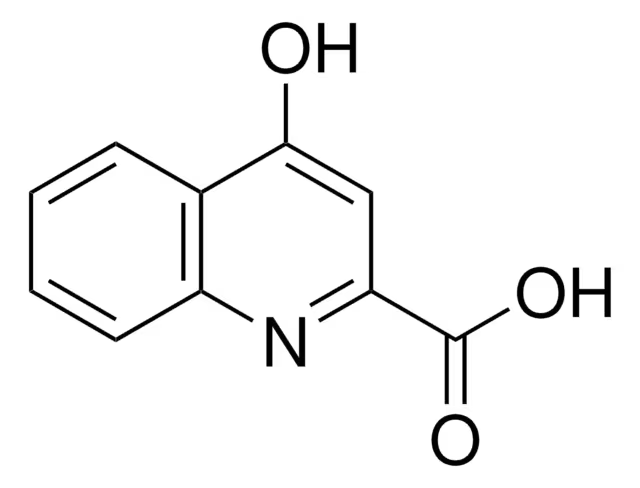
CAS Number492-27-3
Synonyms4-Hydroxyquinaldic Acid; 4-Oxo-1,4-dihydroquinoline-2-carboxylic acid; 4-hydroxy-Quinaldic acid; 2-Carboxy-4-hydroxyquinoline; 1,4-DIHYDRO-4-OXOQUINOLINE-2-CARBOXYLIC ACID; 4-Hydroxy-2-quinolincarboxylic acid; 4-Hydroxyquinoline-2-carboxylic Acid Hydrate; 4-Hydroxyquinoline-2-carboxylic acid; 4-Oxo-1,4-dihydro-2-quinolinecarboxylic acid; Kynurenic acid; EINECS 207-751-5; MFCD00006753
Molecular FormulaC10H7NO3
Molecular Weight189.17
Purity≥98%
Density1.4±0.1 g/cm3
Boiling Point358.4±42.0 °C at 760 mmHg
Melting Point275 °C (dec.) (lit.)
Appearancepowder
EINECS207-751-5
Symbol
Signal WordWarning
| Chemical & Physical Properties | |
|---|---|
| CAS Number | 492-27-3 |
| Catalog No. | 2A-9022233 |
| Chinese Name | 犬尿喹啉酸 |
| Synonyms | 4-Hydroxyquinaldic Acid; 4-Oxo-1,4-dihydroquinoline-2-carboxylic acid; 4-hydroxy-Quinaldic acid; 2-Carboxy-4-hydroxyquinoline; 1,4-DIHYDRO-4-OXOQUINOLINE-2-CARBOXYLIC ACID; 4-Hydroxy-2-quinolincarboxylic acid; 4-Hydroxyquinoline-2-carboxylic Acid Hydrate; 4-Hydroxyquinoline-2-carboxylic acid; 4-Oxo-1,4-dihydro-2-quinolinecarboxylic acid; Kynurenic acid; EINECS 207-751-5; MFCD00006753 |
| Molecular Formula | C10H7NO3 |
| Molecular Weight | 189.17 |
| Purity | ≥98 |
| Density | 1.4±0.1 g/cm3 |
| Boiling Point | 358.4±42.0 °C at 760 mmHg |
| Melting Point | 275 °C (dec.) (lit.) |
| Appearance | powder |
| Storage Condition | Store sealed and placed in a ventilated, dry envir |
| Application | Kynurenic acid is an endogenous tryptophan metabolite, a spectral antagonist targeting the target NMDA, glutamate, α7 nicotinic acetylcholine receptor, and a selective ligand for the GPR35 receptor. |
| EINECS | 207-751-5 |
| PubChem ID | 24277986 |
| MDL Number | MFCD00006753 |
| SMILES | OC(=O)c1cc(O)c2ccccc2n1 |
| InChI | 1S/C10H7NO3/c12-9-5-8(10(13)14)11-7-4-2-1-3-6(7)9/h1-5H,(H,11,12)(H,13,14) |
| InChI Key | HCZHHEIFKROPDY-UHFFFAOYSA-N |
| Beilstein/REAXYS | 147451 |
| NACRES Code | NA.77 |
| UNSPSC | 12352106 |
| Hazard Symbols | Transport |
| MSDS | msds/22233_1_492_27_3.pdf |
| Bioactivity | Kynurenic acid, an endogenous tryptophan metabolite, is a broad-spectrum antagonist targeting NMDA, glutamate, α7 nicotinic acetylcholine receptor. Kynurenic acid is also a selective ligand of the GPR35 receptor. Related Catalog Signaling Pathways >> Membrane Transporter/Ion Channel >> iGluR Signaling Pathways >> Neuronal Signaling >> iGluR Research Areas >> Inflammation/Immunology Research Areas >> Neurological Disease Natural Products >> Others Target Human Endogenous Metabolite In Vitro GPR35 functions as a receptor for the kynurenine pathway intermediate kynurenic acid. Kynurenic acid elicits calcium mobilization and inositol phosphate production in a GPR35-dependent manner in the presence of G qi/o chimeric G proteins. Kynurenic acid stimulates [35S]guanosine 5′-O-(3-thiotriphosphate) binding in GPR35-expressing cells, an effect abolished by pertussis toxin treatment. Kynurenic acid also induces the internalization of GPR35[1]. KYNA's neuroinhibitory qualities and its neuroprotective and anticonvulsant effects are discovered using concentrations of the compound in the millimolar range. This, as well as the low affinity of KYNA at each of the three ionotropic glutamate receptors responsible for these effects [NMDA, alpha-amino-3-hydroxy-5-methyl-4-isoxazole propionic acid (AMPA) and kainate], together with the realization that KYNA concentrations in the mammalian brain are in the sub-micromolar range, suggested that other receptors might serve as targets of endogenous Kynurenic acid. Kynurenic acid, with a shallower inhibition curve and non-competitively, antagonizes α7nAChRs on cultured hippocampal neurons with an IC50 in the low micromolar range[2]. In Vivo Kynurenic acid affects the activity of leukocytes in the peripheral blood of mice, although the lowest one (2.5 mg/L) has the most profound influence in contrast to the highest one (250 mg/L), which produces the weakest effect. The lowest Kynurenic acid dose stimulates the proliferative response of T lymphocytes (p<0.05), after 7 and 28 days of administering the acid to the animals[3]. Kinase Assay CHO-GPR35 stable cells are pretreated with or without pertussis toxin (100 ng/mL) for 16 h before harvesting. Cells are resuspended and homogenized in 10 mM Tris-HCl (pH 7.4), 1 mM EDTA followed by centrifugation at 1000 ×g for 10 min at 4 °C to remove nuclei and cellular debris. Membrane fractions are collected by spinning the supernatant at 38,000 ×g for 30 min and resuspended in 20 mM HEPES (pH 7.5) and 5 mM MgCl2. 25 μg of membranes is incubated at room temperature for 1 h in assay buffer (20 mM HEPES, 5 m MMgCl2, 0.1% bovine serum albumin (pH 7.5)) containing 3 μM GDP and 0.1 nM[35S]GTPγS in the absence or presence of kynurenic acid. Reactions are terminated by vacuum filtration through GF/B filters, and the retained radioactivities are quantified on liquid scintillation counter[1]. Animal Admin Mouse: The experiment is performed on 160 male BALB/c mice, aged 10-12 weeks, with body weight of 22-26 g. The animals are maintained on a 12-h light/dark cycle at controlled temperature (20 ±1°C) and supplied with rodent chow and water ad libitum throughout the experiment. Mice are divided randomLy into four equal groups: control group (0) not receiving the Kynurenic acid, and three experimental groups administered the Kynurenic acid solution in drinking water at concentrations of 2.5, 25 or 250 mg/L. After 3, 7, 14 and 28 consecutive days of administration of the Kynurenic acid solution, 10 individuals from each group are sacrificed. The animals are anesthetized by inhalation of Aerrane and their blood is collected by heart puncture. Blood collected from five individuals of each group is used for the MTT assay, and from the next five for the flow cytometry[3]. References [1]. Wang J, et al. Kynurenic acid as a ligand for orphan G protein-coupled receptor GPR35. J Biol Chem. 2006 Aug 4;281(31):22021-8. [2]. Albuquerque EX, et al. Kynurenic acid as an antagonist of α7 nicotinic acetylcholine receptors in the brain: facts and challenges. Biochem Pharmacol. 2013 Apr 15;85(8):1027-32. [3]. Małaczewska J, et al. Effect of oral administration of kynurenic acid on the activity of the peripheral blood leukocytes in mice. Cent Eur J Immunol. 2014;39(1):6-13. Chemical & Physical Properties Density 1.4±0.1 g/cm3 Boiling Point 358.4±42.0 °C at 760 mmHg Melting Point 275 °C (dec.)(lit.) Molecular Formula C10H7NO3 Molecular Weight 189.167 Flash Point 170.5±27.9 °C Exact Mass 189.042587 PSA 70.42000 LogP 2.28 Vapour Pressure 0.0±0.8 mmHg at 25°C Index of Refraction 1.639 InChIKey HCZHHEIFKROPDY-UHFFFAOYSA-N SMILES O=C(O)c1cc(=O)c2ccccc2[nH]1 Storage condition Store at RT |
| Use of | Kynurenic acid, an endogenous tryptophan metabolite, is a broad-spectrum antagonist targeting NMDA, glutamate, α7 nicotinic acetylcholine receptor. Kynurenic acid is also a selective ligand of the GPR35 receptor. Properties Articles122 Name kynurenic acid Synonym More Synonyms Kynurenic acid Biological Activity Description Kynurenic acid, an endogenous tryptophan metabolite, is a broad-spectrum antagonist targeting NMDA, glutamate, α7 nicotinic acetylcholine receptor. Kynurenic acid is also a selective ligand of the GPR35 receptor. Related Catalog Signaling Pathways >> Membrane Transporter/Ion Channel >> iGluR Signaling Pathways >> Neuronal Signaling >> iGluR Research Areas >> Inflammation/Immunology Research Areas >> Neurological Disease Natural Products >> Others Human Endogenous Metabolite In Vitro GPR35 functions as a receptor for the kynurenine pathway intermediate kynurenic acid. Kynurenic acid elicits calcium mobilization and inositol phosphate production in a GPR35-dependent manner in the presence of G qi/o chimeric G proteins. Kynurenic acid stimulates [35S]guanosine 5′-O-(3-thiotriphosphate) binding in GPR35-expressing cells, an effect abolished by pertussis toxin treatment. Kynurenic acid also induces the internalization of GPR35[1]. KYNA's neuroinhibitory qualities and its neuroprotective and anticonvulsant effects are discovered using concentrations of the compound in the millimolar range. This, as well as the low affinity of KYNA at each of the three ionotropic glutamate receptors responsible for these effects [NMDA, alpha-amino-3-hydroxy-5-methyl-4-isoxazole propionic acid (AMPA) and kainate], together with the realization that KYNA concentrations in the mammalian brain are in the sub-micromolar range, suggested that other receptors might serve as targets of endogenous Kynurenic acid. Kynurenic acid, with a shallower inhibition curve and non-competitively, antagonizes α7nAChRs on cultured hippocampal neurons with an IC50 in the low micromolar range[2]. References [1]. Wang J, et al. Kynurenic acid as a ligand for orphan G protein-coupled receptor GPR35. J Biol Chem. 2006 Aug 4;281(31):22021-8. [2]. Albuquerque EX, et al. Kynurenic acid as an antagonist of α7 nicotinic acetylcholine receptors in the brain: facts and challenges. Biochem Pharmacol. 2013 Apr 15;85(8):1027-32. [3]. Małaczewska J, et al. Effect of oral administration of kynurenic acid on the activity of the peripheral blood leukocytes in mice. Cent Eur J Immunol. 2014;39(1):6-13. Chemical & Physical Properties Molecular Formula C10H7NO3 Exact Mass 189.042587 PSA 70.42000 Index of Refraction 1.639 InChIKey HCZHHEIFKROPDY-UHFFFAOYSA-N Storage condition Store at RT |
| Transport Info | Shipping Name: UN |
| MSDS Transport Info | Module 14. Shipping information 14.1 UN dangerous goods number European Land Transport Dangerous Regulations: -International Maritime Dangerous Regulations: -International Air Transport Dangerous Regulations: - 14.2 United Nations shipping name European Land Transport Dangerous Regulations: Non-dangerous goods IMDG Code: Non-dangerous goods International air transport dangerous goods regulations: non-dangerous goods 14.3 Transport hazard categories European Land Transport Dangerous Regulations: -International Maritime Dangerous Regulations: -International Air Transport Dangerous Regulations: - 14.4 Package group European Land Transport Dangerous Regulations: -International Maritime Dangerous Regulations: -International Air Transport Dangerous Regulations: - 14.5 Environmental hazards European Land Transport Danger Regulations: No International Maritime Danger Regulations International Air Transport Danger Regulations: No Marine pollutants (yes/no): No 14.6 Special reminder to users No data available |
| Related Products in Heterocyclic Building Blocks | ||
|---|---|---|
| 2,6-Dimethyl-4-pyrimidinamine | 461-98-3 | 2A-9022048 |
| 3-Aminopyridine | 462-08-8 | 2A-9022050 |
| Pyridine trifluoroacetate | 464-05-1 | 2A-9022060 |
| 1,2,3,4-Tetrahydro-1-methylquinoline | 491-34-9 | 2A-9022223 |
| 4-Hydroxyquinazoline | 491-36-1 | 2A-9022225 |
| 2,2'-Bithiophene | 492-97-7 | 2A-9022242 |
| Isochroman | 493-05-0 | 2A-9022243 |
| Isoindoline | 496-12-8 | 2A-9022260 |
| Benzofuran-2-carboxylic acid | 496-41-3 | 2A-9022264 |
| 2-(2-Aminoethyl)indole | 496-42-4 | 2A-9022265 |
| Browse all Heterocyclic Building Blocks products » | ||
Phone:
630-322-8886
630-322-8887
Email:
Office Locations:
Chicago, IL, USA
San Francisco, CA, USA


 EN
EN


 SDS
SDS