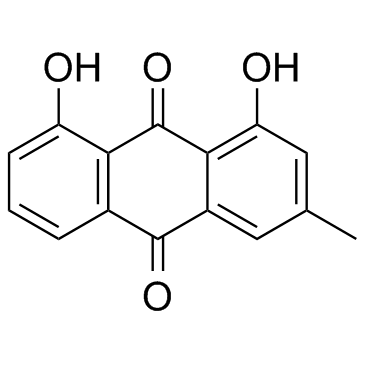
CAS Number481-74-3
Synonyms1,8-dihydroxy-3-methylanthracene-9,10-dione; Chrysophal; 2-methyl-4,5-dihydroxy-9,10-anthraquinone; CHRYSOPHANOL; 1,8-Dihydroxy-3-Methyl-Anthraquinone; turkeyrhubarb; 1,8-Dihydroxy-3-methyl-9,10-anthraquinone; MFCD00001208; 1,8-Dihydroxy-3-methylanthra-9,10-quinone; 2-Methyl-4,5-dihydroxyanthraquinone; Chrysophanic acid; C.I. Natural Yellow 23; EINECS 207-572-2; RHUBARB EXTRACT; 3-methyl-1,8-dihydroxyanthraquinone; 1,8-Dihydroxy-3-methylanthraquinone; 1,8-dihydroxy-3-methyl-9,10-antraquinone
Molecular FormulaC15H10O4
Molecular Weight254.238
Purity98.00%
Density1.5±0.1 g/cm3
Boiling Point489.5±45.0 °C at 760 mmHg
Melting Point194-198 °C
AppearanceSolid;Light yellow to Brown powder to crystal
Symbol
Signal WordWarning
| Chemical & Physical Properties | |
|---|---|
| CAS Number | 481-74-3 |
| Catalog No. | 2A-9022158 |
| Chinese Name | 大黄酚 |
| Synonyms | 1,8-dihydroxy-3-methylanthracene-9,10-dione; Chrysophal; 2-methyl-4,5-dihydroxy-9,10-anthraquinone; CHRYSOPHANOL; 1,8-Dihydroxy-3-Methyl-Anthraquinone; turkeyrhubarb; 1,8-Dihydroxy-3-methyl-9,10-anthraquinone; MFCD00001208; 1,8-Dihydroxy-3-methylanthra-9,10-quinone; 2-Methyl-4,5-dihydroxyanthraquinone; Chrysophanic acid; C.I. Natural Yellow 23; EINECS 207-572-2; RHUBARB EXTRACT; 3-methyl-1,8-dihydroxyanthraquinone; 1,8-Dihydroxy-3-methylanthraquinone; 1,8-dihydroxy-3-methyl-9,10-antraquinone |
| Molecular Formula | C15H10O4 |
| Molecular Weight | 254.238 |
| Purity | 98.00 |
| Density | 1.5±0.1 g/cm3 |
| Boiling Point | 489.5±45.0 °C at 760 mmHg |
| Melting Point | 194-198 °C |
| Appearance | Solid;Light yellow to Brown powder to crystal |
| Water Solubility | <0.1 g/100 mL at 18 ºC |
| Storage Condition | Store in a sealed container in a ventilated and dr |
| Application | Chrysophanol (Chrysophanic acid) is a natural anthraquinone that inhibits EGF-induced EGFR phosphorylation and inhibits AKT and mTOR/p70S6K activation. |
| HTC | 2942000000 |
| SMILES | Cc1cc(O)c2c(c1)C(=O)c1cccc(O)c1C2=O |
| InChI | InChI=1S/C15H10O4/c1-7-5-9-13(11(17)6-7)15(19)12-8(14(9)18)3-2-4-10(12)16/h2-6,16-17H,1H3 |
| InChI Key | LQGUBLBATBMXHT-UHFFFAOYSA-N |
| Hazard Symbols | Transport |
| Bioactivity | Chrysophanol (Chrysophanic acid) is a natural anthraquinone, which inhibits EGF-induced phosphorylation of EGFR and suppresses activation of AKT and mTOR/p70S6K. Related Catalog Natural Products >> Quinones Research Areas >> Cancer Target EGFR In Vitro Chrysophanol (Chrysophanic Acid) blocks proliferation of colon cancer cells by inhibiting EGFR/mTOR pathway. Chrysophanol, a natural anthraquinone, has anticancer activity in EGFR-overexpressing SNU-C5 human colon cancer cells. Chrysophanol treatment in SNU-C5 cells inhibits EGF-induced phosphorylation of EGFR and suppresses activation of downstream signaling molecules, such as AKT, extracellular signal-regulated kinase (ERK) and the mammalian target of Rapamycin (mTOR)/ribosomal protein S6 kinase (p70S6K). Chrysophanol (80 and 120 μM) significantly blocks cell proliferation when combined with the mTOR inhibitor, Rapamycin. Chrysophanol inhibits EGF-induced phosphorylation of EGFR and suppresses activation of AKT and mTOR/p70S6K, and significantly blocks cell proliferation. Chrysophanol dose dependently decreases CCK-8 and the viability of EGFR-overexpressing SNU-C5 cells. Chrysophanol treatment dose-dependently decreases EGF induced phosphorylation of EGFR at Tyr1068. Chrysophanol (80 and 120 μM) reduces the phosphorylation levels of mTOR at Ser2448. Chrysophanol (80 and 120 μM) also decreases the phosphorylation levels of p70S6K at Thr389. Chrysophanol inhibits EGF-induced EGFR activation and suppresses activation of the downstream signaling molecules, AKT and mTOR/p70S6K[1]. Chrysophanol (CA) inhibits lipid accumulation in 3T3-L1 adipocytes. Chrysophanol down-regulates adipogenic factors in 3T3-L1 adipocytes. Chrysophanol induces thermogenic factors in primary cultured brown adipocytes. Chrysophanol suppresses adipogenesis and induces thermogenesis via activation of AMPK pathway[2]. In Vivo Chrysophanol (CA) improves HFD-induced obesity in C57BL/6 Mice. The in vivo performance of Chrysophanol is performed in male C57BL/6J mice to determine the efficacy of administered Chrysophanol. Mice fed the HFD gained significantly more weight than those fed the standard diet mice. On the other hand, weight gain of Chrysophanol group is significantly less than with the untreated HFD. Mice in the HFD-group gained 23.92 ± 1.74 g of weight, while those in the Chrysophanol group gained 16.72±2 g of weight after 16 weeks[2]. Cell Assay The cells are seeded at 5×10³ cells/mL in 96-well microplates and allowed to attach for 24 h. Chrysophanol (20, 50, 80 and 120 μM) is added to the medium at various concentrations up to 120 μM and for different durations. After treatment, cell cytotoxicity and/or proliferation is assessed by a Cell Counting Kit-8 (CCK-8). Briefly, highly water-soluble tetrazolium salt, WST-8, produces an orange colored water-soluble product, formazan. The amount of formazan dye generated by dehydrogenases in cells is directly proportional to the number of living cells.CCK-8 (10 μL) is added to each well and incubated for 3 h at 37°C, then cell proliferation and cytotoxicity are assessed by measuring the absorbance at 450 nm using a microplate reader.Three replicated wells are used for each experimental condition[1]. Animal Admin Mice[2] Male 4-week-old C57BL/6J mice are maintained for 1 week prior to experiments. Mice are maintained on a 12-h light/dark cycle in a pathogen-free animal facility, provided with laboratory diet and water ad libitum. To induce obesity, the mice are fed a HFD with 60% kcal% fat. Control group (C) are fed a commercial standard chow diet. HFD group (HFD) mice are fed with HFD only. HFD plus CA group (CA) Mice are fed with HFD for 4 weeks before administration of Chrysophanol (5 mg/kg/day). The mice are divided into three groups (n = 5) that are fed chow diet, HFD, and HFD plus Chrysophanol for 16 weeks. Body weight and food intake are measured three times per week. References [1]. Lee MS, et al. Chrysophanic acid blocks proliferation of colon cancer cells by inhibiting EGFR/mTOR pathway. Phytother Res. 2011 Jun;25(6):833-7. [2]. Lim H, et al. Chrysophanic Acid Suppresses Adipogenesis and Induces Thermogenesis by Activating AMP-Activated Protein Kinase Alpha In vivo and In vitro. Front Pharmacol. 2016 Dec 8;7:476. Chemical & Physical Properties Density 1.5±0.1 g/cm3 Boiling Point 489.5±45.0 °C at 760 mmHg Melting Point 194-198 °C Molecular Formula C15H10O4 Molecular Weight 254.238 Flash Point 263.9±25.2 °C Exact Mass 254.057907 PSA 74.60000 LogP 5.03 Vapour Pressure 0.0±1.3 mmHg at 25°C Index of Refraction 1.710 InChIKey LQGUBLBATBMXHT-UHFFFAOYSA-N SMILES Cc1cc(O)c2c(c1)C(=O)c1cccc(O)c1C2=O Storage condition 2-8°C Stability Stable. Incompatible with strong oxidizing agents. Water Solubility <0.1 g/100 mL at 18 ºC |
| Use of | Chrysophanol (Chrysophanic acid) is a natural anthraquinone, which inhibits EGF-induced phosphorylation of EGFR and suppresses activation of AKT and mTOR/p70S6K. Properties Articles34 Name chrysophanol Synonym More Synonyms Chrysophanic acid Biological Activity Description Chrysophanol (Chrysophanic acid) is a natural anthraquinone, which inhibits EGF-induced phosphorylation of EGFR and suppresses activation of AKT and mTOR/p70S6K. Related Catalog Natural Products >> Quinones Research Areas >> Cancer References [1]. Lee MS, et al. Chrysophanic acid blocks proliferation of colon cancer cells by inhibiting EGFR/mTOR pathway. Phytother Res. 2011 Jun;25(6):833-7. [2]. Lim H, et al. Chrysophanic Acid Suppresses Adipogenesis and Induces Thermogenesis by Activating AMP-Activated Protein Kinase Alpha In vivo and In vitro. Front Pharmacol. 2016 Dec 8;7:476. Chemical & Physical Properties Molecular Formula C15H10O4 Exact Mass 254.057907 PSA 74.60000 Index of Refraction 1.710 InChIKey LQGUBLBATBMXHT-UHFFFAOYSA-N Stability Stable. Incompatible with strong oxidizing agents. |
| Transport Info | Shipping Name: UN |
| MSDS Transport Info | Module 14. Shipping information 14.1 UN dangerous goods number European Land Transport Dangerous Regulations: -International Maritime Dangerous Regulations: -International Air Transport Dangerous Regulations: - 14.2 United Nations shipping name European Land Transport Dangerous Regulations: Non-dangerous goods IMDG Code: Non-dangerous goods International air transport dangerous goods regulations: non-dangerous goods 14.3 Transport hazard categories European Land Transport Dangerous Regulations: -International Maritime Dangerous Regulations: -International Air Transport Dangerous Regulations: - 14.4 Package group European Land Transport Dangerous Regulations: -International Maritime Dangerous Regulations: -International Air Transport Dangerous Regulations: - 14.5 Environmental hazards European Land Transport Danger Regulations: No International Maritime Danger Regulations International Air Transport Danger Regulations: No Marine pollutants (yes/no): No 14.6 Special reminder to users No data available |
| Related Products in Specialty Chemicals | ||
|---|---|---|
| Artemisin | 481-05-0 | 2A-9022150 |
| Epiandrosterone | 481-29-8 | 2A-0201389 |
| 5-Hydroxy-1,4-naphthalenedione | 481-39-0 | 2A-9022153 |
| Ginkgetin | 481-46-9 | 2A-9022154 |
| Cepharanthine | 481-49-2 | 2A-9022155 |
| 2,7-Dimethyl-1,4-naphthoquinone | 482-70-2 | 2A-9022165 |
| Cryptopine | 482-74-6 | 2A-9022166 |
| Indigo | 482-89-3 | 2A-9022167 |
| 1,7-Dimethylphenanthrene | 483-87-4 | 2A-9022170 |
| Toddaline | 483-90-9 | 2A-9022171 |
| Browse all Specialty Chemicals products » | ||
Phone:
630-322-8886
630-322-8887
Email:
Office Locations:
Chicago, IL, USA
San Francisco, CA, USA


 EN
EN


 SDS
SDS