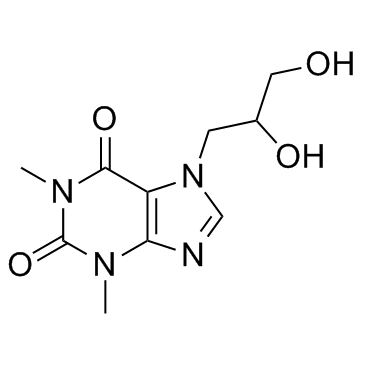
CAS Number479-18-5
SynonymsEINECS 207-526-1; Neutraphylline; COR-theophylline; Neutrafil; Teofen; Circain; Dyflex; Neostenovasan; Propyphyllin; Circair; 7-(2,3-Dihydroxypropyl)-1,3-dimethylxanthine; 7-(2,3-Dihydroxypropyl)-1,3-dimethyl-3,7-dihydro-1H-purine-2,6-dione; Coronal; dilor; Hyphylline; tesfen; Diphylline; Airet; (1,2-Dihydroxy-3-propyl)theophylline; Lufyllin; Solufilin; Solufyllin; diprophylline; Asthmolysin; 7-(2,3-Dihydroxypropyl)theophylline,Dyphylline; 7-(β,γ-Dihydroxypropyl)theophylline; MFCD00005759; Neufil; Coronarin; Theal
Molecular FormulaC10H14N4O4
Molecular Weight254.243
Purity98.00%
Density1.6±0.1 g/cm3
Boiling Point589.6±60.0 °C at 760 mmHg
Melting Point161-162 °C(lit.)
Appearancewhite powder
| Chemical & Physical Properties | |
|---|---|
| CAS Number | 479-18-5 |
| Catalog No. | 2A-9022123 |
| Chinese Name | 二羟丙茶碱 |
| Synonyms | EINECS 207-526-1; Neutraphylline; COR-theophylline; Neutrafil; Teofen; Circain; Dyflex; Neostenovasan; Propyphyllin; Circair; 7-(2,3-Dihydroxypropyl)-1,3-dimethylxanthine; 7-(2,3-Dihydroxypropyl)-1,3-dimethyl-3,7-dihydro-1H-purine-2,6-dione; Coronal; dilor; Hyphylline; tesfen; Diphylline; Airet; (1,2-Dihydroxy-3-propyl)theophylline; Lufyllin; Solufilin; Solufyllin; diprophylline; Asthmolysin; 7-(2,3-Dihydroxypropyl)theophylline,Dyphylline; 7-(β,γ-Dihydroxypropyl)theophylline; MFCD00005759; Neufil; Coronarin; Theal |
| Molecular Formula | C10H14N4O4 |
| Molecular Weight | 254.243 |
| Purity | 98.00 |
| Density | 1.6±0.1 g/cm3 |
| Boiling Point | 589.6±60.0 °C at 760 mmHg |
| Melting Point | 161-162 °C(lit.) |
| Appearance | white powder |
| Water Solubility | 33 g/100 mL (25 ºC) |
| Storage Condition | Store in a sealed container in a ventilated and dr |
| Application | Dyphylline is an adenosine receptor antagonist and PDE inhibitor. |
| HTC | 2939590000 |
| SMILES | Cn1c(=O)c2c(ncn2CC(O)CO)n(C)c1=O |
| InChI | InChI=1S/C10H14N4O4/c1-12-8-7(9(17)13(2)10(12)18)14(5-11-8)3-6(16)4-15/h5-6,15-16H,3-4H2,1-2H3 |
| InChI Key | KSCFJBIXMNOVSH-UHFFFAOYSA-N |
| Bioactivity | Dyphylline acts as an adenosine receptor antagonist and phosphodiesterase inhibitor, which is used in the treatment of respiratory disorders.Target: Adenosine Receptor; PDEDyphylline (trade names Dilor, Lufyllin), also known as diprophylline, is a xanthine derivative with bronchodilator and vasodilator effects. It is used in the treatment of respiratory disorders like asthma, cardiac dyspnea, and bronchitis. It acts as an adenosine receptor antagonist and phosphodiesterase inhibitor. Related Catalog Signaling Pathways >> GPCR/G Protein >> Adenosine Receptor Signaling Pathways >> Metabolic Enzyme/Protease >> Phosphodiesterase (PDE) Research Areas >> Infection References [1]. Schwabe U, et al. Xanthine derivatives as antagonists at A1 and A2 adenosine receptors. Naunyn Schmiedebergs Arch Pharmacol. 1985 Sep;330(3):212-21. [2]. Iancu L, et al. Trials with xanthine derivatives in systemic treatment of psoriasis. Dermatologica. 1979;159(1):55-61. Chemical & Physical Properties Density 1.6±0.1 g/cm3 Boiling Point 589.6±60.0 °C at 760 mmHg Melting Point 161-162 °C(lit.) Molecular Formula C10H14N4O4 Molecular Weight 254.243 Flash Point 310.4±32.9 °C Exact Mass 254.101501 PSA 102.28000 LogP -1.10 Vapour Pressure 0.0±1.7 mmHg at 25°C Index of Refraction 1.689 InChIKey KSCFJBIXMNOVSH-UHFFFAOYSA-N SMILES Cn1c(=O)c2c(ncn2CC(O)CO)n(C)c1=O Storage condition Hygroscopic, Refrigerator, Under Inert Atmosphere Water Solubility 33 g/100 mL (25 ºC) |
| Use of | Dyphylline acts as an adenosine receptor antagonist and phosphodiesterase inhibitor, which is used in the treatment of respiratory disorders.Target: Adenosine Receptor; PDEDyphylline (trade names Dilor, Lufyllin), also known as diprophylline, is a xanthine derivative with bronchodilator and vasodilator effects. It is used in the treatment of respiratory disorders like asthma, cardiac dyspnea, and bronchitis. It acts as an adenosine receptor antagonist and phosphodiesterase inhibitor. Properties Articles31 Name dyphylline Synonym More Synonyms Diprophylline Biological Activity Description Dyphylline acts as an adenosine receptor antagonist and phosphodiesterase inhibitor, which is used in the treatment of respiratory disorders.Target: Adenosine Receptor; PDEDyphylline (trade names Dilor, Lufyllin), also known as diprophylline, is a xanthine derivative with bronchodilator and vasodilator effects. It is used in the treatment of respiratory disorders like asthma, cardiac dyspnea, and bronchitis. It acts as an adenosine receptor antagonist and phosphodiesterase inhibitor. Related Catalog Signaling Pathways >> GPCR/G Protein >> Adenosine Receptor Signaling Pathways >> Metabolic Enzyme/Protease >> Phosphodiesterase (PDE) Research Areas >> Infection References [1]. Schwabe U, et al. Xanthine derivatives as antagonists at A1 and A2 adenosine receptors. Naunyn Schmiedebergs Arch Pharmacol. 1985 Sep;330(3):212-21. [2]. Iancu L, et al. Trials with xanthine derivatives in systemic treatment of psoriasis. Dermatologica. 1979;159(1):55-61. Chemical & Physical Properties Molecular Formula C10H14N4O4 Exact Mass 254.101501 PSA 102.28000 LogP -1.10 Index of Refraction 1.689 InChIKey KSCFJBIXMNOVSH-UHFFFAOYSA-N Storage condition Hygroscopic, Refrigerator, Under Inert Atmosphere |
| Transport Info | Product Name: Dihydroxyprophylline |
| Related Products in Specialty Chemicals | ||
|---|---|---|
| Anthracene-1,4,9,10-tetraol | 476-60-8 | 2A-9022111 |
| Dehydrocostus lactone | 477-43-0 | 2A-9022115 |
| Dimethoxanate | 477-93-0 | 2A-9022119 |
| Nobiletin | 478-01-3 | 2A-9022120 |
| Berbamine | 478-61-5 | 2A-9022122 |
| 1,8-Diaminonaphthalene | 479-27-6 | 2A-9022124 |
| Tetraphenylcyclopentadienone | 479-33-4 | 2A-9022125 |
| Indirubin | 479-41-4 | 2A-9022126 |
| Lucanthone | 479-50-5 | 2A-9022127 |
| Julolidine | 479-59-4 | 2A-9022128 |
| Browse all Specialty Chemicals products » | ||
Phone:
630-322-8886
630-322-8887
Email:
Office Locations:
Chicago, IL, USA
San Francisco, CA, USA


 EN
EN


 SDS
SDS