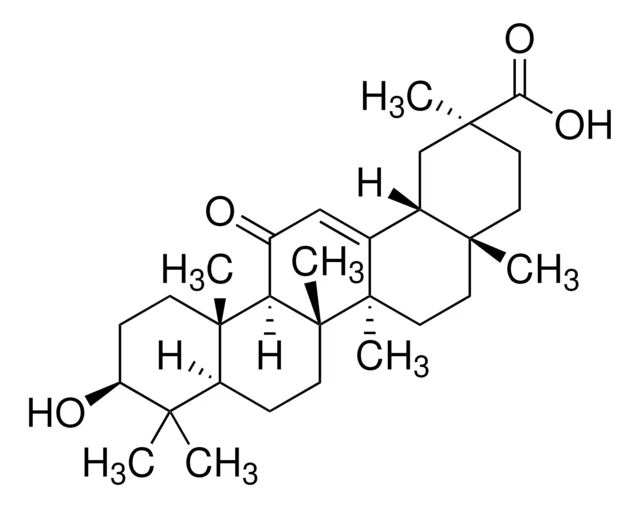
CAS Number471-53-4
SynonymsMFCD00003706; (3β)-3-Hydroxy-11-oxoolean-12-en-30-oic acid; Glycyrrhetinic acid; 18-beta-Glycyrrhetinic acid; Arthrodont; EINECS 207-444-6; 18-β-Glycyrrhetinic Acid; glycyrrhetin; GM 1658; Uralenic acid; 3β-Hydroxy-11-oxoolean-12-en-30-oic acid; 18b-Glycyrrhetic acid; Biosone; 18β-Glycyrrhetinic acid; STX 352; Glycyrrhetic Acid; PO 12; 3b-Hydroxy-11-oxoolean-12-en-30-oic Acid; 18b-Glycyrrhetinic Acid; Glycyrrhetinate; (3b,20b)-3-Hydroxy-11-oxoolean-12-en-29-oic Acid; ENOLOXONE; enoxolone
Molecular FormulaC30H46O4
Molecular Weight470.68
Purity97%
Density1.1±0.1 g/cm3
Boiling Point588.3±50.0 °C at 760 mmHg
Melting Point292-295 °C (lit.)
AppearanceWhite crystalline powder
EINECS207-444-6
| Chemical & Physical Properties | |
|---|---|
| CAS Number | 471-53-4 |
| Catalog No. | 2A-9022090 |
| Chinese Name | 甘草次酸; beta-甘草亭酸 |
| Synonyms | MFCD00003706; (3β)-3-Hydroxy-11-oxoolean-12-en-30-oic acid; Glycyrrhetinic acid; 18-beta-Glycyrrhetinic acid; Arthrodont; EINECS 207-444-6; 18-β-Glycyrrhetinic Acid; glycyrrhetin; GM 1658; Uralenic acid; 3β-Hydroxy-11-oxoolean-12-en-30-oic acid; 18b-Glycyrrhetic acid; Biosone; 18β-Glycyrrhetinic acid; STX 352; Glycyrrhetic Acid; PO 12; 3b-Hydroxy-11-oxoolean-12-en-30-oic Acid; 18b-Glycyrrhetinic Acid; Glycyrrhetinate; (3b,20b)-3-Hydroxy-11-oxoolean-12-en-29-oic Acid; ENOLOXONE; enoxolone |
| Molecular Formula | C30H46O4 |
| Molecular Weight | 470.68 |
| Purity | 97 |
| Density | 1.1±0.1 g/cm3 |
| Boiling Point | 588.3±50.0 °C at 760 mmHg |
| Melting Point | 292-295 °C (lit.) |
| Appearance | White crystalline powder |
| Storage Condition | Store in a sealed container in a ventilated and dr |
| Application | 18β-Glycyrrhetinic acid is the main bioactive component of licorice and has anti-ulcer, anti-inflammatory and anti-proliferative properties. |
| EINECS | 207-444-6 |
| HTC | 2938909030 |
| PubChem ID | 24895033 |
| MDL Number | MFCD00003706 |
| SMILES | CC1(C)[C@@H](O)CC[C@@]2(C)[C@H]1CC[C@]3(C)[C@@H]2C(=O)C=C4[C@@H]5C[C@](C)(CC[C@]5(C)CC[C@@]34C)C(O)=O |
| InChI | 1S/C30H46O4/c1-25(2)21-8-11-30(7)23(28(21,5)10-9-22(25)32)20(31)16-18-19-17-27(4,24(33)34)13-12-26(19,3)14-15-29(18,30)6/h16,19,21-23,32H,8-15,17H2,1-7H3,(H,33,34)/t19-,21-,22-,23+,26+,27-,28-,29+,30+/m0/s1 |
| InChI Key | MPDGHEJMBKOTSU-YKLVYJNSSA-N |
| Beilstein/REAXYS | 2229654 |
| NACRES Code | NA.22 |
| UNSPSC | 12352115 |
| MSDS | msds/22090_1_471_53_4.pdf |
| Bioactivity | 18β-Glycyrrhetinic acid is the major bioactive component of Glycyrrhizae Radix and possesses anti-ulcerative, anti-inflammatory and antiproliferative properties. Related Catalog Research Areas >> Cancer Research Areas >> Inflammation/Immunology Natural Products >> Terpenoids and Glycosides Target Human Endogenous Metabolite In Vitro 18β-Glycyrrhetinic acid is the major bioactive component of Glycyrrhizae Radix and possesses anti-ulcerative, anti-inflammatory and antiproliferative properties. MTS assay demonstrates that 24 h treatment of 18β-Glycyrrhetinic acid suppresses cell proliferation in both cell lines in a dose-dependent manner. 18β-Glycyrrhetinic acid at 160 μM significantly decreases the percentage of viable cells to around 40.5±10.5% in A549 and 38.3±4.6% in NCI-H460 (p<0.01 respectively). When the cells are treated with 320 μM 18β-Glycyrrhetinic acid, a greater inhibitory effects on cell proliferation is shown, as the percentage of viable cells is below 30% compare with untreated controls (p<0.001). Treatment with 18β-Glycyrrhetinic acid at 160 μM and 320 μM decreases the levels of full-length PARP and increases the levels of cleaved-PARP[1]. In Vivo Rats in 18β-Glycyrrhetinic acid+Triptolide (TP) group which receive low-dose 18β-Glycyrrhetinic acid (50 mg/kg) have significant reductions in the three serum parameters when compare with TP rats. Rats in 18β-Glycyrrhetinic acid+TP group which receive the high-dose 18β-Glycyrrhetinic acid (100 mg/kg) have slightly lowered the levels of three liver enzymes, the reductions do not reach statistical significance compare with TP group. Contrastingly, preadministration of low-dose 18β-Glycyrrhetinic acid protects animals from TP-induced hepatic lesions. On the contrary, low-dose 18β-Glycyrrhetinic acid (50 mg/kg) markedly suppresses the release of the four cytokines above[3]. Cell Assay Primary microglia cultures are used in this study. For treatment assay, microglia are incubated with complete DMEM and stimulated with or without 100 ng/mL IFN-γ in the presence or absence of 18β-Glycyrrhetinic acid (25 μM and 50 μM) at 37°C in a humidified incubator with 5% CO2. For cell migration assay, the isolated primary microglia that seeded in complete DMEM medium are stimulated with or without IFN-γ (100 ng/mL), and treated with different doses of 18β-Glycyrrhetinic acid, 24 h later, the microglia culture supernatants are collected and added to the lower chambers of Transwell inserts[2]. Animal Admin Healthy Wistar rats (male, 200±20 g) are used and divided into five groups with 10 individuals for each group randomly. Animals in normal control (NC) group receive distilled water for 6 days and 0.5% CMC-Na for the last 3 days. Rats in Triptolide model group (TP), 18β-Glycyrrhetinic acid low-dose group (GAL+TP), and 18β-Glycyrrhetinic acid high-dose group (GAH+TP) receive distilled water, 18β-Glycyrrhetinic acid (50 mg/kg, p.o., dissolved in distilled water), or 18β-Glycyrrhetinic acid (100 mg/kg, p.o., dissolved in distilled water) for consecutive 6 days, respectively, and liver injury is induced by TP (2.4 mg/kg, p.o., suspended in 0.5% CMC-Na) for the last 3 days. Animals in the above three groups receive TP 6 hours after distilled water or 18β-Glycyrrhetinic acid treatment on the last 3 days[3]. References [1]. Huang RY, et al. 18β-Glycyrrhetinic acid suppresses cell proliferation through inhibiting thromboxane synthase in non-small cell lung cancer. PLoS One. 2014 Apr 2;9(4):e93690. [2]. Zhou J, et al. 18β-glycyrrhetinic acid suppresses experimental autoimmune encephalomyelitis through inhibition of microglia activation and promotion of remyelination. Sci Rep. 2015 Sep 2;5:13713. [3]. Yang G, et al. Protective Effect of 18β-Glycyrrhetinic Acid against Triptolide-Induced Hepatotoxicity in Rats. Evid Based Complement Alternat Med. 2017;2017:3470320. Chemical & Physical Properties Density 1.1±0.1 g/cm3 Boiling Point 588.3±50.0 °C at 760 mmHg Melting Point 292 - 295ºC Molecular Formula C30H46O4 Molecular Weight 470.684 Flash Point 323.7±26.6 °C Exact Mass 470.339600 PSA 74.60000 LogP 6.57 Vapour Pressure 0.0±3.7 mmHg at 25°C Index of Refraction 1.563 InChIKey MPDGHEJMBKOTSU-YKLVYJNSSA-N SMILES CC1(C(=O)O)CCC2(C)CCC3(C)C(=CC(=O)C4C5(C)CCC(O)C(C)(C)C5CCC43C)C2C1 |
| Use of | 18β-Glycyrrhetinic acid is the major bioactive component of Glycyrrhizae Radix and possesses anti-ulcerative, anti-inflammatory and antiproliferative properties. Properties Name Enoxolone Synonym More Synonyms Glycyrrhetinic acid Biological Activity Description 18β-Glycyrrhetinic acid is the major bioactive component of Glycyrrhizae Radix and possesses anti-ulcerative, anti-inflammatory and antiproliferative properties. Related Catalog Research Areas >> Cancer Research Areas >> Inflammation/Immunology Natural Products >> Terpenoids and Glycosides Human Endogenous Metabolite References [1]. Huang RY, et al. 18β-Glycyrrhetinic acid suppresses cell proliferation through inhibiting thromboxane synthase in non-small cell lung cancer. PLoS One. 2014 Apr 2;9(4):e93690. [2]. Zhou J, et al. 18β-glycyrrhetinic acid suppresses experimental autoimmune encephalomyelitis through inhibition of microglia activation and promotion of remyelination. Sci Rep. 2015 Sep 2;5:13713. [3]. Yang G, et al. Protective Effect of 18β-Glycyrrhetinic Acid against Triptolide-Induced Hepatotoxicity in Rats. Evid Based Complement Alternat Med. 2017;2017:3470320. Chemical & Physical Properties Molecular Formula C30H46O4 Exact Mass 470.339600 PSA 74.60000 Index of Refraction 1.563 InChIKey MPDGHEJMBKOTSU-YKLVYJNSSA-N |
| Tax Rebate | 13.0% |
| Supervision | None. MFN tariff: 6.5%. Ordinary tariff: 30.0% |
| Transport Info | Product name: Purity: 98.0% |
| MSDS Transport Info | Module 14. Shipping information United Nations classification: inconsistent with United Nations classification standards UN number: not specified |
| Related Products in Specialty Chemicals | ||
|---|---|---|
| Solvent Violet 9 | 467-63-0 | 2A-9022078 |
| alpha-Cedrene | 469-61-4 | 2A-9022081 |
| Isoalantolactone | 470-17-7 | 2A-9022082 |
| Propiolic acid | 471-25-0 | 2A-9022087 |
| Oxamide | 471-46-5 | 2A-9022089 |
| Isocolumbin | 471-54-5 | 2A-9022091 |
| Stevioside | 471-80-7 | 2A-9022093 |
| N,N-Dimethyl-L-proline | 471-87-4 | 2A-9022094 |
| alpha-Cyperone | 473-08-5 | 2A-9022098 |
| beta-Eudesmol | 473-15-4 | 2A-9022099 |
| Browse all Specialty Chemicals products » | ||
Phone:
630-322-8886
630-322-8887
Email:
Office Locations:
Chicago, IL, USA
San Francisco, CA, USA


 EN
EN


 SDS
SDS