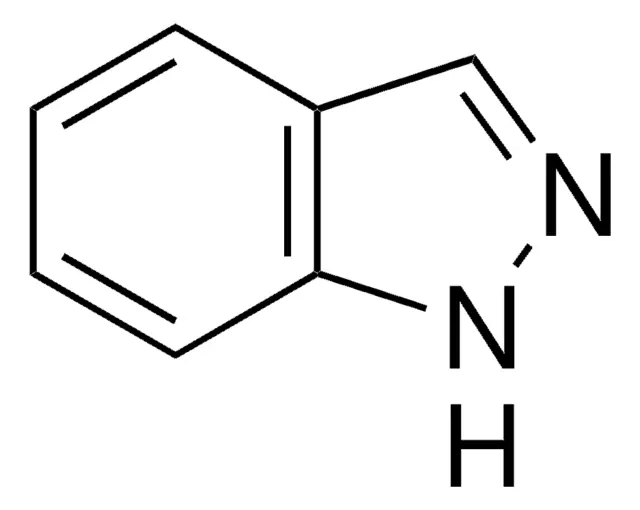
CAS Number271-44-3
Synonymsisoindazole; Indazole; 1H-Indazole; indazole-; MFCD00005691; EINECS 205-978-4; 1,2-Benzopyrazole; 1h-indazol; 1,2-Benzodiazole; BENZOPYRAZOLE; Indazol; 2-Azaindole; benzodiazole
Molecular FormulaC7H6N2
Molecular Weight118.14
Purity98%
Density1.2±0.1 g/cm3
Boiling Point270 °C/743 mmHg (lit.)
Melting Point145-148 °C (lit.)
AppearanceWhite or beige crystalline powder
EINECS205-978-4
Symbol
Signal WordWarning
| Chemical & Physical Properties | |
|---|---|
| CAS Number | 271-44-3 |
| Catalog No. | 2A-9021085 |
| Chinese Name | 吲唑 |
| Synonyms | isoindazole; Indazole; 1H-Indazole; indazole-; MFCD00005691; EINECS 205-978-4; 1,2-Benzopyrazole; 1h-indazol; 1,2-Benzodiazole; BENZOPYRAZOLE; Indazol; 2-Azaindole; benzodiazole |
| Molecular Formula | C7H6N2 |
| Molecular Weight | 118.14 |
| Purity | 98 |
| Density | 1.2±0.1 g/cm3 |
| Boiling Point | 270 °C/743 mmHg (lit.) |
| Melting Point | 145-148 °C (lit.) |
| Appearance | White or beige crystalline powder |
| Water Solubility | SOLUBLE IN HOT WATER |
| Storage Condition | Store in inert gas; avoid air |
| Application | Indazole, also known as isoindazole, is a heterocyclic aromatic organic compound. Its derivatives display a wide range of biological activities, including anti-inflammatory, antibacterial, anti-HIV, a |
| EINECS | 205-978-4 |
| HTC | 29339990 |
| PubChem ID | 24895976 |
| MDL Number | MFCD00005691 |
| SMILES | c1ccc2[nH]ncc2c1 |
| InChI | 1S/C7H6N2/c1-2-4-7-6(3-1)5-8-9-7/h1-5H,(H,8,9) |
| InChI Key | BAXOFTOLAUCFNW-UHFFFAOYSA-N |
| Beilstein/REAXYS | 109676 |
| NACRES Code | NA.22 |
| UNSPSC | 12352100 |
| Hazard Symbols | Transport |
| MSDS | msds/21085_1_271_44_3.pdf |
| Bioactivity | Indazole, also called isoindazole, a heterocyclic aromatic organic compound. Its derivatives display a broad variety of biological activities including anti-inflammatory, antibacterial, anti-HIV, antiarrhythmic, antifungal and antitumour properties. Indazole and its derivatives can be used for research of cancer, neurological disorders, cardiovascular diseases, gastrointestinal diseases[1][2][3][4][5]. Related Catalog Signaling Pathways >> Stem Cell/Wnt >> GSK-3 Research Areas >> Cancer Research Areas >> Cardiovascular Disease Signaling Pathways >> Autophagy >> LRRK2 Signaling Pathways >> Neuronal Signaling >> Monoamine Oxidase Research Areas >> Neurological Disease Signaling Pathways >> PI3K/Akt/mTOR >> GSK-3 In Vitro Indazole compounds possess potential anticancer activity, and indazole-based agents such as, Axitinib (HY-10065), Lonidamine (HY-B0486) and Pazopanib (HY-10208) have already been used for cancer research, demonstrating indazole compounds as useful templates for the development of novel anticancer agents[1]. Indazoles show potent activities against neurological disorders by inhibiting the monoamine oxidase (MAO) and kinase enzymes like Glycogen synthase kinase 3 (GSK3), and leucinerich repeat kinase enzyme 2 (LRRK2)[2]. Various natural and synthetic indazole derivatives Nigellicine, Nigellamine, Nigellidine, Zanubrutinib (HY-101474A) and SCH772984 (HY-50846) showes prominent results to cure various gastrointestinal disorders[4]. References [1]. Shang C, et al. The Anticancer Activity of Indazole Compounds: A Mini Review. Curr Top Med Chem. 2021;21(5):363-376. [2]. Pal D, et al. Importance of Indazole against Neurological Disorders. Curr Top Med Chem. 2022;22(14):1136-1151. [3]. Uppulapu SK, et al. Indazole and its Derivatives in Cardiovascular Diseases: Overview, Current Scenario, and Future Perspectives. Curr Top Med Chem. 2022;22(14):1177-1188. [4]. Saha S, et al. Indazole Derivatives Effective against Gastrointestinal Diseases. Curr Top Med Chem. 2022;22(14):1189-1214. [5]. Qin J, et al. Indazole as a Privileged Scaffold: The Derivatives and their Therapeutic Applications. Anticancer Agents Med Chem. 2021;21(7):839-860. Chemical & Physical Properties Density 1.2±0.1 g/cm3 Boiling Point 270.0±9.0 °C at 760 mmHg Melting Point 145-148 °C(lit.) Molecular Formula C7H6N2 Molecular Weight 118.136 Flash Point 128.5±11.7 °C Exact Mass 118.053101 PSA 28.68000 LogP 1.82 Vapour Pressure 0.0±0.5 mmHg at 25°C Index of Refraction 1.697 InChIKey BAXOFTOLAUCFNW-UHFFFAOYSA-N SMILES c1ccc2[nH]ncc2c1 Water Solubility SOLUBLE IN HOT WATER |
| Use of | Indazole, also called isoindazole, a heterocyclic aromatic organic compound. Its derivatives display a broad variety of biological activities including anti-inflammatory, antibacterial, anti-HIV, antiarrhythmic, antifungal and antitumour properties. Indazole and its derivatives can be used for research of cancer, neurological disorders, cardiovascular diseases, gastrointestinal diseases[1][2][3][4][5]. Properties Name 1H-indazole Synonym More Synonyms 1H-Indazole Biological Activity Description Indazole, also called isoindazole, a heterocyclic aromatic organic compound. Its derivatives display a broad variety of biological activities including anti-inflammatory, antibacterial, anti-HIV, antiarrhythmic, antifungal and antitumour properties. Indazole and its derivatives can be used for research of cancer, neurological disorders, cardiovascular diseases, gastrointestinal diseases[1][2][3][4][5]. Related Catalog Signaling Pathways >> Stem Cell/Wnt >> GSK-3 Research Areas >> Cancer Research Areas >> Cardiovascular Disease Signaling Pathways >> Autophagy >> LRRK2 Signaling Pathways >> Neuronal Signaling >> Monoamine Oxidase Research Areas >> Neurological Disease Signaling Pathways >> PI3K/Akt/mTOR >> GSK-3 In Vitro Indazole compounds possess potential anticancer activity, and indazole-based agents such as, Axitinib (HY-10065), Lonidamine (HY-B0486) and Pazopanib (HY-10208) have already been used for cancer research, demonstrating indazole compounds as useful templates for the development of novel anticancer agents[1]. Indazoles show potent activities against neurological disorders by inhibiting the monoamine oxidase (MAO) and kinase enzymes like Glycogen synthase kinase 3 (GSK3), and leucinerich repeat kinase enzyme 2 (LRRK2)[2]. Various natural and synthetic indazole derivatives Nigellicine, Nigellamine, Nigellidine, Zanubrutinib (HY-101474A) and SCH772984 (HY-50846) showes prominent results to cure various gastrointestinal disorders[4]. References [1]. Shang C, et al. The Anticancer Activity of Indazole Compounds: A Mini Review. Curr Top Med Chem. 2021;21(5):363-376. [2]. Pal D, et al. Importance of Indazole against Neurological Disorders. Curr Top Med Chem. 2022;22(14):1136-1151. [3]. Uppulapu SK, et al. Indazole and its Derivatives in Cardiovascular Diseases: Overview, Current Scenario, and Future Perspectives. Curr Top Med Chem. 2022;22(14):1177-1188. [4]. Saha S, et al. Indazole Derivatives Effective against Gastrointestinal Diseases. Curr Top Med Chem. 2022;22(14):1189-1214. [5]. Qin J, et al. Indazole as a Privileged Scaffold: The Derivatives and their Therapeutic Applications. Anticancer Agents Med Chem. 2021;21(7):839-860. Chemical & Physical Properties Molecular Formula C7H6N2 Exact Mass 118.053101 PSA 28.68000 Index of Refraction 1.697 InChIKey BAXOFTOLAUCFNW-UHFFFAOYSA-N Water Solubility SOLUBLE IN HOT WATER |
| Tax Rebate | 13.0% |
| Supervision | None. MFN tariff: 6.5%. Ordinary tariff: 20.0% |
| Transport Info | Shipping Name: UN |
| MSDS Transport Info | Module 14. Shipping information 14.1 UN dangerous goods number European Land Transport Dangerous Regulations: -International Maritime Dangerous Regulations: -International Air Transport Dangerous Regulations: - 14.2 United Nations shipping name European Land Transport Dangerous Regulations: Non-dangerous goods IMDG Code: Non-dangerous goods International air transport dangerous goods regulations: non-dangerous goods 14.3 Transport hazard categories European Land Transport Dangerous Regulations: -International Maritime Dangerous Regulations: -International Air Transport Dangerous Regulations: - 14.4 Package group European Land Transport Dangerous Regulations: -International Maritime Dangerous Regulations: -International Air Transport Dangerous Regulations: - 14.5 Environmental hazards European Land Transport Danger Regulations: No International Maritime Danger Regulations International Air Transport Danger Regulations: No Marine pollutants (yes/no): No 14.6 Special reminder to users No data available |
| Related Products in Heterocyclic Building Blocks | ||
|---|---|---|
| 1,2-Dihydro-2,2,4-trimethylquinoline | 147-47-7 | 2A-9020972 |
| 6-Thioguanine | 154-42-7 | 2A-9021038 |
| 7,8-Benzoquinoline | 230-27-3 | 2A-9021074 |
| Thieno[3,2-b]thiophene | 251-41-2 | 2A-9021075 |
| Quinazoline | 253-82-7 | 2A-9021079 |
| 1H-Pyrazolo[3,4-b]pyridine | 271-73-8 | 2A-9021088 |
| Thieno[3,4-b]pyrazine | 272-43-5 | 2A-9021090 |
| 1H-Pyrazolo[4,3-b]pyridine | 272-52-6 | 2A-9021092 |
| 5-Azabenzimidazole | 272-97-9 | 2A-9021093 |
| 4-Azabenzimidazole | 273-21-2 | 2A-9021095 |
| Browse all Heterocyclic Building Blocks products » | ||
Phone:
630-322-8886
630-322-8887
Email:
Office Locations:
Chicago, IL, USA
San Francisco, CA, USA


 EN
EN


 SDS
SDS