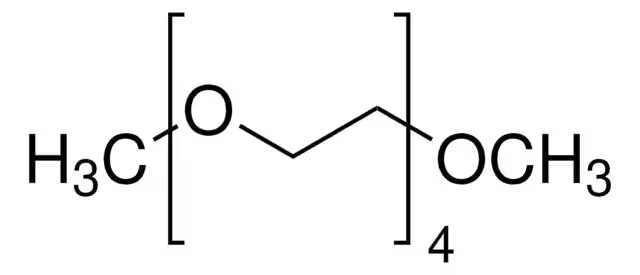
CAS Number143-24-8
Synonymstetraglyme; Dimethyltetraglycol; Bis[2-(2-methoxyethoxy)ethyl] ether; MFCD00008505; 2,5,8,11,14-Pentaoxapentadecane; EINECS 205-594-7; 1-methoxy-2-[2-[2-(2-methoxyethoxy)ethoxy]ethoxy]ethane; 2,5,8,11,14-Pentaoxapentadecane (Bis[2-(2-methoxyethoxy)ethyl] ether; Dimethoxytetraethylene glycol; Tetraethylene glycol dimethyl ether
Molecular FormulaCH3O(CH2CH2O)4CH3
Molecular Weight222.28
Purity≥99%
Density1.0±0.1 g/cm3
Boiling Point275-276 °C (lit.)
Melting Point−30 °C (lit.)
Appearanceliquid
EINECS205-594-7
Symbol
Signal WordWarning
| Chemical & Physical Properties | |
|---|---|
| CAS Number | 143-24-8 |
| Catalog No. | 2A-9020932 |
| Chinese Name | 四乙二醇二甲醚 |
| Synonyms | tetraglyme; Dimethyltetraglycol; Bis[2-(2-methoxyethoxy)ethyl] ether; MFCD00008505; 2,5,8,11,14-Pentaoxapentadecane; EINECS 205-594-7; 1-methoxy-2-[2-[2-(2-methoxyethoxy)ethoxy]ethoxy]ethane; 2,5,8,11,14-Pentaoxapentadecane (Bis[2-(2-methoxyethoxy)ethyl] ether; Dimethoxytetraethylene glycol; Tetraethylene glycol dimethyl ether |
| Molecular Formula | CH3O(CH2CH2O)4CH3 |
| Molecular Weight | 222.28 |
| Purity | ≥99 |
| Density | 1.0±0.1 g/cm3 |
| Boiling Point | 275-276 °C (lit.) |
| Melting Point | −30 °C (lit.) |
| Appearance | liquid |
| Water Solubility | Soluble |
| Storage Condition | Keep sealed. |
| Application | Me-PEG4-Me is a PROTAC linker, belonging to the PEG class. Can be used to synthesize PROTAC molecules. |
| EINECS | 205-594-7 |
| HTC | 2942000000 |
| PubChem ID | 24850399 |
| MDL Number | MFCD00008505 |
| SMILES | COCCOCCOCCOCCOC |
| InChI | 1S/C10H22O5/c1-11-3-5-13-7-9-15-10-8-14-6-4-12-2/h3-10H2,1-2H3 |
| InChI Key | ZUHZGEOKBKGPSW-UHFFFAOYSA-N |
| Beilstein/REAXYS | 1760005 |
| NACRES Code | NA.23 |
| UNSPSC | 12162002 |
| Hazard Symbols | Transport |
| MSDS | msds/20932_1_143_24_8.pdf |
| Bioactivity | Me-PEG4-Me is a PEG-based PROTAC linker that can be used in the synthesis of PROTACs[1]. Related Catalog Research Areas >> Cancer Signaling Pathways >> PROTAC >> PROTAC Linker Target PEGs In Vitro PROTACs contain two different ligands connected by a linker; one is a ligand for an E3 ubiquitin ligase and the other is for the target protein. PROTACs exploit the intracellular ubiquitin-proteasome system to selectively degrade target proteins[1]. References [1]. An S, et al. Small-molecule PROTACs: An emerging and promising approach for the development of targeted therapy drugs. EBioMedicine. 2018 Oct;36:553-562 Chemical & Physical Properties Density 1.0±0.1 g/cm3 Boiling Point 275.3±0.0 °C at 760 mmHg Melting Point −30 °C(lit.) Molecular Formula C10H22O5 Molecular Weight 222.279 Flash Point 140.6±0.0 °C Exact Mass 222.146729 PSA 46.15000 LogP -1.51 Vapour density 7.7 (vs air) Vapour Pressure 0.0±0.5 mmHg at 25°C Index of Refraction 1.421 InChIKey ZUHZGEOKBKGPSW-UHFFFAOYSA-N SMILES COCCOCCOCCOCCOC |
| Use of | Me-PEG4-Me is a PEG-based PROTAC linker that can be used in the synthesis of PROTACs[1]. Properties Articles29 Name tetraglyme Synonym More Synonyms Me-PEG4-Me Biological Activity Description Me-PEG4-Me is a PEG-based PROTAC linker that can be used in the synthesis of PROTACs[1]. Related Catalog Research Areas >> Cancer Signaling Pathways >> PROTAC >> PROTAC Linker In Vitro PROTACs contain two different ligands connected by a linker; one is a ligand for an E3 ubiquitin ligase and the other is for the target protein. PROTACs exploit the intracellular ubiquitin-proteasome system to selectively degrade target proteins[1]. References [1]. An S, et al. Small-molecule PROTACs: An emerging and promising approach for the development of targeted therapy drugs. EBioMedicine. 2018 Oct;36:553-562 Chemical & Physical Properties Molecular Formula C10H22O5 Exact Mass 222.146729 PSA 46.15000 LogP -1.51 Vapour density 7.7 (vs air) Index of Refraction 1.421 InChIKey ZUHZGEOKBKGPSW-UHFFFAOYSA-N SMILES COCCOCCOCCOCCOC |
| Tax Rebate | 9.0% |
| Supervision | none |
| Transport Info | Shipping Name: UN |
| MSDS Transport Info | Module 14. Shipping information 14.1 United Nations number European Land Transport Dangerous Regulations: -International Maritime Dangerous Regulations: -International Air Transport Dangerous Regulations: - 14.2 United Nations shipping name European Land Transport Dangerous Regulations: Non-dangerous goods IMDG Code: Non-dangerous goods International air transport dangerous goods regulations: non-dangerous goods 14.3 Transport hazard categories European Land Transport Dangerous Regulations: -International Maritime Dangerous Regulations: -International Air Transport Dangerous Regulations: - 14.4 Package group European Land Transport Dangerous Regulations: -International Maritime Dangerous Regulations: -International Air Transport Dangerous Regulations: - 14.5 Environmental hazards European Land Transport Danger Regulations: No International Maritime Danger Regulations International Air Transport Danger Regulations: No Marine pollutants (yes/no): No 14.6 Special precautions No data available |
| Related Products in Specialty Chemicals | ||
|---|---|---|
| Hexyl acetate | 142-92-7 | 2A-9020921 |
| (6-Aminohexyl)carbamic acid | 143-06-6 | 2A-9020924 |
| 1-Decanethiol | 143-10-2 | 2A-9020927 |
| Potassium oleate | 143-18-0 | 2A-9020929 |
| Bis(hexamethylene)triamine | 143-23-7 | 2A-9020931 |
| 1-Hexadecylamine | 143-27-1 | 2A-9020933 |
| Oleyl alcohol | 143-28-2 | 2A-9020934 |
| Sodium tetraphenylboron | 143-66-8 | 2A-9020936 |
| Phenol Red | 143-74-8 | 2A-9020938 |
| Trihexylphenedyl | 144-11-6 | 2A-9020939 |
| Browse all Specialty Chemicals products » | ||
Phone:
630-322-8886
630-322-8887
Email:
Office Locations:
Chicago, IL, USA
San Francisco, CA, USA


 EN
EN


 SDS
SDS