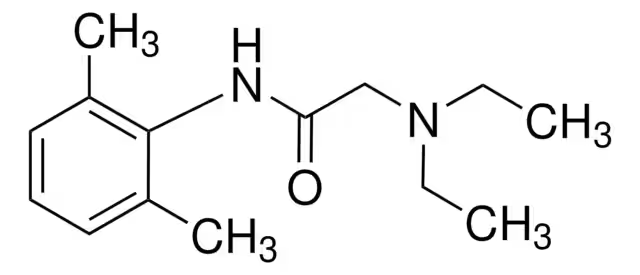
CAS Number137-58-6
Synonyms2-Diethylamino-N-(2,6-dimethylphenyl)acetamide; Lignocaine; 4,4'-DIMETHOXY DIPHENYL SULFOXIDE LIDOCAINE-D6; 2-Diethylamino-N-(2,6-dimethylphenyl)acetamide,Lignocaine,Xylocaine; Maricaine; MFCD08443609; Gravocain; 2-(Diethylamino)-N-(2,6-dimethylphenyl)-acetamide; Lidoderm; N1-(2,6-dimethylphenyl)-2-(diethylamino)acetamide; 2-(diethylamino)-N-(2,6-dimethylphenyl)acetamide; XYLOCAINE; N-(2,6-Dimethylphenyl)-N,N-diethylglycinamide; 2-Diethylamino-2',6'-acetoxylidide; N-(2,6-Diméthylphényl)-N,N-diéthylglycinamide; Anestacon; L-Caine; Leostesin; Esracaine; Lidothesin; 2-Diethylamino-N-(2,6-dimethylphenyl)acetamide Lignocaine Xylocaine; N-(2,6-dimethylphenyl)-N2,N2-diethylglycinamide; lignocainum hydrochloricum; Lidocaine; w-Diethylamino-2,6-dimethylacetanilide; EINECS 205-302-8
Molecular FormulaC14H22N2O
Molecular Weight234.34
Purity99%
Density1.0±0.1 g/cm3
Boiling Point372.7±52.0 °C at 760 mmHg
Melting Point66-69°C
AppearanceWhite crystalline powder
EINECS205-302-8
Symbol
Signal WordWarning
| Chemical & Physical Properties | |
|---|---|
| CAS Number | 137-58-6 |
| Catalog No. | 2A-0202350 |
| Chinese Name | 利多卡因 |
| Synonyms | 2-Diethylamino-N-(2,6-dimethylphenyl)acetamide; Lignocaine; 4,4'-DIMETHOXY DIPHENYL SULFOXIDE LIDOCAINE-D6; 2-Diethylamino-N-(2,6-dimethylphenyl)acetamide,Lignocaine,Xylocaine; Maricaine; MFCD08443609; Gravocain; 2-(Diethylamino)-N-(2,6-dimethylphenyl)-acetamide; Lidoderm; N1-(2,6-dimethylphenyl)-2-(diethylamino)acetamide; 2-(diethylamino)-N-(2,6-dimethylphenyl)acetamide; XYLOCAINE; N-(2,6-Dimethylphenyl)-N,N-diethylglycinamide; 2-Diethylamino-2',6'-acetoxylidide; N-(2,6-Diméthylphényl)-N,N-diéthylglycinamide; Anestacon; L-Caine; Leostesin; Esracaine; Lidothesin; 2-Diethylamino-N-(2,6-dimethylphenyl)acetamide Lignocaine Xylocaine; N-(2,6-dimethylphenyl)-N2,N2-diethylglycinamide; lignocainum hydrochloricum; Lidocaine; w-Diethylamino-2,6-dimethylacetanilide; EINECS 205-302-8 |
| Molecular Formula | C14H22N2O |
| Molecular Weight | 234.34 |
| Purity | 99 |
| Density | 1.0±0.1 g/cm3 |
| Boiling Point | 372.7±52.0 °C at 760 mmHg |
| Melting Point | 66-69°C |
| Appearance | White crystalline powder |
| Water Solubility | practically insoluble |
| Storage Condition | This product should be sealed and stored in a cool |
| Packaging | III |
| Application | Lidocaine is an inverse agonist of histamine H1 receptor with IC50>32 μM. |
| EINECS | 205-302-8 |
| HTC | 2924299090 |
| PubChem ID | 329823064 |
| MDL Number | MFCD00026733 |
| SMILES | CCN(CC)CC(=O)Nc1c(C)cccc1C |
| InChI | 1S/C14H22N2O/c1-5-16(6-2)10-13(17)15-14-11(3)8-7-9-12(14)4/h7-9H,5-6,10H2,1-4H3,(H,15,17) |
| InChI Key | NNJVILVZKWQKPM-UHFFFAOYSA-N |
| NACRES Code | NA.24 |
| UNSPSC | 41116107 |
| Hazard Symbols | 6.1(b) |
| MSDS | msds/20797_1_137_58_6.pdf |
| Bioactivity | Lidocaine, an amide local anesthetic, has anti-inflammatory properties in vitro and in vivo, possibly due to an attenuation of pro-inflammatory cytokines, intracellular adhesion molecule-1 (ICAM-1), and reduction of neutrophils influx.Target: Lidocaine is a common local anesthetic and antiarrhythmic drug. Lidocaine is used topically to relieve itching, burning and pain from skin inflammations, injected as a dental anesthetic or as a local anesthetic for minor surgery. Lidocaine, the first amino amide-type local anesthetic, was first synthesized under the name xylocaine by Swedish chemist Nils Lofgren in 1943. His colleague Bengt Lundqvist performed the first injection anesthesia experiments on himself.Lidocaine is approximately 95% metabolized (dealkylated) in the liver by CYP3A4 to the pharmacologically-active metabolites monoethylglycinexylidide (MEGX) and then subsequently to the inactive glycine xylidide. MEGX has a longer half life than lidocaine but also is a less potent sodium channel blocker. The elimination half-life of lidocaine is approximately 90-120 minutes in most patients. This may be prolonged in patients with hepatic impairment (average 343 minutes) or congestive heart failure (average 136 minutes). Related Catalog Signaling Pathways >> Membrane Transporter/Ion Channel >> Sodium Channel Research Areas >> Cardiovascular Disease References [1]. VAN DER Wal S, et al. Lidocaine increases the anti-inflammatory cytokine IL-10 following mechanical ventilation in healthy mice. Acta Anaesthesiol Scand. 2014 Oct 14. [2]. Acevedo-Arcique CM, et al. Lidocaine, dexmedetomidine and their combination reduce isoflurane minimum alveolar concentration in dogs. PLoS One. 2014 Sep 18;9(9):e106620. Chemical & Physical Properties Density 1.0±0.1 g/cm3 Boiling Point 372.7±52.0 °C at 760 mmHg Melting Point 66-69°C Molecular Formula C14H22N2O Molecular Weight 234.337 Flash Point 179.2±30.7 °C Exact Mass 234.173218 PSA 32.34000 LogP 3.63 Vapour Pressure 0.0±0.9 mmHg at 25°C Index of Refraction 1.512 InChIKey NNJVILVZKWQKPM-UHFFFAOYSA-N SMILES CCN(CC)CC(=O)Nc1c(C)cccc1C Storage condition Store at RT Stability Stable. Incompatible with strong oxidizing agents. Water Solubility practically insoluble |
| Use of | Properties Articles439 Name lidocaine Synonym More Synonyms Lidocaine Biological Activity Related Catalog Signaling Pathways >> Membrane Transporter/Ion Channel >> Sodium Channel Research Areas >> Cardiovascular Disease References [1]. VAN DER Wal S, et al. Lidocaine increases the anti-inflammatory cytokine IL-10 following mechanical ventilation in healthy mice. Acta Anaesthesiol Scand. 2014 Oct 14. [2]. Acevedo-Arcique CM, et al. Lidocaine, dexmedetomidine and their combination reduce isoflurane minimum alveolar concentration in dogs. PLoS One. 2014 Sep 18;9(9):e106620. Chemical & Physical Properties Molecular Formula C14H22N2O Exact Mass 234.173218 PSA 32.34000 Index of Refraction 1.512 InChIKey NNJVILVZKWQKPM-UHFFFAOYSA-N Storage condition Store at RT Stability Stable. Incompatible with strong oxidizing agents. Water Solubility practically insoluble |
| Tax Rebate | 13.0% |
| Supervision | None. MFN tariff: 6.5%. Ordinary tariff: 30.0% |
| Transport Info | Product name: Purity: 99.0% |
| MSDS Transport Info | Module 14. Shipping information United Nations classification: inconsistent with United Nations classification standards UN number: not specified |
| Related Products in Specialty Chemicals | ||
|---|---|---|
| Sodium propionate | 137-40-6 | 2A-9020789 |
| Potassium methyldithiocarbamate | 137-41-7 | 2A-9020790 |
| 4-Chloro-N-methyl-3-nitrobenzenesulfonamide | 137-48-4 | 2A-9020793 |
| 4-Chloro-3-nitro-N-phenylbenzenesulfonamide | 137-49-5 | 2A-9020794 |
| N-(5-Chloro-2-methoxyphenyl)-3-hydroxynaphthalene-2-carboxamide | 137-52-0 | 2A-9020796 |
| Ascorbyl palmitate | 137-66-6 | 2A-9020799 |
| L-(+)-Glutamic acid hydrochloride | 138-15-8 | 2A-9020803 |
| Butyl lactate | 138-22-7 | 2A-9020804 |
| Phenyltrimethylammonium chloride | 138-24-9 | 2A-9020805 |
| Cetrimonium tosylate | 138-32-9 | 2A-9020806 |
| Browse all Specialty Chemicals products » | ||
Phone:
630-322-8886
630-322-8887
Email:
Office Locations:
Chicago, IL, USA
San Francisco, CA, USA


 EN
EN


 SDS
SDS