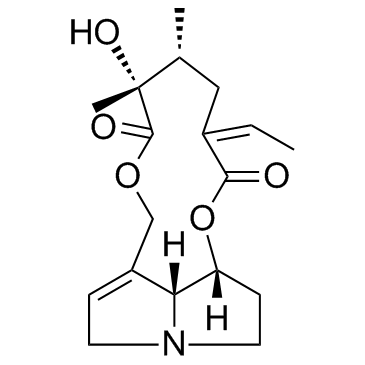
| Chemical & Physical Properties | |
|---|---|
| CAS Number | 130-01-8 |
| Catalog No. | 2A-2204150 |
| Chinese Name | 千里光宁 |
| Synonyms | aureine; Senecionine; MFCD00221720; (15Z)-12-Hydroxysenecionan-11,16-dione; Integerrimine |
| Molecular Formula | C18H25NO5 |
| Molecular Weight | 335.395 |
| Density | 1.3±0.1 g/cm3 |
| Boiling Point | 563.7±50.0 °C at 760 mmHg |
| Melting Point | 236ºC(lit.) |
| Storage Condition | Ventilated, low-temperature drying, stored separat |
| Packaging | II |
| Application | Senecionine is a pyrrolizidine alkaloid isolated from Senecio vulgaris. Senecionine is toxic to animals and humans. |
| SMILES | CC=C1CC(C)C(C)(O)C(=O)OCC2=CCN3CCC(OC1=O)C23 |
| InChI | InChI=1S/C18H25NO5/c1-4-12-9-11(2)18(3,22)17(21)23-10-13-5-7-19-8-6-14(15(13)19)24-16(12)20/h4-5,11,14-15,22H,6-10H2,1-3H3/b12-4-/t11-,14-,15-,18-/m1/s1 |
| InChI Key | HKODIGSRFALUTA-JTLQZVBZSA-N |
| Hazard Symbols | 6.1(a) |
| Bioactivity | Senecionine is a pyrrolizidine alkaloid isolated from Senecio vulgaris. Senecionine is toxic to animals and humans. Related Catalog Signaling Pathways >> Others >> Others Research Areas >> Metabolic Disease In Vitro Pyrrolizidine alkaloids (PAs) are considered to be one of the most hepatotoxic groups of compounds of plant origin and are present in about 3% of the world's flowering plants. Most PAs represent a considerable health hazard to both livestock and humans through the consumption of plants and PA-contaminated products such as milk, honey, herbal teas, and medicines[1]. In Vivo Upon intravenous administration and oral administration of Senecionine and Adonifoline, significant differences in pharmacokinetics were observed, with the Senecionine and Adonifoline being absorbed fast with lower bioavailability and being quickly metabolized to PA N-oxides and hydroxylation products of PAs or their N-oxides[1]. Senecionine fails to stimulate epoxide hydrase, it diminishs the activity of glutathione-s-transferase, aminopyrine demethylase and AHH[2]. Twice-weekly injections of a third constituent, senecionine, beginning on Day 12 or later, results in premature deliveries in three of seven rats, and the pups from all litters are stillborn or die shortly after birth[3]. Animal Admin Rats[1] Swiss albino rats weighing 155-175 g are incubated for 3 consecutive days with seneciphylline and senecionine at a daily dose of 40 or 80 mg/kg body wt. Control animals received normal saline only. The animals are killed 24 h after the last dose. The livers are removed, weighed and then homogenized in 1.15% KCI, 0.02 HEPES (pH 7.4)[1]. References [1]. Wang C, et al. The comparative pharmacokinetics of two pyrrolizidine alkaloids, senecionine and adonifoline, and their main metabolites in rats after intravenous and oral administration by UPLC/ESIMS. Anal Bioanal Chem. 2011 Jul;401(1):275-87. [2]. Kakrani HK, et al. Effect of seneciphylline and senecionine on hepatic drug metabolizing enzymes in rats. J Ethnopharmacol. 1984 Dec;12(3):271-8. [3]. Tu ZB, et al. Identification of senecionine and senecionine N-oxide as antifertility constituents in Senecio vulgaris. J Pharm Sci. 1988 May;77(5):461-3. Chemical & Physical Properties Density 1.3±0.1 g/cm3 Boiling Point 563.7±50.0 °C at 760 mmHg Melting Point 236ºC(lit.) Molecular Formula C18H25NO5 Molecular Weight 335.395 Flash Point 294.7±30.1 °C Exact Mass 335.173279 PSA 76.07000 LogP 0.88 Vapour Pressure 0.0±3.5 mmHg at 25°C Index of Refraction 1.570 InChIKey HKODIGSRFALUTA-JTLQZVBZSA-N SMILES CC=C1CC(C)C(C)(O)C(=O)OCC2=CCN3CCC(OC1=O)C23 |
| Use of | Senecionine is a pyrrolizidine alkaloid isolated from Senecio vulgaris. Senecionine is toxic to animals and humans. Properties Articles26 Name senecionine Synonym More Synonyms Senecionine Biological Activity Description Senecionine is a pyrrolizidine alkaloid isolated from Senecio vulgaris. Senecionine is toxic to animals and humans. Related Catalog Signaling Pathways >> Others >> Others Research Areas >> Metabolic Disease In Vitro Pyrrolizidine alkaloids (PAs) are considered to be one of the most hepatotoxic groups of compounds of plant origin and are present in about 3% of the world's flowering plants. Most PAs represent a considerable health hazard to both livestock and humans through the consumption of plants and PA-contaminated products such as milk, honey, herbal teas, and medicines[1]. In Vivo Upon intravenous administration and oral administration of Senecionine and Adonifoline, significant differences in pharmacokinetics were observed, with the Senecionine and Adonifoline being absorbed fast with lower bioavailability and being quickly metabolized to PA N-oxides and hydroxylation products of PAs or their N-oxides[1]. Senecionine fails to stimulate epoxide hydrase, it diminishs the activity of glutathione-s-transferase, aminopyrine demethylase and AHH[2]. Twice-weekly injections of a third constituent, senecionine, beginning on Day 12 or later, results in premature deliveries in three of seven rats, and the pups from all litters are stillborn or die shortly after birth[3]. References [1]. Wang C, et al. The comparative pharmacokinetics of two pyrrolizidine alkaloids, senecionine and adonifoline, and their main metabolites in rats after intravenous and oral administration by UPLC/ESIMS. Anal Bioanal Chem. 2011 Jul;401(1):275-87. [2]. Kakrani HK, et al. Effect of seneciphylline and senecionine on hepatic drug metabolizing enzymes in rats. J Ethnopharmacol. 1984 Dec;12(3):271-8. [3]. Tu ZB, et al. Identification of senecionine and senecionine N-oxide as antifertility constituents in Senecio vulgaris. J Pharm Sci. 1988 May;77(5):461-3. Chemical & Physical Properties Molecular Formula C18H25NO5 Exact Mass 335.173279 PSA 76.07000 Index of Refraction 1.570 InChIKey HKODIGSRFALUTA-JTLQZVBZSA-N |
| Transport Info | Shipping Name: UN |
| MSDS Transport Info | Module 14. Shipping information 14.1 UN dangerous goods number European Dangerous Regulations for land transport: 2811 International Dangerous Regulations for sea transport: 2811 International Dangerous Regulations for air transport: 2811 14.2 United Nations shipping name European Land Transport Dangerous Regulations: TOXIC SOLID, ORGANIC, N.O.S. (12-Hydroxy-senecionan-11,16-dione) IMDG Code: TOXIC SOLID, ORGANIC, N.O.S. (12-Hydroxy-senecionan-11,16-dione) International air transport hazard regulations: Toxic solid, organic, n.o.s. (12-Hydroxy-senecionan-11,16-dione) 14.3 Transport hazard categories European Land Transport Danger Regulations: 6.1 International Maritime Transport Danger Regulations: 6.1 International Air Transport Danger Regulations: 6.1 14.4 Package group European Land Transport Danger Regulations: III International Maritime Transport Danger Regulations: III International Air Transport Danger Regulations: III 14.5 Environmental hazards European Land Transport Danger Regulations: No International Maritime Danger Regulations International Air Transport Danger Regulations: No Marine pollutants (yes/no): No 14.6 Special reminder to users No data available |
| Related Products in Alkaloids | ||
|---|---|---|
| InterMedine N-Oxide | 95462-14-9 | 2A-0204304 |
| Lycopsamine | 10285-07-1 | 2A-0204301 |
| lycopsamine N-oxide | 95462-15-0 | 2A-0204300 |
| Senecionine | 130-01-8 | 2A-0202764 |
| senecionine N-oxide | 13268-67-2 | 2A-0204298 |
| Browse all Alkaloids products » | ||
Phone:
630-322-8886
630-322-8887
Email:
Office Locations:
Chicago, IL, USA
San Francisco, CA, USA


 EN
EN


 SDS
SDS