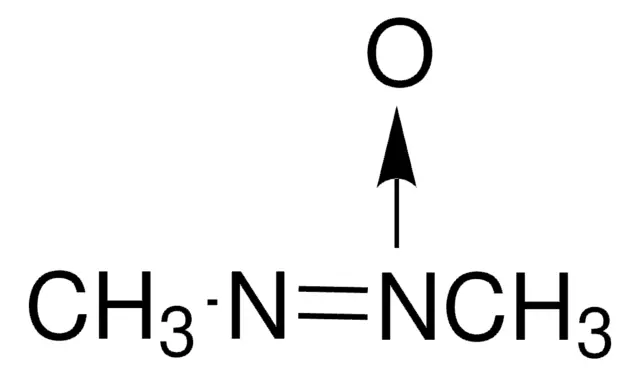
| Chemical & Physical Properties | |
|---|---|
| CAS Number | 25843-45-2 |
| Catalog No. | 2A-0201727 |
| Chinese Name | 偶氮甲烷 |
| Synonyms | methyl-methylimino-oxidoazanium; MFCD00126912 |
| Molecular Formula | CH3N=N(→O)CH3 |
| Molecular Weight | 74.08 |
| Purity | ≥98 |
| Density | 0.98g/cm3 |
| Boiling Point | 97-99 °C (lit.) |
| Appearance | liquid |
| Storage Condition | -20℃ |
| Application | Azoxymethane is a colon carcinogen that can cause the formation of DNA adducts. |
| HTC | 2927000090 |
| PubChem ID | 329770827 |
| MDL Number | MFCD00126912 |
| SMILES | C\N=[N+](/C)[O-] |
| InChI | 1S/C2H6N2O/c1-3-4(2)5/h1-2H3/b4-3+ |
| InChI Key | DGAKHGXRMXWHBX-ONEGZZNKSA-N |
| NACRES Code | NA.25 |
| UNSPSC | 12352124 |
| Hazard Symbols | transportation |
| MSDS | msds/203199_1_25843_45_2.pdf |
| Bioactivity | Azoxymethane is a colon carcinogen which leads to the formation of DNA adducts. Related Catalog Signaling Pathways >> Others >> Others Research Areas >> Cancer In Vitro Azoxymethane is a colon carcinogen which leads to the formation of DNA adducts. On an equal protein basis, hepatic microsomes are much more active than SI and colon microsomes in NADPH-dependent Azoxymethane bioactivation and N7-mG adduct formation. Hepatic microsomes show the highest activity in the hydroxylation of Azoxymethane, followed by SI and colon microsomes[1]. In Vivo Regardless of the strain, the amounts of O6-mG and N7-mG produced by Azoxymethane are highest in the liver, followed by proximal and distal colons, which have similar levels, and then by duodenum, jejunum and ileum. Results indicate that the Azoxymethane-induced DNA adduct formation in the SI and colon does not depend on bioactivation by hepatic P450 enzymes. Irrespective of the mouse strain, no aberrant crypt foci (ACF) is detected in the colons of saline-treated mice; in contrast, colonic ACF is detected in all three strains of Azoxymethane-treated mice[1]. The Azoxymethane-treated athymic mice have approximately an 11-fold lower tumor incidence than similarly treated WT animals[2]. Kinase Assay The assay for Azoxymethane-induced in vitro DNA adduct formation is performed. Briefly, microsomes (0.5 to 2.0 mg/mL) are incubated with calf thymus DNA (1 mg/mL) and Azoxymethane (200 μM) in a total volume of 1.0 mL. The assay buffer consists of 0.1 M Tris-HCl (pH 7.4), 1 mM EDTA, 20 mM MgCl2, 0.3 M KCl, and 1.5 mM NADPH. Incubations are carried out at 37°C for 60 min in a shaking water bath. An additional 30 nM of NADPH is added after the first 30 min. The reaction is stopped by the addition of 0.5 mL of ice-cold 7.5 M ammonium acetate. DNA is then extracted for tissue homogenates. Control incubations are performed without NADPH[1]. Animal Admin Male, 8 to 10 week old, WT-A/J, IECN-A/J, and LCN-A/J mice (8 per group) are treated with either saline or Azoxymethane (7.5 mg/kg BW, s.c.), once weekly for 3 weeks. Mice are sacrificed 6 weeks post-treatment for aberrant crypt foci (ACF) detection. The entire colon is excised. A longitudinal incision is made along the entire length of the colon, which is further cut into two equal-length segments, representing proximal and distal portions of the colon. The segments are dipped in PBS to remove fecal pellets and then kept flat between filter papers in 10% buffered formalin for at least 24 h. Subsequently, the colons are immersed in freshly prepared 0.1% methylene blue for 10 min and rinsed briefly in deionized H2O to remove excess dye. The colon is mounted carefully on a microscope slide with the mucosal surface side up and viewed under a light microscope. The ACF in the entire mucosal surface of the colon are counted blindly and independently by two investigators and recorded[1]. References [1]. Megaraj V, et al. Role of hepatic and intestinal p450 enzymes in the metabolic activation of the colon carcinogen azoxymethane in mice. Chem Res Toxicol. 2014 Apr 21;27(4):656-62. [2]. Whetstone RD, et al. Colon carcinogenesis in wild type and immune compromised mice after treatment with azoxymethane, and azoxymethane with dextran sodium sulfate. Mol Carcinog. 2016 Jul;55(7):1187-95. Chemical & Physical Properties Density 0.98g/cm3 Boiling Point 92ºC at 760mmHg Molecular Formula C2H6N2O Molecular Weight 74.08180 Flash Point 9.4ºC Exact Mass 74.04800 PSA 41.11000 LogP 0.73170 Vapour Pressure 59.7mmHg at 25°C Index of Refraction 1.427 InChIKey DGAKHGXRMXWHBX-UHFFFAOYSA-N SMILES CN=[N+](C)[O-] |
| Use of | Azoxymethane is a colon carcinogen which leads to the formation of DNA adducts. Properties Articles93 Name Azoxymethane Synonym More Synonyms Azoxymethane Biological Activity Description Azoxymethane is a colon carcinogen which leads to the formation of DNA adducts. Related Catalog Signaling Pathways >> Others >> Others Research Areas >> Cancer In Vitro Azoxymethane is a colon carcinogen which leads to the formation of DNA adducts. On an equal protein basis, hepatic microsomes are much more active than SI and colon microsomes in NADPH-dependent Azoxymethane bioactivation and N7-mG adduct formation. Hepatic microsomes show the highest activity in the hydroxylation of Azoxymethane, followed by SI and colon microsomes[1]. In Vivo Regardless of the strain, the amounts of O6-mG and N7-mG produced by Azoxymethane are highest in the liver, followed by proximal and distal colons, which have similar levels, and then by duodenum, jejunum and ileum. Results indicate that the Azoxymethane-induced DNA adduct formation in the SI and colon does not depend on bioactivation by hepatic P450 enzymes. Irrespective of the mouse strain, no aberrant crypt foci (ACF) is detected in the colons of saline-treated mice; in contrast, colonic ACF is detected in all three strains of Azoxymethane-treated mice[1]. The Azoxymethane-treated athymic mice have approximately an 11-fold lower tumor incidence than similarly treated WT animals[2]. References [1]. Megaraj V, et al. Role of hepatic and intestinal p450 enzymes in the metabolic activation of the colon carcinogen azoxymethane in mice. Chem Res Toxicol. 2014 Apr 21;27(4):656-62. [2]. Whetstone RD, et al. Colon carcinogenesis in wild type and immune compromised mice after treatment with azoxymethane, and azoxymethane with dextran sodium sulfate. Mol Carcinog. 2016 Jul;55(7):1187-95. Chemical & Physical Properties Molecular Formula C2H6N2O Exact Mass 74.04800 PSA 41.11000 LogP 0.73170 Index of Refraction 1.427 InChIKey DGAKHGXRMXWHBX-UHFFFAOYSA-N SMILES CN=[N+](C)[O-] |
| Tax Rebate | 9.0% |
| Supervision | None MFN tariff: 6.5% Ordinary tariff: 30.0% |
| Transport Info | Shipping Name: UN |
| MSDS Transport Info | Module 14. Shipping information 14.1 UN dangerous goods number European Land Transport Danger Regulations: 2810 International Maritime Transport Danger Regulations: 2810 International Air Transport Danger Regulations: 2810 14.2 United Nations shipping name European Land Transport Dangerous Regulations: TOXIC LIQUID, ORGANIC, N.O.S. (Azoxymethane) IMDG Code: TOXIC LIQUID, ORGANIC, N.O.S. (Azoxymethane) International air transport hazard regulations: Toxic liquid, organic, n.o.s. (Azoxymethane) 14.3 Transport hazard categories European Land Transport Danger Regulations: 6.1 International Maritime Transport Danger Regulations: 6.1 International Air Transport Danger Regulations: 6.1 14.4 Package group European Land Transport Danger Regulations: III International Maritime Transport Danger Regulations: III International Air Transport Danger Regulations: III 14.5 Environmental hazards European Land Transport Danger Regulations: No International Maritime Danger Regulations International Air Transport Danger Regulations: No Marine pollutants (yes/no): No 14.6 Special reminder to users No data available |
| Related Products in Specialty Chemicals | ||
|---|---|---|
| 2-[Acetyl(methyl)amino]acetic acid | 5888-91-5 | 2A-1201672 |
| Benzene, 1-bromo-2-(2,2-dimethoxyethyl)- | 112396-13-1 | 2A-0201687 |
| [R-(R*,S*)]-S-(3-amino-3-carboxypropyl)-S-methylsulphoximide | 21752-31-8 | 2A-0201685 |
| Potassium peroxysulfate | 10361-76-9 | 2A-0201704 |
| Ethyl 2-Methoxy-a,g-dioxo-benzenebutanoate | 60943-39-7 | 2A-1201703 |
| Carbamic acid, N-(chlorosulfonyl)-, 1,1-dimethylethyl ester | 147000-89-3 | 2A-0201739 |
| N-Phenylsulfamide | 15959-53-2 | 2A-1201731 |
| Sulfamide, (4-chlorophenyl)- (9CI) | 98198-68-6 | 2A-0201740 |
| Propanoic acid, 2,3-dihydroxy-, methyl ester | 615-34-9 | 2A-0201768 |
| Serine, N-[(1,1-dimethylethoxy)carbonyl]-O-[(1,1-dimethylethyl)dimethylsilyl]- | 1370360-24-9 | 2A-0201779 |
| Browse all Specialty Chemicals products » | ||
Phone:
630-322-8886
630-322-8887
Email:
Office Locations:
Chicago, IL, USA
San Francisco, CA, USA


 EN
EN


 SDS
SDS