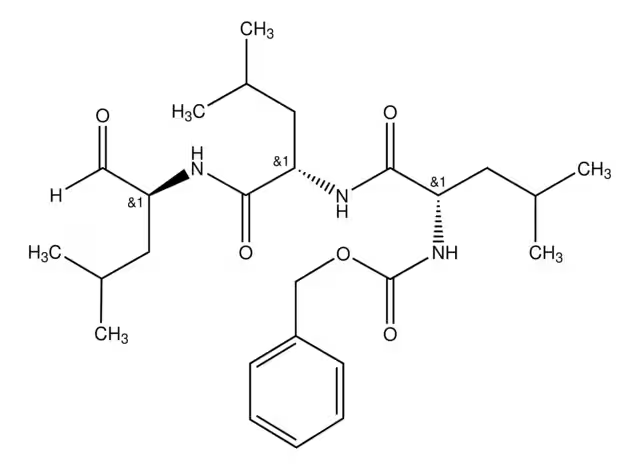
CAS Number133407-82-6
Synonymsbenzyloxycarbonyl-Leu-Leu-Leu-aldehyde; Z-LLL-CHO; MG132; zLLL; Z-Leu-Leu-Leu-CHO; Cbz-Leu-Leu-Leu-H; N-[(Benzyloxy)carbonyl]-L-leucyl-N-[(2S)-4-methyl-1-oxopentan-2-yl]-L-leucinamide; Z-Leu-Leu-Leu-H; benzyloxycarbonylleucyl-leucyl-leucine aldehyde; benzyloxycarbonyl-leucyl-leucyl-leucinal; Z-Leu-Leu-leucinal; N-benzyloxycarbonyl-L-leucyl-L-leucyl-L-leucinal; MFCD00674886; Carbobenzoxy-L-leucyl-L-leucyl-L-leucinal; Cbz-Leu-Leu-Leu-CHO; N-[(Benzyloxy)carbonyl]-L-leucyl-N-[(2S)-4-methyl-1-oxo-2-pentanyl]-L-leucinamide; MG-132
Molecular FormulaC26H41N3O5
Molecular Weight475.62
Purity≥98 (HPLC)%
Density1.1±0.1 g/cm3
Boiling Point682.0±55.0 °C at 760 mmHg
Melting Point80-84℃ (DEC.)
Appearancesolid
Symbol
Signal WordWarning
| Chemical & Physical Properties | |
|---|---|
| CAS Number | 133407-82-6 |
| Catalog No. | 2A-2198137 |
| Chinese Name | 蛋白酶体抑制剂 |
| Synonyms | benzyloxycarbonyl-Leu-Leu-Leu-aldehyde; Z-LLL-CHO; MG132; zLLL; Z-Leu-Leu-Leu-CHO; Cbz-Leu-Leu-Leu-H; N-[(Benzyloxy)carbonyl]-L-leucyl-N-[(2S)-4-methyl-1-oxopentan-2-yl]-L-leucinamide; Z-Leu-Leu-Leu-H; benzyloxycarbonylleucyl-leucyl-leucine aldehyde; benzyloxycarbonyl-leucyl-leucyl-leucinal; Z-Leu-Leu-leucinal; N-benzyloxycarbonyl-L-leucyl-L-leucyl-L-leucinal; MFCD00674886; Carbobenzoxy-L-leucyl-L-leucyl-L-leucinal; Cbz-Leu-Leu-Leu-CHO; N-[(Benzyloxy)carbonyl]-L-leucyl-N-[(2S)-4-methyl-1-oxo-2-pentanyl]-L-leucinamide; MG-132 |
| Molecular Formula | C26H41N3O5 |
| Molecular Weight | 475.62 |
| Purity | ≥98 (HPLC) |
| Density | 1.1±0.1 g/cm3 |
| Boiling Point | 682.0±55.0 °C at 760 mmHg |
| Melting Point | 80-84℃ (DEC.) |
| Appearance | solid |
| Water Solubility | methanol: 1 mg/mL | Soluble in ethanol, chloroform |
| Storage Condition | Seal and store at -20ºC |
| Application | MG-132 is a potent, reversible, cell-penetrating 20S proteasome inhibitor. It inhibits the proteasomal chymotrypsin-like peptidase activity with an IC50 value of 24.2 nM. |
| MDL Number | MFCD00674886 |
| SMILES | [H]C(=O)[C@H](CC(C)C)NC(=O)[C@H](CC(C)C)NC(=O)[C@H](CC(C)C)NC(=O)OCc1ccccc1 |
| InChI | 1S/C26H41N3O5/c1-17(2)12-21(15-30)27-24(31)22(13-18(3)4)28-25(32)23(14-19(5)6)29-26(33)34-16-20-10-8-7-9-11-20/h7-11,15,17-19,21-23H,12-14,16H2,1-6H3,(H,27,31)(H,28,32)(H,29,33)/t21-,22-,23-/m0/s1 |
| InChI Key | TZYWCYJVHRLUCT-VABKMULXSA-N |
| NACRES Code | NA.77 |
| UNSPSC | 12352200 |
| Hazard Symbols | transportation |
| MSDS | msds/200019_1_133407_82_6.pdf |
| Bioactivity | MG-132 is a potent, reversible, and cell-permeable 20S proteasome inhibitor which inhibits proteasomal chymotrypsin-like peptidase activity with an IC50 of 24.2 nM. Related Catalog Signaling Pathways >> Autophagy >> Autophagy Signaling Pathways >> Metabolic Enzyme/Protease >> Proteasome Research Areas >> Cancer Target IC50: 24.2 nM (chymotrypsin-like activity)[1] In Vitro Dose-dependent inhibition of cell growth is observed in HeLa cells with an IC50 of approximately 5 μM MG132 for 24 h. MG132 inhibits the growth of HeLa cells via inducing the cell cycle arrest as well as triggering apoptosis[2]. MG-132 inhibits C6 glioma cell proliferation in a time- and dose-dependent manner (the IC50 value at 24 h is 18.5 μM). MG-132 (18.5 μM) suppresses the proteasome activity by about 70% at 3 h. MG-132 induces apoptosis via down-regulation of antiapoptotic proteins Bcl-2 and XIAP, up-regulation of pro-apoptotic protein Bax and caspase-3, and production of cleaved C-terminal 85 kDa PARP. MG-132 also causes a more than 5-fold increase of reactive oxygen species[3]. The IC50 of MG-132 against HeLa, CaSki, and C33A cervical cancer cells viability after 48 h of incubation is 2.1, 3.2, and 5.2 μM, respectively[4]. In Vivo The in vivo antitumor activity of MG-132 against cervical cancer is examined using s.c. xenograft models. MG-132 is injected at 1 mg/kg using the following schedule: days 1, 4, 8, 12, 15 18, 23, and 26 for mice bearing HeLa tumors. The growth inhibition rates of MG132 compared to control is 49%[4]. MG-132 (i.p., 0.1 mg/kg/day) attenuates pressure-overload-induced cardiac hypertrophy and improves cardiac function in abdominal aortic banding (AAB) rats through regulation of ERK1/2 and JNK1 signaling pathways[5]. Kinase Assay After growing on six-well plates (3×10⁵ cells/well) for 24 h, C6 glioma cells are treated with either PBS (control) or 18.5 μM MG-132 for 3, 6, 12, or 24 h at 37°C. Cells are thoroughly scraped from the culture dishes with a cell scraper and washed with cold PBS. After centrifugation for 10 min at 800×g, the cell pellets are suspended in ice-cold buffer (50 mM Tris-HCl, pH 7.5, 20 μM ATP, 5 mM MgCl2, 1 mM dithiothreitol, and 20% glycerol) and homogenized with a Pyrex glass microhomogenizer (20 strokes). The homogenate is centrifuged at 15 000×g for 10 min at 4°C to obtain supernatant. Protein concentration is determined using protein assay kits. A total of 10 μL (1 μg/μL) of each freshly made supernatant is incubated in a 96-well plate at 37°C for 30 min with 10 μL of 300 μM of Succinyl-LLVY-AMC and 85 μL of assay buffer (20 mM Tris-HCl, pH 7.5, and 20% glycerol). Release of fluorescent AMC is measured with a spectrofluorometer at 440 nm with an excitation wavelength of 380 nm[3]. Cell Assay C6 glioma cells are seeded onto 96-well microplates (3×10⁴ cells/well) and cultured for 24 h. The cells are treated with PBS or MG-132 final concentrations of 10, 20, 30, and 40 μM, respectively. Cell viability is assessed using an MTT assay at 3, 6, 12, and 24 h after MG-132 treatment. The absorbance value at 570 nm is read using an automatic multi-well spectrophotometer. C6 glioma cells (3×10⁵ cells/well) are allowed to grow on coverslips in 6-well culture plates for 24 h. The cells are then treated with either PBS (control) or 18.5 μM MG-132 at 37°C for 24 h. Cells growing on glass coverslips are fixed in methanol for 5 min at room temperature. The fixed cells are washed twice with PBS and then incubated with Hoechst 33342 for 5 min at room temperature and observed under a fluorescence microscope. Fragmented or condensed nuclei are scored as apoptotic[3]. Animal Admin Mice[4] C.B-17/lcr-scid/scidJcl mice are inoculated s.c. with HeLa, CaSki, or C33A (1×10⁷ cells). Tumors are allowed to grow for 1 week. Mice are killed and tumors are removed. Tumors are then cut into 2-mm diameter pieces and s.c. transplanted in C.B-17/lcr-scid/scidJcl mice (n=6 per group). One week after inoculation, mice are treated with i.v. injection of saline (control), MG-132 (1 mg/kg/dose) twice a week for 4 weeks. The volume (V) of tumors is measured before every injection, as estimated using equation V=a×b2/2 where a and b are major and minor axes of the tumor measured by a caliper, respectively. Rats[5] Male Sprague-Dawley rats (8 weeks old, 180-230 g) are used to establish pressure-overload model. All animals are separated into four groups (10 rats per group): (i) vehicle-treated sham group; (ii) MG-132-treated sham group; (iii) vehicle-treated abdominal aortic banding (AAB) group; and (iv) MG-132-treated AAB group. Under intraperitoneal pentobarbital (50 mg/kg) anesthesia, AAB is created using a 5-0 suture tied twice around the abdominal aorta in which a 21-gauge needle is inserted. The needle is then retracted yielding a 70-80% constriction with an outer aortic diameter of ~0.8 mm. In the sham surgery rats, the same surgery is performed except the aorta is constricted. At Day 3 after the surgery, MG-132-treated rats are intraperitoneally injected with 0.1 mg/kg/day of MG-132 for 8 weeks. All control animals are injected with a corresponding volume of vehicle only (0.1% DMSO). References [1]. Braun HA, et al. Tripeptide mimetics inhibit the 20 S proteasome by covalent bonding to the active threonines. J Biol Chem. 2005 Aug 5;280(31):28394-401. [2]. Han YH, et al. The effect of MG132, a proteasome inhibitor on HeLa cells in relation to cell growth, reactive oxygen species and GSH. Oncol Rep. 2009 Jul;22(1):215-21. [3]. Fan WH, et al. Proteasome inhibitor MG-132 induces C6 glioma cell apoptosis via oxidative stress. Acta Pharmacol Sin. 2011 May;32(5):619-25. [4]. Matsumoto Y, et al. Enhanced efficacy against cervical carcinomas through polymeric micelles physically incorporating theproteasome inhibitor MG132. Cancer Sci. 2016 Jun;107(6):773-81. [5]. Chen B, et al. MG132, a proteasome inhibitor, attenuates pressure-overload-induced cardiac hypertrophy in rats by modulation of mitogen-activated protein kinase signals. Acta Biochim Biophys Sin (Shanghai). 2010 Apr;42(4):253-8. Chemical & Physical Properties Density 1.1±0.1 g/cm3 Boiling Point 682.0±55.0 °C at 760 mmHg Melting Point 80-84℃ (DEC.) Molecular Formula C26H41N3O5 Molecular Weight 475.621 Flash Point 366.3±31.5 °C Exact Mass 475.304626 PSA 113.60000 LogP 5.75 Vapour Pressure 0.0±2.1 mmHg at 25°C Index of Refraction 1.506 InChIKey TZYWCYJVHRLUCT-VABKMULXSA-N SMILES CC(C)CC(C=O)NC(=O)C(CC(C)C)NC(=O)C(CC(C)C)NC(=O)OCc1ccccc1 Storage condition −20°C Water Solubility methanol: 1 mg/mL | Soluble in ethanol, chloroform, methanol, water. |
| Use of | MG-132 is a potent, reversible, and cell-permeable 20S proteasome inhibitor which inhibits proteasomal chymotrypsin-like peptidase activity with an IC50 of 24.2 nM. Properties Articles738 Name N-benzyloxycarbonyl-L-leucyl-L-leucyl-L-leucinal Synonym More Synonyms MG-132 Biological Activity Description MG-132 is a potent, reversible, and cell-permeable 20S proteasome inhibitor which inhibits proteasomal chymotrypsin-like peptidase activity with an IC50 of 24.2 nM. Related Catalog Signaling Pathways >> Autophagy >> Autophagy Signaling Pathways >> Metabolic Enzyme/Protease >> Proteasome Research Areas >> Cancer IC50: 24.2 nM (chymotrypsin-like activity)[1] References [1]. Braun HA, et al. Tripeptide mimetics inhibit the 20 S proteasome by covalent bonding to the active threonines. J Biol Chem. 2005 Aug 5;280(31):28394-401. [2]. Han YH, et al. The effect of MG132, a proteasome inhibitor on HeLa cells in relation to cell growth, reactive oxygen species and GSH. Oncol Rep. 2009 Jul;22(1):215-21. [5]. Chen B, et al. MG132, a proteasome inhibitor, attenuates pressure-overload-induced cardiac hypertrophy in rats by modulation of mitogen-activated protein kinase signals. Acta Biochim Biophys Sin (Shanghai). 2010 Apr;42(4):253-8. Chemical & Physical Properties Molecular Formula C26H41N3O5 Exact Mass 475.304626 PSA 113.60000 Index of Refraction 1.506 InChIKey TZYWCYJVHRLUCT-VABKMULXSA-N |
| Transport Info | Shipping Name: UN |
| MSDS Transport Info | Module 14. Shipping information 14.1 UN dangerous goods number European Land Transport Dangerous Regulations: -International Maritime Dangerous Regulations: -International Air Transport Dangerous Regulations: - 14.2 United Nations shipping name European Land Transport Dangerous Regulations: Non-dangerous goods IMDG Code: Non-dangerous goods International air transport dangerous goods regulations: non-dangerous goods 14.3 Transport hazard categories European Land Transport Dangerous Regulations: -International Maritime Dangerous Regulations: -International Air Transport Dangerous Regulations: - 14.4 Package group European Land Transport Dangerous Regulations: -International Maritime Dangerous Regulations: -International Air Transport Dangerous Regulations: - 14.5 Environmental hazards European Land Transport Danger Regulations: No International Maritime Danger Regulations International Air Transport Danger Regulations: No Marine pollutants (yes/no): No 14.6 Special reminder to users No data available |
| Related Products in Specialty Chemicals | ||
|---|---|---|
| Cobalt sulfate | 10393-49-4 | 2A-2198131 |
| Cobalt oxide | 11104-61-3 | 2A-2198132 |
| MICROCYSTIN-LR | 101043-37-2 | 2A-2198133 |
| MES hydrate | 1266615-59-1 | 2A-2198135 |
| 1-Butyl-2,3,3-trimethyl-3H-indol-1-ium iodide | 20205-30-5 | 2A-1198136 |
| 3-BUTYL-1,1,2-TRIMETHYL-1H-BENZ[E]INDOLIUM IODIDE | 137107-72-3 | 2A-1198139 |
| N-Acetyl-3,5-difluorophenylalanine | 266360-52-5 | 2A-2198141 |
| 3,5-DIFLUOROBENZYLZINC BROMIDE | 308796-30-7 | 2A-2198144 |
| Benzamide, N-[4-[[(5R)-7-chloro-2,3,4,5-tetrahydro-5-hydroxy-1H-1-benzazepin-1-yl]carbonyl]phenyl]-2-methyl- | 2376909-00-9 | 2A-1198148 |
| METHYL 3-OXOTETRADECANOATE | 22348-97-6 | 2A-1198150 |
| Browse all Specialty Chemicals products » | ||
Phone:
630-322-8886
630-322-8887
Email:
Office Locations:
Chicago, IL, USA
San Francisco, CA, USA


 EN
EN


 SDS
SDS