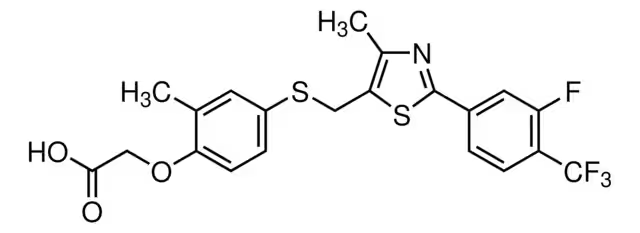
| Chemical & Physical Properties | |
|---|---|
| CAS Number | 317318-84-6 |
| Catalog No. | 2A-1197819 |
| Chinese Name | 2-(4-(((2-(3-氟-4-(三氟甲基)苯基)-4-甲基噻唑-5-基)甲基)硫代)-2-甲基苯氧基)乙酸 |
| Synonyms | gw 0742; GW0742 |
| Molecular Formula | C21H17F4NO3S2 |
| Molecular Weight | 471.49 |
| Purity | ≥98 (HPLC) |
| Density | 1.5±0.1 g/cm3 |
| Boiling Point | 591.5±60.0 °C at 760 mmHg |
| Melting Point | 134.5-135.5 °C |
| Appearance | powder |
| Water Solubility | DMSO: >5 mg/mL |
| Storage Condition | 2-8°C |
| Application | GW0742 is a potent PPARβ and PPARδ agonist with an IC50 of 1 nM for human PPARδ and EC50 of 1 nM, 1.1 μM and 2 μM for human PPARδ, PPARα and PPARγ, respectively. |
| PubChem ID | 24895123 |
| MDL Number | MFCD07369423 |
| SMILES | Cc1cc(SCc2sc(nc2C)-c3ccc(c(F)c3)C(F)(F)F)ccc1OCC(O)=O |
| InChI | 1S/C21H17F4NO3S2/c1-11-7-14(4-6-17(11)29-9-19(27)28)30-10-18-12(2)26-20(31-18)13-3-5-15(16(22)8-13)21(23,24)25/h3-8H,9-10H2,1-2H3,(H,27,28) |
| InChI Key | HWVNEWGKWRGSRK-UHFFFAOYSA-N |
| NACRES Code | NA.77 |
| UNSPSC | 12352200 |
| Hazard Symbols | transportation |
| MSDS | msds/199678_1_317318_84_6.pdf |
| Bioactivity | GW0742 is a high affinity PPAR β/δ agonist with an IC50 of 1 nM for human PPARδ, and EC50s of 1 nM, 1.1 μM and 2 μM for human PPARδ, PPARα, and PPARγ, respectively. Related Catalog Signaling Pathways >> Cell Cycle/DNA Damage >> PPAR Research Areas >> Inflammation/Immunology Research Areas >> Metabolic Disease Research Areas >> Cardiovascular Disease Target PPARδ:1 nM (EC50) PPARα:1.1 μM (EC50) PPARγ:2 μM (EC50) In Vitro GW0742 is a potent PPARβ and PPARδ agonist, with an IC50 of 1 nM for human PPARδ, and EC50s of 1 nM, 1.1 μM and 2 μM for human PPARδ, PPARα, and PPARγ respectively[1]. GW0742 (100 μM) activates human PPARα and mouse PPARβ in MCF-7 cells. GW0742 (100 μM) significantly reduces low-KCl-induced apoptosis of cerebellar granule neurons. GW0742 shows no obvious inherent toxicity on cerebellar granule neuronal cells after treatment of 3-100 μM for 24 h, but induces increased cell death at 100 μM after 48 hr of treatment. Moreover, GW0742 (100 μM) increases c-Jun expression in cerebellar granule neuron cultures observed at 6 hr[2]. GW0742 (1 μM) induces PPARδ protein in neonatal rat cardiomyocytes. GW0742 also raises mRNA levels of long-chain acyl-CoA dehydrogenase (LCAD), very long-chain acyl-CoA dehydrogenase (VLCAD), acyl-CoA oxidase 1 (ACOX1), uncoupling protein 3 (UCP3), malonyl-CoA decarboxylase (MCD), and pyruvate dehydrogenase kinase 4 (PDK4) in neonatal rat cardiomyocytes[4]. In Vivo GW0742 (0.3 mg/kg, i.p.) reduces intensity masson-trichrome staining, and attenuates the histological signs in bleomycin instillatio (BLEO)-induced lung injury of mice. GW0742 (0.3 mg/kg, i.p.) also causes a reduction of the BLEO-induced loss body weight, and a decrease of myeloperoxidase (MPO) activity. GW0742 shows significant inhibition of TNF-a and IL-1β in instilled-mice. GW0742 prevents bleomycin-induced IkB-a degradation, reduces the levels of NF-kB p65 in the lung, and decreases iNOS and p-ERK expression in BLEO-induced mice[3]. GW0742 (5 mg/kg/day, i.v.) increases PPARδ protein level in the heart of rats. GW0742 also induces the increase in LCAD, VLCAD, and ACOX1 in the heart of rats[4]. Cell Assay The PPARβ activator GW0742 and the RXR activator 9-cis-retinoic acid are dissolved in DMSO. The final DMSO concentration des not exceed 0.5% v/v, and this concentration is used in control wells. For each culture plate, one row of wells is treated with 500 μM glutamate. These wells serve as a positive control and for normalisation of data. Cell death (toxicity) is assessed by using an assay designed to measure lactate dehydrogenase (LDH) release[2]. Animal Admin Male CD mice (25-35 g) are housed in a controlled environment and provided with standard rodent chow and water. Mice are randomized into four experimental groups: bleomycin-treated group: mice are subjected to lung injury induced by intratracheal instillation of bleomycin and treated daily via intraperitoneal injection with vehicle of GW0742 (10% dimethylsulfoxide (OMSO, 1 mL/kg), 1 h after BLEO instillation (n = 15). GW0742 group: identical to bleomycin-treated group but mice are treated daily with GW0742 (0.3 mg/kg, 1h after BLEO instillation) via intraperitoneal injection (n = 15). Sham-operated mice + vehicle group: animals are subjected to the identical surgical procedure but receive intratracheal instillation of saline (0.9%) instead of BLEO and are treated daily with the vehicle of GW0742 (10% dimethylsulfoxide (DMSO), 1 mL/kg, i.p.), 1 h after saline instillation (n = 15). Sham-operated mice + GW0742 group: identical to sham + vehicle group but mice are treated daily with GW0742 (0.3 mg/kg, 1 h after saline instillation) via intraperitoneal injection (n = 15)[3]. References [1]. Sznaidman ML, et al. Novel selective small molecule agonists for peroxisome proliferator-activated receptor delta (PPARdelta)--synthesis and biological activity. Bioorg Med Chem Lett. 2003 May 5;13(9):1517-21. [2]. Smith SA, et al. Effect of the peroxisome proliferator-activated receptor beta activator GW0742 in rat cultured cerebellar granule neurons. J Neurosci Res. 2004 Jul 15;77(2):240-9. [3]. Galuppo M, et al. GW0742, a high affinity PPAR-β/δ agonist reduces lung inflammation induced by bleomycin instillation in mice. Int J Immunopathol Pharmacol. 2010 Oct-Dec;23(4):1033-46. [4]. Kuo SC, et al. Activation of receptors δ (PPARδ) by agonist (GW0742) may enhance lipid metabolism in heart both in vivo and in vitro. Horm Metab Res. 2013 Nov;45(12):880-6. Chemical & Physical Properties Density 1.5±0.1 g/cm3 Boiling Point 591.5±60.0 °C at 760 mmHg Melting Point 134.5-135.5 °C Molecular Formula C21H17F4NO3S2 Molecular Weight 471.488 Flash Point 311.5±32.9 °C Exact Mass 471.058594 PSA 112.96000 LogP 6.57 Appearance of Characters solid | white Vapour Pressure 0.0±1.7 mmHg at 25°C Index of Refraction 1.609 Storage condition 2-8°C Water Solubility DMSO: >5 mg/mL |
| Use of | GW0742 is a high affinity PPAR β/δ agonist with an IC50 of 1 nM for human PPARδ, and EC50s of 1 nM, 1.1 μM and 2 μM for human PPARδ, PPARα, and PPARγ, respectively. Properties Name 2-[4-[[2-[3-fluoro-4-(trifluoromethyl)phenyl]-4-methyl-1,3-thiazol-5-yl]methylsulfanyl]-2-methylphenoxy]acetic acid Synonym More Synonyms GW0742 Biological Activity Description GW0742 is a high affinity PPAR β/δ agonist with an IC50 of 1 nM for human PPARδ, and EC50s of 1 nM, 1.1 μM and 2 μM for human PPARδ, PPARα, and PPARγ, respectively. Related Catalog Signaling Pathways >> Cell Cycle/DNA Damage >> PPAR Research Areas >> Inflammation/Immunology Research Areas >> Metabolic Disease Research Areas >> Cardiovascular Disease PPARδ:1 nM (EC50) PPARα:1.1 μM (EC50) PPARγ:2 μM (EC50) Cell Assay The PPARβ activator GW0742 and the RXR activator 9-cis-retinoic acid are dissolved in DMSO. The final DMSO concentration des not exceed 0.5% v/v, and this concentration is used in control wells. For each culture plate, one row of wells is treated with 500 μM glutamate. These wells serve as a positive control and for normalisation of data. Cell death (toxicity) is assessed by using an assay designed to measure lactate dehydrogenase (LDH) release[2]. References [1]. Sznaidman ML, et al. Novel selective small molecule agonists for peroxisome proliferator-activated receptor delta (PPARdelta)--synthesis and biological activity. Bioorg Med Chem Lett. 2003 May 5;13(9):1517-21. [2]. Smith SA, et al. Effect of the peroxisome proliferator-activated receptor beta activator GW0742 in rat cultured cerebellar granule neurons. J Neurosci Res. 2004 Jul 15;77(2):240-9. [3]. Galuppo M, et al. GW0742, a high affinity PPAR-β/δ agonist reduces lung inflammation induced by bleomycin instillation in mice. Int J Immunopathol Pharmacol. 2010 Oct-Dec;23(4):1033-46. [4]. Kuo SC, et al. Activation of receptors δ (PPARδ) by agonist (GW0742) may enhance lipid metabolism in heart both in vivo and in vitro. Horm Metab Res. 2013 Nov;45(12):880-6. Chemical & Physical Properties Molecular Formula C21H17F4NO3S2 Exact Mass 471.058594 PSA 112.96000 Appearance of Characters solid | white Index of Refraction 1.609 |
| Transport Info | Product name: Purity: 98.0% |
| MSDS Transport Info | Module 14. Shipping information 14.1 UN dangerous goods number European Land Transport Dangerous Regulations: -International Maritime Dangerous Regulations: -International Air Transport Dangerous Regulations: - 14.2 Names specified by the United Nations (UN) European Land Transport Dangerous Regulations: Non-dangerous goods IMDG Code: Non-dangerous goods International air transport dangerous goods regulations: non-dangerous goods 14.3 Transport hazard categories European Land Transport Dangerous Regulations: -International Maritime Dangerous Regulations: -International Air Transport Dangerous Regulations: - 14.4 Package group European Land Transport Dangerous Regulations: -International Maritime Dangerous Regulations: -International Air Transport Dangerous Regulations: - 14.5 Environmental hazards European Land Transport Dangerous Regulations: No International Maritime Transport Dangerous Regulations Maritime Pollutants: No International Air Transport Risk Regulations: No 14.6 Special reminder to users No data available |
| Related Products in Specialty Chemicals | ||
|---|---|---|
| Di(Hydrogenated Tallowalkyl) Methylamines | 2A-2197814 | 2A-2197814 |
| Dihexadecyl dimethyl ammonium chloride | 2A-2197815 | 2A-2197815 |
| SR9011 | 1379686-29-9 | 2A-1197816 |
| Hydrogenated tallow dimethyllylammonium chloride | 2A-2197817 | 2A-2197817 |
| Hydrogenated tallowamine polyoxyethylene ether | 2A-2197818 | 2A-2197818 |
| Tallow amine polyoxyethylene ether | 2A-2197820 | 2A-2197820 |
| Dodecylamine polyoxyethylene ether | 2A-2197821 | 2A-2197821 |
| Cocoamine polyoxyethylene ether | 2A-2197822 | 2A-2197822 |
| R-PHYCOERYTHRIN | 11016-17-4 | 2A-1197823 |
| Oleamine polyoxyethylene ether | 2A-2197823 | 2A-2197823 |
| Browse all Specialty Chemicals products » | ||
Phone:
630-322-8886
630-322-8887
Email:
Office Locations:
Chicago, IL, USA
San Francisco, CA, USA


 EN
EN


 SDS
SDS