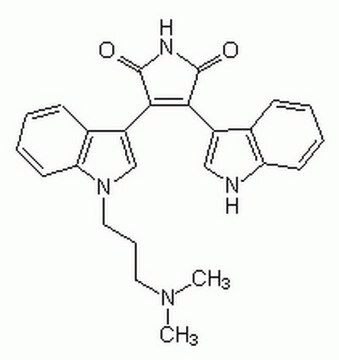
CAS Number133052-90-1
SynonymsMFCD00236428; bisindolylmaleimide i; 3-[1-[3-(dimethylamino)propyl]-1H-indol-3-yl]-4-(1H-indol-3-yl)-1H-pyrrolyl-2,5-dione; 3-{1-[3-(Dimethylamino)propyl]-1H-indol-3-yl}-4-(1H-indol-3-yl)-1H-pyrrole-2,5-dione; BIM-1; GF 109203X
Molecular FormulaC25H24N4O2
Molecular Weight412.48
Purity≥95 (HPLC)%
Density1.3±0.1 g/cm3
Boiling Point685.6±55.0 °C at 760 mmHg
Melting Point208-210ºC
Appearancesolid
Symbol
Signal WordWarning
| Chemical & Physical Properties | |
|---|---|
| CAS Number | 133052-90-1 |
| Catalog No. | 2A-2195386 |
| Chinese Name | Bisindolylmaleimide I |
| Synonyms | MFCD00236428; bisindolylmaleimide i; 3-[1-[3-(dimethylamino)propyl]-1H-indol-3-yl]-4-(1H-indol-3-yl)-1H-pyrrolyl-2,5-dione; 3-{1-[3-(Dimethylamino)propyl]-1H-indol-3-yl}-4-(1H-indol-3-yl)-1H-pyrrole-2,5-dione; BIM-1; GF 109203X |
| Molecular Formula | C25H24N4O2 |
| Molecular Weight | 412.48 |
| Purity | ≥95 (HPLC) |
| Density | 1.3±0.1 g/cm3 |
| Boiling Point | 685.6±55.0 °C at 760 mmHg |
| Melting Point | 208-210ºC |
| Appearance | solid |
| Water Solubility | DMSO: ~1 mg/mlsoluble | Insoluble in water. |
| Storage Condition | Sealed, store at 2 ºC -8 ºC |
| Application | Bisindolylmaleimide I (GF109203X) is a highly selective, cell-permeable and reversible PKC inhibitor with a Ki value of 14 nM. |
| PubChem ID | 13417 |
| MDL Number | MFCD00236428 |
| SMILES | N1C(=O)C(=C(C1=O)c4c5c([nH]c4)cccc5)c2c3c([n](c2)CCCN(C)C)cccc3 |
| InChI | 1S/C25H24N4O2/c1-28(2)12-7-13-29-15-19(17-9-4-6-11-21(17)29)23-22(24(30)27-25(23)31)18-14-26-20-10-5-3-8-16(18)20/h3-6,8-11,14-15,26H,7,12-13H2,1-2H3,(H,27,30,31) |
| InChI Key | QMGUOJYZJKLOLH-UHFFFAOYSA-N |
| NACRES Code | NA.77 |
| UNSPSC | 12352111 |
| Hazard Symbols | transportation |
| MSDS | msds/197083_1_133052_90_1.pdf |
| Bioactivity | Bisindolylmaleimide I (GF109203X) is a highly selective, cell-permeable, and reversible protein kinase C (PKC) inhibitor with a Ki of 14 nM. Related Catalog Signaling Pathways >> Epigenetics >> PKC Signaling Pathways >> TGF-beta/Smad >> PKC Research Areas >> Metabolic Disease Target Bovine brain PKC:10 nM (IC50) PKCβII:16 nM (IC50) PKCβI:17 nM (IC50) PKCα:20 nM (IC50) PKCγ:20 nM (IC50) FDGFR:65 μM (IC50) In Vitro Bisindolylmaleimide I is a competitive inhibitor with respect to ATP (Ki=14 nM) and displays high selectivity for PKC as compared to five different protein kinases. GF 109203X efficiently prevents PKC-mediated phosphorylations of an Mr=47,000 protein in platelets and of an Mr=80,000 protein in Swiss 3T3 cells. GF 109203X inhibits collagen- and a-thrombin-induced platelet aggregation as well as collagen-triggered ATP secretion. However, ADP-dependent reversible aggregation is not modified. In Swiss 3T3 fibroblasts, GF 109203X reverses the inhibition of epidermal growth factor binding induced by phorbol 12,13-dibutyrate and prevents [3H] thymidine incorporation into DNA, only when this is elicited by growth promoting agents which activate PKC[1]. In Vivo Pial arteriole diameter changes are monitored using a closed cranial window in vivo microscopy technique. The pial arteriole dilatory response associated with SNS is decreased by 45%, when comparing DM vs either ND or TR rats. Also, pial arteriolar dilations to topical KCl and NS1619 are largely attenuated in DM rats, but not in ND or TR animals. These responses are completely restored by the acute application of Bisindolylmaleimide I to the brain surface. The PKC inhibitor has no effect on vascular responses in normoglycemic and TR animals. In conclusion, DM-associated chronic impairment of neurovascular coupling may be readily reversed by a PKC-α/β/γ inhibitor or prevented via pancreatic islet transplantation. Specific PCK isoforms (α/β/γ) are believed to be mechanistically linked to the neurovascular uncoupling seen with hyperglycemia[2]. Kinase Assay Assay of PKC is arrayed by measuring 32Pi transferred from [γ-32Pi] ATP to lysine-rich histone type Ill-s. The reaction mixture (80 μL) contains 50 mM Tris-HCI, pH 7.4. 100 μM CaCl2, 10 mM MgCI2, 37.5 μg/mL histone type Ill-s, l0 μM [γ-32Pi] ATP (1250cpm/pmol), 31 μM bovine brain phosphatidylserine and 0.5 μM 1,2 sn-dioleylglycerol. 15 μL of purified PKC (final concentration in assay 0.38 μg/mL) is added to the incubation mixture. After 10 minutes, the reaction is stopped by addition of at 30 μL of casein 30 mg/mL and 0.9 mL of 12% trichlomacetic acid[1]. Animal Admin Three sets of Lewis rats is used for this study: 1) euglycemic 4-6 month old non-diabetic controls (ND group, n=11); 2) streptozotocin (STZ)-treated diabetic rats (6 month old, 4 months post-STZ) (DM group, n=6); and 3) STZ-treated diabetic animals, subjected to pancreatic islet transplantation soon after the establishment of the diabetic model, studied 100-110 days after the transplant (TR group, n=7)[2]. References [1]. Toullec D, et al. The bisindolylmaleimide GF 109203X is a potent and selective inhibitor of protein kinase C. J Biol Chem. 1991 Aug 25;266(24):15771-81. [2]. Vetri F, et al. Impairment of neurovascular coupling in Type 1 Diabetes Mellitus in rats is prevented by pancreatic islet transplantation and reversed by a semi-selective PKC inhibitor. Brain Res. 2017 Jan 15;1655:48-54. Chemical & Physical Properties Density 1.3±0.1 g/cm3 Boiling Point 685.6±55.0 °C at 760 mmHg Melting Point 208-210ºC Molecular Formula C25H24N4O2 Molecular Weight 412.484 Flash Point 368.5±31.5 °C Exact Mass 412.189911 PSA 70.13000 LogP 3.88 Vapour Pressure 0.0±2.1 mmHg at 25°C Index of Refraction 1.687 InChIKey QMGUOJYZJKLOLH-UHFFFAOYSA-N SMILES CN(C)CCCn1cc(C2=C(c3c[nH]c4ccccc34)C(=O)NC2=O)c2ccccc21 Storage condition 2-8°C Water Solubility DMSO: ~1 mg/mlsoluble | Insoluble in water. |
| Use of | Bisindolylmaleimide I (GF109203X) is a highly selective, cell-permeable, and reversible protein kinase C (PKC) inhibitor with a Ki of 14 nM. Properties Articles79 Name 3-[1-[3-(dimethylamino)propyl]indol-3-yl]-4-(1H-indol-3-yl)pyrrole-2,5-dione Synonym More Synonyms Bisindolylmaleimide I (GF109203X) Biological Activity Description Bisindolylmaleimide I (GF109203X) is a highly selective, cell-permeable, and reversible protein kinase C (PKC) inhibitor with a Ki of 14 nM. Related Catalog Signaling Pathways >> Epigenetics >> PKC Signaling Pathways >> TGF-beta/Smad >> PKC Research Areas >> Metabolic Disease Bovine brain PKC:10 nM (IC50) PKCβII:16 nM (IC50) PKCβI:17 nM (IC50) PKCα:20 nM (IC50) PKCγ:20 nM (IC50) FDGFR:65 μM (IC50) In Vivo Pial arteriole diameter changes are monitored using a closed cranial window in vivo microscopy technique. The pial arteriole dilatory response associated with SNS is decreased by 45%, when comparing DM vs either ND or TR rats. Also, pial arteriolar dilations to topical KCl and NS1619 are largely attenuated in DM rats, but not in ND or TR animals. These responses are completely restored by the acute application of Bisindolylmaleimide I to the brain surface. The PKC inhibitor has no effect on vascular responses in normoglycemic and TR animals. In conclusion, DM-associated chronic impairment of neurovascular coupling may be readily reversed by a PKC-α/β/γ inhibitor or prevented via pancreatic islet transplantation. Specific PCK isoforms (α/β/γ) are believed to be mechanistically linked to the neurovascular uncoupling seen with hyperglycemia[2]. References [1]. Toullec D, et al. The bisindolylmaleimide GF 109203X is a potent and selective inhibitor of protein kinase C. J Biol Chem. 1991 Aug 25;266(24):15771-81. [2]. Vetri F, et al. Impairment of neurovascular coupling in Type 1 Diabetes Mellitus in rats is prevented by pancreatic islet transplantation and reversed by a semi-selective PKC inhibitor. Brain Res. 2017 Jan 15;1655:48-54. Chemical & Physical Properties Molecular Formula C25H24N4O2 Exact Mass 412.189911 PSA 70.13000 Index of Refraction 1.687 InChIKey QMGUOJYZJKLOLH-UHFFFAOYSA-N |
| Transport Info | Shipping Name: UN |
| MSDS Transport Info | Module 14. Shipping information 14.1 UN dangerous goods number European Land Transport Dangerous Regulations: -International Maritime Dangerous Regulations: -International Air Transport Dangerous Regulations: - 14.2 United Nations shipping name European Land Transport Dangerous Regulations: Non-dangerous goods IMDG Code: Non-dangerous goods International air transport dangerous goods regulations: non-dangerous goods 14.3 Transport hazard categories European Land Transport Dangerous Regulations: -International Maritime Dangerous Regulations: -International Air Transport Dangerous Regulations: - 14.4 Package group European Land Transport Dangerous Regulations: -International Maritime Dangerous Regulations: -International Air Transport Dangerous Regulations: - 14.5 Environmental hazards European Land Transport Danger Regulations: No International Maritime Danger Regulations International Air Transport Danger Regulations: No Marine pollutants (yes/no): No 14.6 Special reminder to users No data available The above information is believed to be correct, but is not all-inclusive and should be used as a guide only. The information in this document is based on our current knowledge and is Correct safety instructions apply to this product. This information does not represent a warranty as to the properties of this product. See reverse side of invoice or packing slip. |
| Related Products in Specialty Chemicals | ||
|---|---|---|
| Benzoic acid, 3,5-dibromo-2-ethyl-6-iodo- | 2319580-35-1 | 2A-1195372 |
| 1-(prop-2-yn-1-yl)piperidin-3-amine | 1247503-99-6 | 2A-1195374 |
| PF-3758309 | 898044-15-0 | 2A-2195380 |
| GSK 2334470 | 1227911-45-6 | 2A-2195382 |
| FEXUPRAZAN / ABEPRAZAN | 1902954-60-2 | 2A-2195384 |
| LY-3009120 | 1454682-72-4 | 2A-2195387 |
| IWP L6 | 1427782-89-5 | 2A-2195388 |
| GZD824 | 1421783-64-3 | 2A-2195389 |
| PHA-848125 | 802539-81-7 | 2A-2195390 |
| SR2516 | 1061353-68-1 | 2A-2195392 |
| Browse all Specialty Chemicals products » | ||
Phone:
630-322-8886
630-322-8887
Email:
Office Locations:
Chicago, IL, USA
San Francisco, CA, USA


 EN
EN


 SDS
SDS