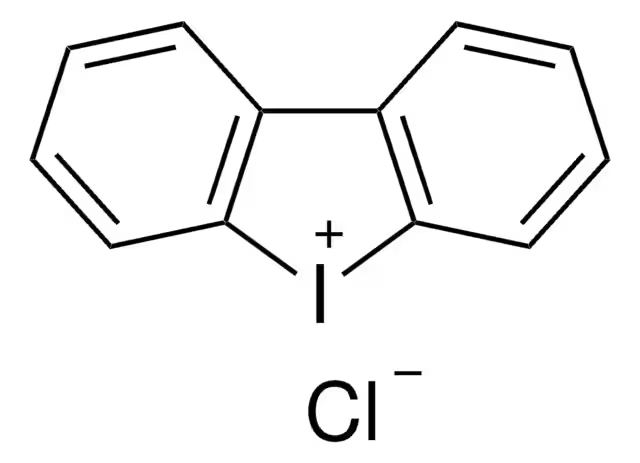
| Chemical & Physical Properties | |
|---|---|
| CAS Number | 4673-26-1 |
| Catalog No. | 2A-1191293 |
| Chinese Name | 氯化二亚苯基碘鎓 |
| Synonyms | Diphenyleneiodonium chloride; DPI Dibenziodolium chloride; MFCD00214165 |
| Molecular Formula | C12H8ClI |
| Molecular Weight | 314.55 |
| Melting Point | 312-322ºC |
| Appearance | Powder | Off-white |
| Storage Condition | -20℃ Avoid light, ventilated and dry place, sealed |
| Application | Diphenyleneiodonium chloride is an NADPH oxidase (NOX) inhibitor and a TRPA1 activator with EC50 values between 1 and 3 μM. |
| HTC | 2903999090 |
| SMILES | [Cl-].c1ccc2c(c1)[I+]c1ccccc1-2 |
| InChI Key | FCFZKAVCDNTYID-UHFFFAOYSA-M |
| Hazard Symbols | transportation |
| Bioactivity | Diphenyleneiodonium chloride is a NADPH oxidase (NOX) inhibitor and also functions as a TRPA1 activator with an EC50 of 1 to 3 μM. Related Catalog Signaling Pathways >> Membrane Transporter/Ion Channel >> TRP Channel Research Areas >> Inflammation/Immunology Research Areas >> Neurological Disease Target NOX[1] EC50: 1 to 3 μM (TRPA1)[1] In Vitro Diphenyleneiodonium chloride is a NADPH oxidase (NOX) inhibitor and also functions as a TRPA1 activator with an EC50 of 1 to 3 μM. Application of Diphenyleneiodonium chloride to HEK-TRPA1 cells at a concentration ranges of 0.03 to 10 μM effectively induces a Ca2+ response. However, Diphenyleneiodonium chloride fails to evoke a Ca2+ response in control HEK cells, even at a relatively high dose of 10 μM[1]. When Diphenyleneiodonium chloride is included in the co-cultures, lipopolysaccharide (LPS)-induced preOL apoptosis is significantly inhibited. Treatment with Diphenyleneiodonium chloride is found to significantly attenuate the LPS-induced O2- production by 2.0-fold, reducing it to within 27% of the controls[2]. In Vivo Intraplantar injection of 2 mM Diphenyleneiodonium chloride to the hindpaw causes licking or biting behavior[1]. Diphenyleneiodonium chloride treatment immediately or 24 h after lipopolysaccharide (LPS) injection significantly attenuates the LPS-induced loss of O4 positive cells. Treatment with Diphenyleneiodonium chloride either immediately or 24 h after LPS injection significantly ameliorates the LPS-induced disorganization of the white matter nerve fibers. However, treatment with DPI 48 h after LPS injection does not appear to correct the LPS-induced white matter damage. DPI treatment either immediately or 24 h after LPS injection significantly reduces the accumulation of both gp91phox and p67phox in the membrane fraction[2]. Cell Assay Purified microglia and preOLs are co-cultured using a Transwell culture system. Co-cultured cells are divided into three groups: control, lipopolysaccharide (LPS)-activated, and LPS plus Diphenyleneiodonium chloride. Microglia are cultured in Transwells over established preOL layers and exposed to either LPS (100 ng/mL), LPS+Diphenyleneiodonium chloride (10 μM) or untreated. The medium supernatants and cellular protein fractions from the co-cultures are then collected for further analysis after 48 h incubation[2]. Animal Admin The ddy mice (6 to 7 wk of age) are individually placed in transparent cages for 30 min before experiments. An intraplantar injection of 10 μL Diphenyleneiodonium chloride (2 mM, solvent: Kolliphor EL with 20% DMSO) is then injected into the right hindpaw with or without intraperitoneal administration with HC030031 (300 mg/kg at 0.5 h prior to injection of Diphenyleneiodonium chloride; solvent: saline with 0.5% methyl cellulose). The time spent licking or biting the injected paw is recorded for 45 min after injection[1]. References [1]. Suzuki H, et al. The NADPH oxidase inhibitor diphenyleneiodonium activates the human TRPA1 nociceptor. Am J Physiol Cell Physiol. 2014 Aug 15;307(4):C384-94. [2]. He YF, et al. Diphenyleneiodonium protects preoligodendrocytes against endotoxin-activated microglial NADPH oxidase-generated peroxynitrite in a neonatal rat model of periventricular leukomalacia. Brain Res. 2013 Jan 25;1492:108-21. Chemical & Physical Properties Melting Point 312-322ºC Molecular Formula C12H8ClI Molecular Weight 314.54900 Exact Mass 313.93600 Appearance of Characters Powder | Off-white InChIKey FCFZKAVCDNTYID-UHFFFAOYSA-M SMILES [Cl-].c1ccc2c(c1)[I+]c1ccccc1-2 Storage condition -20°C |
| Use of | Diphenyleneiodonium chloride is a NADPH oxidase (NOX) inhibitor and also functions as a TRPA1 activator with an EC50 of 1 to 3 μM. Properties Articles174 Name dibenziodolium chloride Synonym More Synonyms Diphenyleneiodonium chloride Biological Activity Description Diphenyleneiodonium chloride is a NADPH oxidase (NOX) inhibitor and also functions as a TRPA1 activator with an EC50 of 1 to 3 μM. Related Catalog Signaling Pathways >> Membrane Transporter/Ion Channel >> TRP Channel Research Areas >> Inflammation/Immunology Research Areas >> Neurological Disease NOX[1] EC50: 1 to 3 μM (TRPA1)[1] Cell Assay Purified microglia and preOLs are co-cultured using a Transwell culture system. Co-cultured cells are divided into three groups: control, lipopolysaccharide (LPS)-activated, and LPS plus Diphenyleneiodonium chloride. Microglia are cultured in Transwells over established preOL layers and exposed to either LPS (100 ng/mL), LPS+Diphenyleneiodonium chloride (10 μM) or untreated. The medium supernatants and cellular protein fractions from the co-cultures are then collected for further analysis after 48 h incubation[2]. References [1]. Suzuki H, et al. The NADPH oxidase inhibitor diphenyleneiodonium activates the human TRPA1 nociceptor. Am J Physiol Cell Physiol. 2014 Aug 15;307(4):C384-94. [2]. He YF, et al. Diphenyleneiodonium protects preoligodendrocytes against endotoxin-activated microglial NADPH oxidase-generated peroxynitrite in a neonatal rat model of periventricular leukomalacia. Brain Res. 2013 Jan 25;1492:108-21. Chemical & Physical Properties Exact Mass 313.93600 Appearance of Characters Powder | Off-white InChIKey FCFZKAVCDNTYID-UHFFFAOYSA-M |
| Tax Rebate | 9.0% |
| Supervision | None MFN tariff: 5.5% Ordinary tariff: 30.0% |
| Transport Info | Product name: Purity: 97.0% |
| MSDS Transport Info | Module 14. Shipping information 14.1 UN dangerous goods number European Land Transport Dangerous Regulations: -International Maritime Dangerous Regulations: -International Air Transport Dangerous Regulations: - 14.2 Names specified by the United Nations (UN) European Land Transport Dangerous Regulations: Non-dangerous goods IMDG Code: Non-dangerous goods International air transport dangerous goods regulations: non-dangerous goods 14.3 Transport hazard categories European Land Transport Dangerous Regulations: -International Maritime Dangerous Regulations: -International Air Transport Dangerous Regulations: - 14.4 Package group European Land Transport Dangerous Regulations: -International Maritime Dangerous Regulations: -International Air Transport Dangerous Regulations: - 14.5 Environmental hazards European Land Transport Dangerous Regulations: No International Maritime Transport Dangerous Regulations Maritime Pollutants: No International Air Transport Risk Regulations: No 14.6 Special reminder to users No data available See reverse side of invoice or packing slip. |
| Related Products in Specialty Chemicals | ||
|---|---|---|
| 4-Fluoro-3-nitrobenzoic acid benzyl ester | 291528-32-0 | 2A-1191288 |
| 2-Bromo-3-iodoanisole | 74128-84-0 | 2A-1191289 |
| FLUOROIMIDE | 41205-21-4 | 2A-1191290 |
| diphenyliodonium bromide | 29490-55-9 | 2A-1191291 |
| diphenyleneiodonium trifluoromethanesulfonate | 189999-35-7 | 2A-1191292 |
| 1-bromocyclopentyl-o-chlorophenyl ketone | 6740-86-9 | 2A-1191277 |
| N-CARBOBENZYLOXY-L-PROLINE METHYL ESTER | 5211-23-4 | 2A-1191296 |
| H-DL-GLU(OME)-OH | 14487-45-7 | 2A-1191297 |
| methyl N6-[(1,1-dimethylethoxy)carbonyl]-N2-[(phenylmethoxy)carbonyl]-L-lysinate | 2389-49-3 | 2A-1191300 |
| N - (tert - butoxycarbonyl) - ± - Methylalanine Methyl ester | 84758-55-4 | 2A-1191301 |
| Browse all Specialty Chemicals products » | ||
Phone:
630-322-8886
630-322-8887
Email:
Office Locations:
Chicago, IL, USA
San Francisco, CA, USA


 EN
EN


 SDS
SDS