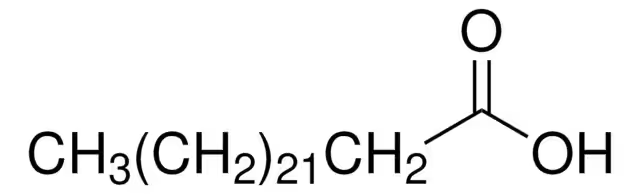
CAS Number557-59-5
SynonymsLignoceric acid; Tetracosanoic acid; EINECS 209-180-7; MFCD00002810; n-tetracosanoic acid
Molecular FormulaCH3(CH2)22COOH
Molecular Weight368.64
Density0.9±0.1 g/cm3
Boiling Point405.9±8.0 °C at 760 mmHg
Melting Point80-82 °C
AppearanceSolid;White to Light yellow powder to crystal
Symbol
Signal WordWarning
| Chemical & Physical Properties | |
|---|---|
| CAS Number | 557-59-5 |
| Catalog No. | 2A-1190876 |
| Chinese Name | 二十四烷酸 |
| Synonyms | Lignoceric acid; Tetracosanoic acid; EINECS 209-180-7; MFCD00002810; n-tetracosanoic acid |
| Molecular Formula | CH3(CH2)22COOH |
| Molecular Weight | 368.64 |
| Density | 0.9±0.1 g/cm3 |
| Boiling Point | 405.9±8.0 °C at 760 mmHg |
| Melting Point | 80-82 °C |
| Appearance | Solid;White to Light yellow powder to crystal |
| Water Solubility | Water solubility: Practically insoluble; Soluble i |
| Storage Condition | 2. Storage Keep sealed. |
| Application | Lignocellulosic acid is a 24-carbon saturated (24:0) fatty acid synthesized in the developing brain. Lignocellulosic acid is also a by-product of lignin production. Lignocellulosic acid can be used in |
| PubChem ID | 10518 |
| SMILES | CCCCCCCCCCCCCCCCCCCCCCCC(=O)O |
| InChI | InChI=1S/C24H48O2/c1-2-3-4-5-6-7-8-9-10-11-12-13-14-15-16-17-18-19-20-21-22-23-24(25)26/h2-23H2,1H3,(H,25,26) |
| InChI Key | QZZGJDVWLFXDLK-UHFFFAOYSA-N |
| Hazard Symbols | transportation |
| Bioactivity | Lignoceric acid (Tetracosanoic acid) is a 24-carbon saturated (24:0) fatty acid, which is synthesized in the developing brain. Lignoceric acid is also a by-product of lignin production. Lignoceric acid can be used for Zellweger cerebro‐hepato‐renal syndrome and adrenoleukodystrophy research[1][2]. Related Catalog Research Areas >> Neurological Disease Target Human Endogenous Metabolite In Vitro Heat flux induced by lignoceric acid in HepG2 peroxisomes was exothermic, indicating normal peroxisomal metabolism[1]. References [1]. Anna Petroni, et al. Thermogenic flux induced by lignoceric acid in peroxisomes isolated from HepG2 cells and from X-adrenoleukodystrophy and control fibroblasts. J Cell Physiol. 2019 Aug;234(10):18344-18348. [2]. J M Bourre, et al. Lignoceric acid biosynthesis in the developing brain. Activities of mitochondrial acetyl-CoA-dependent synthesis and microsomal malonyl-CoA chain-elongating system in relation to myelination. Comparison between normal mouse and dysmyelinating mutants (quaking and jimpy). Eur J Biochem. 1977 Jan 3;72(1):41-7. Chemical & Physical Properties Density 0.9±0.1 g/cm3 Boiling Point 405.9±8.0 °C at 760 mmHg Melting Point 80-82 °C Molecular Formula C24H48O2 Molecular Weight 368.637 Flash Point 182.2±13.3 °C Exact Mass 368.365417 PSA 37.30000 LogP 11.40 Vapour Pressure 0.0±1.0 mmHg at 25°C Index of Refraction 1.460 InChIKey QZZGJDVWLFXDLK-UHFFFAOYSA-N SMILES CCCCCCCCCCCCCCCCCCCCCCCC(=O)O Storage condition 2-8°C |
| Use of | Lignoceric acid (Tetracosanoic acid) is a 24-carbon saturated (24:0) fatty acid, which is synthesized in the developing brain. Lignoceric acid is also a by-product of lignin production. Lignoceric acid can be used for Zellweger cerebro‐hepato‐renal syndrome and adrenoleukodystrophy research[1][2]. Properties Articles45 Name lignoceric acid Synonym More Synonyms Lignoceric acid Biological Activity Description Lignoceric acid (Tetracosanoic acid) is a 24-carbon saturated (24:0) fatty acid, which is synthesized in the developing brain. Lignoceric acid is also a by-product of lignin production. Lignoceric acid can be used for Zellweger cerebro‐hepato‐renal syndrome and adrenoleukodystrophy research[1][2]. Related Catalog Research Areas >> Neurological Disease Human Endogenous Metabolite In Vitro Heat flux induced by lignoceric acid in HepG2 peroxisomes was exothermic, indicating normal peroxisomal metabolism[1]. References [2]. J M Bourre, et al. Lignoceric acid biosynthesis in the developing brain. Activities of mitochondrial acetyl-CoA-dependent synthesis and microsomal malonyl-CoA chain-elongating system in relation to myelination. Comparison between normal mouse and dysmyelinating mutants (quaking and jimpy). Eur J Biochem. 1977 Jan 3;72(1):41-7. Chemical & Physical Properties Molecular Formula C24H48O2 Exact Mass 368.365417 PSA 37.30000 LogP 11.40 Index of Refraction 1.460 InChIKey QZZGJDVWLFXDLK-UHFFFAOYSA-N SMILES CCCCCCCCCCCCCCCCCCCCCCCC(=O)O |
| Transport Info | Product name: Purity: 98.0% |
| MSDS Transport Info | Module 14. Shipping information 14.1 UN dangerous goods number European Land Transport Dangerous Regulations: -International Maritime Dangerous Regulations: -International Air Transport Dangerous Regulations: - 14.2 Names specified by the United Nations (UN) European Land Transport Dangerous Regulations: Non-dangerous goods IMDG Code: Non-dangerous goods International air transport dangerous goods regulations: non-dangerous goods 14.3 Transport hazard categories European Land Transport Dangerous Regulations: -International Maritime Dangerous Regulations: -International Air Transport Dangerous Regulations: - 14.4 Package group European Land Transport Dangerous Regulations: -International Maritime Dangerous Regulations: -International Air Transport Dangerous Regulations: - 14.5 Environmental hazards European Land Transport Dangerous Regulations: No International Maritime Transport Dangerous Regulations Maritime Pollutants: No International Air Transport Risk Regulations: No 14.6 Special reminder to users No data available |
| Related Products in Specialty Chemicals | ||
|---|---|---|
| 1,2-DITRIDECANOYL-SN-GLYCERO-3-PHOSPHOCHOLINE | 71242-28-9 | 2A-1190869 |
| 1,2-DIUNDECANOYL-SN-GLYCERO-3-PHOSPHOCHOLINE | 27869-47-2 | 2A-1190870 |
| 1,2-DISTEAROYL-SN-GLYCERO-3-PHOSPHATIDYL-RAC-GLYCEROL, NA SALT | 124011-52-5 | 2A-1190872 |
| N-(1-(2,3-dioleyloxy)propyl)-N,N,N-trimethylammonium | 104162-48-3 | 2A-1190873 |
| MONOPALMITIN | 542-44-9 | 2A-1190874 |
| 1-OCTADECANOYL-2-[(CIS,CIS,CIS,CIS)-5,8,11,14-EICOSATETRAENOYL]-SN-GLYCERO-3-PHOSPHOCHOLINE | 35418-59-8 | 2A-1190877 |
| 1,2-DIHEXANOYL-SN-GLYCERO-3-PHOSPHOCHOLINE | 34506-67-7 | 2A-1190878 |
| 1,2-DIPALMITOYL-RAC-GLYCEROL | 40290-32-2 | 2A-1190879 |
| ACETYLACETICACID,SODIUMSALT | 623-58-5 | 2A-1190880 |
| OCTENYLSUCCINIC ANHYDRIDE | 7757-96-2 | 2A-1190881 |
| Browse all Specialty Chemicals products » | ||
Phone:
630-322-8886
630-322-8887
Email:
Office Locations:
Chicago, IL, USA
San Francisco, CA, USA


 EN
EN


 SDS
SDS