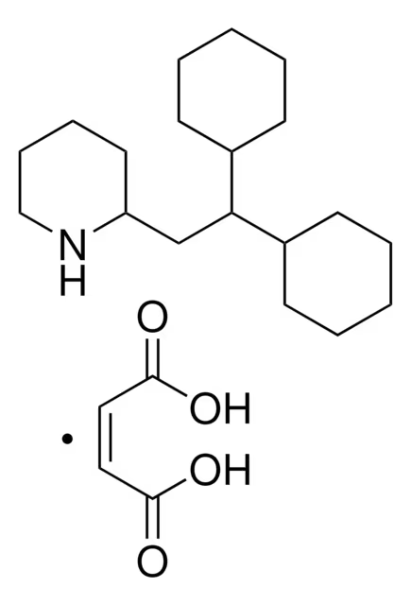
CAS Number6724-53-4
Synonymsperhexilline maleate; Perhexiline maleate (USAN); EINECS 229-775-5; Pexid; 2-(2,2-Dicyclohexylethyl)piperidine maleate; DSSTox_CID_1114; perhexilene maleate; Perhexiline maleate
Molecular FormulaC23H39NO4
Molecular Weight393.56
Boiling Point574.1ºC at 760 mmHg
Melting Point181-183ºC
Appearancewhite to tan
EINECS229-775-5
Symbol
Signal WordWarning
| Chemical & Physical Properties | |
|---|---|
| CAS Number | 6724-53-4 |
| Catalog No. | 2A-1190117 |
| Chinese Name | 马来酸哌克昔林 |
| Synonyms | perhexilline maleate; Perhexiline maleate (USAN); EINECS 229-775-5; Pexid; 2-(2,2-Dicyclohexylethyl)piperidine maleate; DSSTox_CID_1114; perhexilene maleate; Perhexiline maleate |
| Molecular Formula | C23H39NO4 |
| Molecular Weight | 393.56 |
| Boiling Point | 574.1ºC at 760 mmHg |
| Melting Point | 181-183ºC |
| Appearance | white to tan |
| Water Solubility | DMSO: ≥5mg/mL |
| Storage Condition | -20?C Freezer, Under Inert Atmosphere |
| Application | Perhexiline maleate is a potent inhibitor of carnitine palmitoyltransferase 1, with IC50 values of 77 and 148 μM for rat heart and liver CPT 1, respectively. |
| EINECS | 229-775-5 |
| HTC | 2933399090 |
| PubChem ID | 329825171 |
| MDL Number | MFCD00057329 |
| SMILES | C1CCC(C(CC2CCCCN2)C2CCCCC2)CC1.O=C(O)C=CC(=O)O |
| InChI | InChI=1S/C19H35N.C4H4O4/c1-3-9-16(10-4-1)19(17-11-5-2-6-12-17)15-18-13-7-8-14-20-18;5-3(6)1-2-4(7)8/h16-20H,1-15H2;1-2H,(H,5,6)(H,7,8)/b;2-1- |
| InChI Key | JDZOTSLZMQDFLG-BTJKTKAUSA-N |
| NACRES Code | NA.25 |
| UNSPSC | 12352200 |
| Hazard Symbols | transportation |
| Bioactivity | Perhexiline maleate is a potent carnitine palmitoyltransferase 1 (CPT 1) inhibitor with IC50s of 77 and 148 μM for rat heart and liver CPT 1, respectively. Related Catalog Signaling Pathways >> Others >> Others Research Areas >> Cancer Research Areas >> Cardiovascular Disease Target IC50: 77 μM (Rat heart CPT 1), 148 μM (Rat liver CPT 1)[1] In Vitro At 24, 48 and 72 h of treatment with 0.01 and 1 μM of Perhexiline , NDM29 ncRNA expression level in SH-SY5Y cells is progressively increased, reaching a peak after 48 hours of treatment. Perhexiline treatment increases the susceptibility of NB cells to antiblastic treatments. Co-administration of Perhexiline maleate potentiates the efficacy of cisplatin to reduce the in vitro clonogenic potential of NB cells[2]. In Vivo The co-administration of Perhexiline and cisplatin yields a clear enhancement of antitumor effects, resulting in a significantly improved progression-free survival as compared with mice treated with DMSO. Perhexiline favors NB cell transition to differentiated phenotype[2]. Cell Assay The effect of antitumoral drugs on neuroblastoma cell survival is evaluated using the MTT assay. Approximately 24 hours after plating, cells are exposed to Perhexiline maleate (0.01 μM) for 48 hours at 37°C. Cytotoxicity is expressed as the percentage of cells surviving in relation to untreated cells[2]. Animal Admin Mice: In protocol a, 21 mice are divided in 4 groups: control vehicle group: DMSO; cisplatin (3 mg/kg/dose) treated group; Perhexiline (1 mg/kg/dose) treated group and; Perhexiline (1 mg/kg/dose) and cisplatin (3 mg/kg/dose) treated group. In protocol b, 20 mice are divided in 4 groups: control vehicle group: DMSO; Perhexiline (3 mg/kg/dose) treated group; cisplatin (5 mg/kg/dose) treated group; Perhexiline (3 mg/kg/dose) and cisplatin (5 mg/kg/dose) treated group[2]. References [1]. Kennedy JA, et al. Inhibition of carnitine palmitoyltransferase-1 in rat heart and liver by Perhexiline and amiodarone. Biochem Pharmacol. 1996 Jul 26;52(2):273-80. [2]. Vella S, et al. Perhexiline maleate enhances antitumor efficacy of cisplatin in neuroblastoma by inducing over-expression of NDM29 ncRNA. Sci Rep. 2015 Dec 17;5:18144. Chemical & Physical Properties Boiling Point 574.1ºC at 760 mmHg Melting Point 181-183ºC Molecular Formula C23H39NO4 Molecular Weight 393.56000 Flash Point 301ºC Exact Mass 393.28800 PSA 86.63000 LogP 5.33600 Appearance of Characters white to tan InChIKey JDZOTSLZMQDFLG-BTJKTKAUSA-N SMILES C1CCC(C(CC2CCCCN2)C2CCCCC2)CC1.O=C(O)C=CC(=O)O Storage condition -20?C Freezer, Under Inert Atmosphere Water Solubility DMSO: ≥5mg/mL |
| Use of | Perhexiline maleate is a potent carnitine palmitoyltransferase 1 (CPT 1) inhibitor with IC50s of 77 and 148 μM for rat heart and liver CPT 1, respectively. Properties Articles25 Name (Z)-but-2-enedioic acid,2-(2,2-dicyclohexylethyl)piperidine Synonym More Synonyms Perhexiline maleate Biological Activity Description Perhexiline maleate is a potent carnitine palmitoyltransferase 1 (CPT 1) inhibitor with IC50s of 77 and 148 μM for rat heart and liver CPT 1, respectively. Related Catalog Signaling Pathways >> Others >> Others Research Areas >> Cancer Research Areas >> Cardiovascular Disease IC50: 77 μM (Rat heart CPT 1), 148 μM (Rat liver CPT 1)[1] In Vitro At 24, 48 and 72 h of treatment with 0.01 and 1 μM of Perhexiline , NDM29 ncRNA expression level in SH-SY5Y cells is progressively increased, reaching a peak after 48 hours of treatment. Perhexiline treatment increases the susceptibility of NB cells to antiblastic treatments. Co-administration of Perhexiline maleate potentiates the efficacy of cisplatin to reduce the in vitro clonogenic potential of NB cells[2]. In Vivo The co-administration of Perhexiline and cisplatin yields a clear enhancement of antitumor effects, resulting in a significantly improved progression-free survival as compared with mice treated with DMSO. Perhexiline favors NB cell transition to differentiated phenotype[2]. References [1]. Kennedy JA, et al. Inhibition of carnitine palmitoyltransferase-1 in rat heart and liver by Perhexiline and amiodarone. Biochem Pharmacol. 1996 Jul 26;52(2):273-80. [2]. Vella S, et al. Perhexiline maleate enhances antitumor efficacy of cisplatin in neuroblastoma by inducing over-expression of NDM29 ncRNA. Sci Rep. 2015 Dec 17;5:18144. Chemical & Physical Properties Molecular Formula C23H39NO4 Exact Mass 393.28800 PSA 86.63000 LogP 5.33600 Appearance of Characters white to tan InChIKey JDZOTSLZMQDFLG-BTJKTKAUSA-N Storage condition -20?C Freezer, Under Inert Atmosphere |
| Tax Rebate | 13.0% |
| Supervision | None. MFN tariff: 6.5%. Ordinary tariff: 20.0% |
| Transport Info | Product name: Purity: 98.0% |
| MSDS Transport Info | Module 14. Shipping information 14.1 UN dangerous goods number European Land Transport Dangerous Regulations: -International Maritime Dangerous Regulations: -International Air Transport Dangerous Regulations: - 14.2 Names specified by the United Nations (UN) European Land Transport Dangerous Regulations: Non-dangerous goods IMDG Code: Non-dangerous goods International air transport dangerous goods regulations: non-dangerous goods 14.3 Transport hazard categories European Land Transport Dangerous Regulations: -International Maritime Dangerous Regulations: -International Air Transport Dangerous Regulations: - 14.4 Package group European Land Transport Dangerous Regulations: -International Maritime Dangerous Regulations: -International Air Transport Dangerous Regulations: - 14.5 Environmental hazards European Land Transport Dangerous Regulations: No International Maritime Transport Dangerous Regulations Maritime Pollutants: No International Air Transport Risk Regulations: No 14.6 Special reminder to users No data available |
| Related Products in Specialty Chemicals | ||
|---|---|---|
| ACETIC ANHYDRIDE-D6 | 16649-49-3 | 2A-1190107 |
| 1,4-DIBROMOBENZENE-D4 | 4165-56-4 | 2A-1190113 |
| Nickel(II) hexadecafluoroophthalocyanine | 128653-34-9 | 2A-1190114 |
| 2,9-Diphenyl-1,10-phenanthroline | 25677-69-4 | 2A-1190115 |
| 4,7-DIHYDROXY-1,10-PHENANTHROLINE HYDROCHLORIDE | 61626-11-7 | 2A-1190116 |
| 1,3-Benzenedicarbonitrile, 2,4,5,6-tetrakis(diphenylamino)- | 1846598-27-3 | 2A-1190118 |
| DecarboxaMide MeprobaMate | 1471-56-3 | 2A-1190119 |
| 5,6-Dibromo-1,10-phenanthroline | 56290-06-3 | 2A-1190120 |
| Nickel(II) hexadecachlorophthalocyanine | 31270-08-3 | 2A-2190122 |
| 3,4,5,6-tetrakis(3,6-di-t-Butylcarbazol-9-yl)- 1,2-dicyanobenzene | 1469705-93-8 | 2A-1190123 |
| Browse all Specialty Chemicals products » | ||
Phone:
630-322-8886
630-322-8887
Email:
Office Locations:
Chicago, IL, USA
San Francisco, CA, USA


 EN
EN


 SDS
SDS