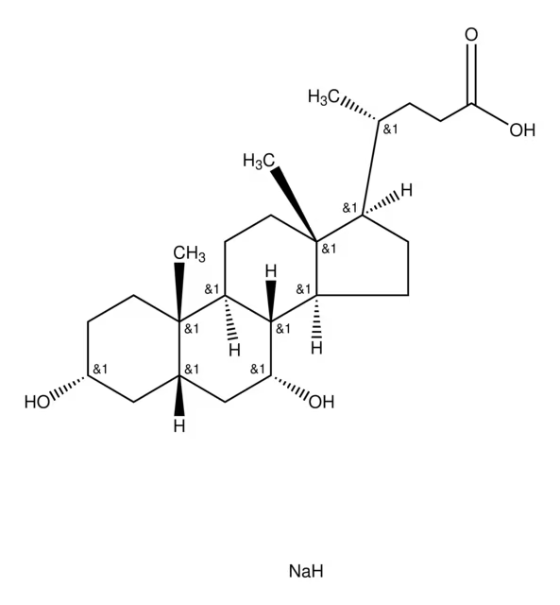
CAS Number2646-38-0
Synonymssodium sat of chenodeoxycholic acid; Chenodeoxycholate sodium salt; Chenodeoxycholic acid sodium; Chenodeoxycholic acid sodium salt; UNII:6V4571KSKE; sodium chenodexoycholate; 5β-Cholanic acid-3α,7α-diol; sodium chenodeoxycholate; sodiumchenodesoxycholate; 3α,7α-Dihydroxy-5β-cholanic acid; Chenodeoxycholic acid sodium salt,Chenodesoxycholic acid; ChenodiolChenodesoxycholic acid; chenodesoxycholate de sodium; Sodium (3α,5β,7α)-3,7-dihydroxycholan-24-oate; cenodeoxycholate; Cholan-24-oic acid, 3,7-dihydroxy-, sodium salt, (3α,5β,7α)- (1:1)
Molecular FormulaC24H39NaO4
Molecular Weight414.55
Boiling Point547.1ºC at 760mmHg
Melting Point298 °C(dec.)
AppearanceSolid;White to Almost white powder to crystal
| Chemical & Physical Properties | |
|---|---|
| CAS Number | 2646-38-0 |
| Catalog No. | 2A-2187314 |
| Chinese Name | 鹅去氧胆酸钠 |
| Synonyms | sodium sat of chenodeoxycholic acid; Chenodeoxycholate sodium salt; Chenodeoxycholic acid sodium; Chenodeoxycholic acid sodium salt; UNII:6V4571KSKE; sodium chenodexoycholate; 5β-Cholanic acid-3α,7α-diol; sodium chenodeoxycholate; sodiumchenodesoxycholate; 3α,7α-Dihydroxy-5β-cholanic acid; Chenodeoxycholic acid sodium salt,Chenodesoxycholic acid; ChenodiolChenodesoxycholic acid; chenodesoxycholate de sodium; Sodium (3α,5β,7α)-3,7-dihydroxycholan-24-oate; cenodeoxycholate; Cholan-24-oic acid, 3,7-dihydroxy-, sodium salt, (3α,5β,7α)- (1:1) |
| Molecular Formula | C24H39NaO4 |
| Molecular Weight | 414.55 |
| Boiling Point | 547.1ºC at 760mmHg |
| Melting Point | 298 °C(dec.) |
| Appearance | Solid;White to Almost white powder to crystal |
| Storage Condition | Sealed in a cool, dry environment. |
| Application | Sodium chenodeoxycholate is a hydrophobic primary bile acid that activates nuclear receptors (FXR) involved in cholesterol metabolism. |
| PubChem ID | 24893037 |
| MDL Number | MFCD00065452 |
| SMILES | CC(CCC(=O)O)C1CCC2C3C(O)CC4CC(O)CCC4(C)C3CCC12C.[Na] |
| InChI | InChI=1S/C24H40O4.Na/c1-14(4-7-21(27)28)17-5-6-18-22-19(9-11-24(17,18)3)23(2)10-8-16(25)12-15(23)13-20(22)26;/h14-20,22,25-26H,4-13H2,1-3H3,(H,27,28);/q;+1/p-1/t14-,15+,16-,17-,18+,19+,20-,22+,23+,24-;/m1./s1 |
| InChI Key | DOVZGADDWOFQEZ-OICFXQLMSA-N |
| NACRES Code | NA.25 |
| UNSPSC | 12161900 |
| Bioactivity | Chenodeoxycholic acid sodium is a hydrophobic primary bile acid that activates nuclear receptors (FXR) involved in cholesterol metabolism. Related Catalog Research Areas >> Cancer Signaling Pathways >> Metabolic Enzyme/Protease >> FXR Signaling Pathways >> Autophagy >> Autophagy Research Areas >> Metabolic Disease In Vitro Chenodeoxycholic acid sodium (CDCA) and Deoxycholic acid (DCA) both inhibit 11 beta HSD2 with IC50 values of 22 mM and 38 mM, respectively and causes cortisol-dependent nuclear translocation and increases transcriptionalactivity of mineralocorticoid receptor (MR)[1]. Chenodeoxycholic acid sodium is able to stimulate Ishikawa cell growth by inducing a significant increase in Cyclin D1 protein and mRNA expression through the activation of the membrane G protein-coupled receptor (TGR5)-dependent pathway[2]. Chenodeoxycholic acid sodium (CDCA) induces LDL receptor mRNA levels approximately 4 fold and mRNA levels for HMG-CoA reductase and HMG-CoA synthase two fold in a cultured human hepatoblastoma cell line, Hep G2[3]. Chenodeoxycholic acid sodium-induced Isc is inhibited (≥67%) by Bumetanide, BaCl2, and the cystic fibrosis transmembrane conductance regulator (CFTR) inhibitor CFTRinh-172. Chenodeoxycholic acid sodium-stimulated Isc is decreased 43% by the adenylate cyclase inhibitor MDL12330A and Chenodeoxycholic acid sodium increases intracellular cAMP concentration[4]. Chenodeoxycholic acid sodium treatment activates C/EBPβ, as shown by increases in its phosphorylation, nuclear accumulation, and expression in HepG2 cells. Chenodeoxycholic acid sodium enhances luciferase gene transcription from the construct containing -1.65-kb GSTA2 promoter, which contains C/EBP response element (pGL-1651). Chenodeoxycholic acid sodium treatment activates AMP-activated protein kinase (AMPK), which leads to extracellular signal-regulated kinase 1/2 (ERK1/2) activation, as evidenced by the results of experiments using a dominant-negative mutant of AMPKα and chemical inhibitor[5]. Kinase Assay Briefly, transfected HEK-293 cells, incubated in charcoal-treated Dulbecco's modified Eagle's medium for 24 h, are washed once with Hanks' solution and resuspended in a buffer containing 100 mM NaCl, 1 mM MgCl2, 1 mM EDTA, 1 mM EGTA, 250 mMsucrose, 20 mM Tris-HCl, pH 7.4. Cells are lysed by freezing in liquid nitrogen. Dehydrogenase activity is measured in a final volume of 20 μL containing the appropriate concentration of bile acid, 30 nCi of [3H]cortisol, and unlabeled cortisol to a final concentrations of 50 nM. The reaction is started by mixing cell lysate with the reaction mixture. Alternatively, endoplasmic reticulum microsomes are prepared from transfected HEK-293 cells and incubated with reaction mixture containing various concentrations of cortisol and CDCA. Incubation proceeded for 20 min, and the conversion of cortisol to cortisone is determined by thin layer chromatography (TLC). Because of the inaccuracy of the TLC method at low conversion rates and the end-product inhibition of 11βHSD2 at conversion rates higher than 60-70%, only conversion rates between 10 and 60% are considered for calculation. The inhibitory constant IC50 is evaluated using the curve-fitting program. Results are expressed as means±S.E. and consist of at least four independent measurements. Cell Assay The cell viability is analyzed by incubating transfected HEK-293 cells and CHO cells for 1 h with the corresponding concentration of bile acid and staining with trypan blue. The toxicity of bile acids is analyzed using the tetrazolium salt MTT (3-(4,5-dimethylthiazol-2-yl)-2,5-diphenyltetrazolium bromide) according to the cell proliferation kit I. No significant differences between control and bile acid-treated cells are obtained in both tests. References [1]. Stauffer AT, et al. Chenodeoxycholic acid and deoxycholic acid inhibit 11 beta-hydroxysteroid dehydrogenase type 2 and cause cortisol-induced transcriptional activation of the mineralocorticoid receptor. J Biol Chem. 2002 Jul 19;277(29):26286-92 [2]. Noh K, et al. Farnesoid X receptor activation by chenodeoxycholic acid induces detoxifying enzymes through AMP-activated protein kinase and extracellular signal-regulated kinase 1/2-mediated phosphorylation of CCAAT/enhancer binding protein β. Drug Metab [3]. Casaburi I, et al. Chenodeoxycholic acid through a TGR5-dependent CREB signaling activation enhances cyclin D1 expression and promotes human endometrial cancer cell proliferation. Cell Cycle. 2012 Jul 15;11(14):2699-710 [4]. Ao M, et al. Chenodeoxycholic acid stimulates Cl(-) secretion via cAMP signaling and increases cystic fibrosis transmembrane conductance regulator phosphorylation in T84 cells. Am J Physiol Cell Physiol. 2013 Aug 15;305(4):C447-56 [5]. Kawabe Y, et al. The molecular mechanism of the induction of the low density lipoprotein receptor by chenodeoxycholic acid in cultured human cells. Biochem Biophys Res Commun. 1995 Mar 8;208(1):405-11. Chemical & Physical Properties Boiling Point 547.1ºC at 760mmHg Melting Point 298 °C(dec.) Molecular Formula C24H39NaO4 Molecular Weight 414.55 Flash Point 298.8ºC Exact Mass 414.274597 PSA 80.59000 LogP 3.14320 Vapour Pressure 2.98E-14mmHg at 25°C InChIKey DOVZGADDWOFQEZ-OICFXQLMSA-N SMILES CC(CCC(=O)O)C1CCC2C3C(O)CC4CC(O)CCC4(C)C3CCC12C.[Na] |
| Use of | Chenodeoxycholic acid sodium is a hydrophobic primary bile acid that activates nuclear receptors (FXR) involved in cholesterol metabolism. Properties Name chenodeoxycholic acid sodium Synonym More Synonyms Sodium chenodeoxycholate Biological Activity Description Chenodeoxycholic acid sodium is a hydrophobic primary bile acid that activates nuclear receptors (FXR) involved in cholesterol metabolism. Related Catalog Research Areas >> Cancer Signaling Pathways >> Metabolic Enzyme/Protease >> FXR Signaling Pathways >> Autophagy >> Autophagy Research Areas >> Metabolic Disease References [1]. Stauffer AT, et al. Chenodeoxycholic acid and deoxycholic acid inhibit 11 beta-hydroxysteroid dehydrogenase type 2 and cause cortisol-induced transcriptional activation of the mineralocorticoid receptor. J Biol Chem. 2002 Jul 19;277(29):26286-92 [3]. Casaburi I, et al. Chenodeoxycholic acid through a TGR5-dependent CREB signaling activation enhances cyclin D1 expression and promotes human endometrial cancer cell proliferation. Cell Cycle. 2012 Jul 15;11(14):2699-710 [5]. Kawabe Y, et al. The molecular mechanism of the induction of the low density lipoprotein receptor by chenodeoxycholic acid in cultured human cells. Biochem Biophys Res Commun. 1995 Mar 8;208(1):405-11. Chemical & Physical Properties Molecular Formula C24H39NaO4 Exact Mass 414.274597 PSA 80.59000 LogP 3.14320 InChIKey DOVZGADDWOFQEZ-OICFXQLMSA-N |
| Transport Info | Product Name: Sodium Chenodeoxycholate |
| Related Products in Specialty Chemicals | ||
|---|---|---|
| diethyl 2,3-difluorofumarate | 7589-41-5 | 2A-2187308 |
| DEXTRIN PALMITATE/ETHYLHEXANOATE | 183387-52-2 | 2A-1187309 |
| TETRAFLUOROSUCCINIC ANHYDRIDE | 699-30-9 | 2A-2187310 |
| ALLOPREGNANOLONE | 516-55-2 | 2A-2187311 |
| 21-hydroxy-20-methylpregn-4-en-3-one | 60966-36-1 | 2A-2187312 |
| Glycine, (2R)-N-[[[3,3-dibutyl-2,3,4,5-tetrahydro-7-(methylthio)-1,1-dioxido-5-phenyl-1,5-benzothiazepin-8-yl]oxy]acetyl]-2-phenylglycyl-, 1,1-dimethylethyl ester (9CI) | 439088-54-7 | 2A-1187310 |
| Benzeneacetic acid, α-[[2-[[3,3-dibutyl-2,3,4,5-tetrahydro-7-(methylthio)-1,1-dioxido-5-phenyl-1,5-benzothiazepin-8-yl]oxy]acetyl]amino]-, (αR)- | 439086-76-7 | 2A-1187316 |
| Benzeneacetic acid, α-[[2-[[3,3-dibutyl-2,3,4,5-tetrahydro-7-(methylthio)-1,1-dioxido-5-phenyl-1,5-benzothiazepin-8-yl]oxy]acetyl]amino]-, methyl ester, (αR)- | 439088-19-4 | 2A-1187317 |
| EKC 265 | 155409-97-5 | 2A-4187318 |
| Corey Lactone Diol(+) | 76704-08-7 | 2A-1187319 |
| Browse all Specialty Chemicals products » | ||
Phone:
630-322-8886
630-322-8887
Email:
Office Locations:
Chicago, IL, USA
San Francisco, CA, USA


 EN
EN


 SDS
SDS