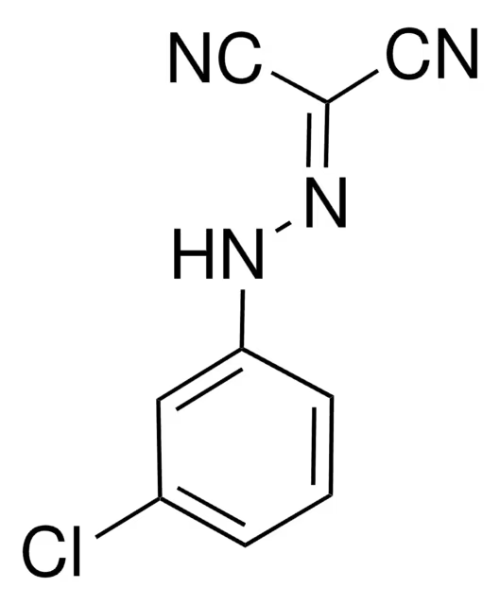
CAS Number555-60-2
SynonymsMFCD00001848; EINECS 209-103-7; 2-[(3-chlorophenyl)hydrazinylidene]propanedinitrile; CARBONYL CYANIDE 3-CHLOROPHENYLHYDRAZONE
Molecular FormulaC9H5ClN4
Molecular Weight204.62
Purity98.00%
Density1.26 g/cm3
Boiling Point318.3ºC at 760 mmHg
Melting Point170-175 °C (dec.)
AppearanceYellow to orange powder
EINECS209-103-7
Symbol
Signal WordWarning
| Chemical & Physical Properties | |
|---|---|
| CAS Number | 555-60-2 |
| Catalog No. | 2A-1186197 |
| Chinese Name | 羰基氰化氯苯腙 |
| Synonyms | MFCD00001848; EINECS 209-103-7; 2-[(3-chlorophenyl)hydrazinylidene]propanedinitrile; CARBONYL CYANIDE 3-CHLOROPHENYLHYDRAZONE |
| Molecular Formula | C9H5ClN4 |
| Molecular Weight | 204.62 |
| Purity | 98.00 |
| Density | 1.26 g/cm3 |
| Boiling Point | 318.3ºC at 760 mmHg |
| Melting Point | 170-175 °C (dec.) |
| Appearance | Yellow to orange powder |
| Water Solubility | methanol: 10 mg/mL, clear, very deep yellow |
| Storage Condition | 2-8°C |
| Packaging | III |
| Application | CCCP is an oxidative phosphorylation uncoupling agent. |
| EINECS | 209-103-7 |
| HTC | 2928000090 |
| PubChem ID | 24892523 |
| MDL Number | MFCD00001848 |
| SMILES | N#CC(C#N)=NNc1cccc(Cl)c1 |
| InChI | InChI=1S/C9H5ClN4/c10-7-2-1-3-8(4-7)13-14-9(5-11)6-12/h1-4,13H |
| InChI Key | UGTJLJZQQFGTJD-UHFFFAOYSA-N |
| Beilstein/REAXYS | 1842102 |
| NACRES Code | NA.77 |
| UNSPSC | 12352200 |
| Hazard Symbols | 6.1 |
| Bioactivity | CCCP is an oxidative phosphorylation uncoupler. Related Catalog Signaling Pathways >> Immunology/Inflammation >> IFNAR Signaling Pathways >> Immunology/Inflammation >> STING Research Areas >> Cancer Research Areas >> Inflammation/Immunology Target STING[1] IFN-β[1] In Vitro CCCP inhibits IFN-β production induced by various types of the STING pathway activators. CCCP suppresses the phosphorylation of STING, TBK1, and IRF3 via disrupting the association of STING and TBK1. CCCP inhibits activation of STING and its downstream signaling molecules, TBK1 and IRF3, but not STING translocation to the perinuclear region. CCCP impairs the interaction between STING and TBK1 and concomitantly triggers mitochondria fission. Importantly, the knockout of the crucial mitochondria fission regulator Drp1 restored the STING activity, indicating that CCCP down-modulates the STING pathway through DRP1-mediated mitochondria fragmentation. The protonophore CCCP that disrupts membrane potential suppresses the DMXAA-triggered STING signaling pathway. CCCP drastically suppresses the production of IFN-β in DMXAA-treated RAW264.7 cells and MEFs[1]. In Vivo The same dosage of 3 mg/kg.bw each of CCCP and PPEF is used. In both the cases 1 log reduction is observed in the bacterial load. However, when 3 mg/kg.bw of PPEF is used in combination with 3 mg/kg.bw of CCCP, 6 log10 reduction is observed in the bacterial count. The developed model validates the enhanced antibacterial activity of combination therapy[2].99mTc-MIBI signals in the hearts of SD rats administered CCCP (4 mg/kg intraperitoneally) or vehicle is also measured. 99mTc-MIBI signals decrease in rat hearts administered CCCP, and the ATP content, as measured by 31P magnetic resonance spectroscopy, decreased simultaneously. To investigate whether CCCP decreased the 99mTc-MIBI signals in rats, we analyzed the radioisotope activity of excised heart tissue from rats administered CCCP. At 180 min after 99mTc-MIBI injection, the 99mTc-MIBI signals from the hearts in the CCCP group are significantly lower than those in the vehicle group[3]. Cell Assay MEFs (5×10⁵), Raw264.7 cells (1×10⁶), and HeLa cells stable expressing STING (1.5×10⁵) are stimulated with DMXAA (100 μg/mL) for 2 or 3 h, or transfected with c-di-GMP (5 μM), cGAMP (5 μg/mL), or poly (dA:dT) (2 μg/mL) for 6 h. CCCP (50 μM) is co-treated with DMXAA (100 μg/mL), or treated for the last 5 h in case of treatment of c-di-GMP or poly (dA:dT)[1]. Animal Admin Mice[2] Female Balb/c mice n=6, per dosing group weighing 20-25 g are rendered neutropenic with 2 intraperitoneal injections of cyclophosphamide 150 mg/kg.bw and 100 mg/kg.bw on 4 days and 1 day prior to bacterial infection. 0.1 mL of the 106 CFU/mL bacterial suspension is injected into right posterior thigh muscle. After 2 h post-infection mice are treated with PPEF (3 mg/kg.bw), CCCP (3 mg/kg.bw) and in combination PPEF+CCCP (3 mg/kg.bw+3 mg/kg.bw) dissolved in 0.1 mL sterile water by single bolus intravenous injection. Twenty-four hours after antibacterial administration, the mice are humanely sacrificed. Right thigh muscles from each mouse are aseptically collected, homogenized and serially diluted and processed for quantitative cultures. Rats[3] Rats are randomly divided into three groups. One group is euthanized 15 min after a dose of 12.5 MBq (337.8 μCi) 99mTc-MIBI injection (n=6). The other two groups are administered 4 mg/kg CCCP (CCCP group; n=7) or vehicle (vehicle group; n=7) by intraperitoneal (i.p.) injection 90 min after the same dose of 99mTc-MIBI injection and are euthanized after an additional 90 min (180 min after the 99mTc-MIBI injection). Hearts are excised and weighed, and radioactivity is measured between 110 and 170 keV with an auto-well gamma counter. 99mTc-MIBI signals are corrected for physical decay (half-life=6 h). References [1]. Kwon D, et al. Carbonyl cyanide 3-chlorophenylhydrazone (CCCP) suppresses STING-mediated DNA sensing pathway through inducing mitochondrial fission. Biochem Biophys Res Commun. 2017 Aug 30. pii: S0006-291X(17)31704-7. [2]. Sinha D, et al. Synergistic efficacy of Bisbenzimidazole and Carbonyl Cyanide 3-Chlorophenylhydrazonecombination against MDR bacterial strains. Sci Rep. 2017 Mar 17;7:44419. [3]. Kawamoto A, et al. Measurement of technetium-99m sestamibi signals in rats administered a mitochondrial uncoupler and in a rat model of heart failure. PLoS One. 2015 Jan 16;10(1):e0117091. Chemical & Physical Properties Density 1.26 g/cm3 Boiling Point 318.3ºC at 760 mmHg Melting Point 170-175 °C (dec.) Molecular Formula C9H5ClN4 Molecular Weight 204.61600 Flash Point 146.3ºC Exact Mass 204.02000 PSA 71.97000 LogP 2.22806 Index of Refraction 1.611 InChIKey UGTJLJZQQFGTJD-UHFFFAOYSA-N SMILES N#CC(C#N)=NNc1cccc(Cl)c1 Storage condition 2-8°C Water Solubility methanol: 10 mg/mL, clear, very deep yellow |
| Use of | CCCP is an oxidative phosphorylation uncoupler. Properties Articles214 Synonym More Synonyms CCCP Biological Activity Description CCCP is an oxidative phosphorylation uncoupler. Related Catalog Signaling Pathways >> Immunology/Inflammation >> IFNAR Signaling Pathways >> Immunology/Inflammation >> STING Research Areas >> Cancer Research Areas >> Inflammation/Immunology STING[1] IFN-β[1] References [1]. Kwon D, et al. Carbonyl cyanide 3-chlorophenylhydrazone (CCCP) suppresses STING-mediated DNA sensing pathway through inducing mitochondrial fission. Biochem Biophys Res Commun. 2017 Aug 30. pii: S0006-291X(17)31704-7. [2]. Sinha D, et al. Synergistic efficacy of Bisbenzimidazole and Carbonyl Cyanide 3-Chlorophenylhydrazonecombination against MDR bacterial strains. Sci Rep. 2017 Mar 17;7:44419. Chemical & Physical Properties Exact Mass 204.02000 PSA 71.97000 LogP 2.22806 Index of Refraction 1.611 InChIKey UGTJLJZQQFGTJD-UHFFFAOYSA-N |
| Tax Rebate | 9.0% |
| Supervision | none |
| Transport Info | Product name: Purity: 98.0% |
| MSDS Transport Info | Module 14. Shipping information 14.1 UN number European Dangerous Regulations for land transport: 2811 International Dangerous Regulations for sea transport: 2811 International Dangerous Regulations for air transport: 2811 14.2 Names specified by the United Nations (UN) European Land Transport Dangerous Regulations: TOXIC SOLID, ORGANIC, N.O.S. ([(3-Chlorophenyl)hydrazono]malononitrile) IMDG Code: TOXIC SOLID, ORGANIC, N.O.S. ([(3-Chlorophenyl)hydrazono]malononitrile) International air transport hazard regulations: Toxic solid, organic, n.o.s. ([(3-Chlorophenyl)hydrazono]malononitrile) 14.3 Transport hazard categories European Land Transport Danger Regulations: 6.1 International Maritime Transport Danger Regulations: 6.1 International Air Transport Danger Regulations: 6.1 14.4 Package group European Land Transport Danger Regulations: III International Maritime Transport Danger Regulations: III International Air Transport Danger Regulations: III 14.5 Environmental hazards European Land Transport Dangerous Regulations: No International Maritime Transport Dangerous Regulations Maritime Pollutants: No International Air Transport Risk Regulations: No 14.6 Special reminder to users No data available |
| Related Products in Functional Building Blocks | ||
|---|---|---|
| [1,1':4',1'':4'',1''':4''',1'''':4'''',1'''''-sexiphenyl]-4,4'''''-dicarboxylic acid | 1246015-46-2 | 2A-3186034 |
| [1-(3-TRIFLUOROMETHYLPHENYL)-1-TOSYL]METHYL ISOCYANIDE | 263389-45-3 | 2A-3186049 |
| 4-[1,2,3]TRIAZOL-1-YL-BENZALDEHYDE | 41498-10-6 | 2A-3186050 |
| 2,2'-(9,9-Didecyl-9H-fluorene-2,7-diyl)bis[4,4,5,5-tetramethyl-1,3,2-dioxaborolane | 711026-06-1 | 2A-3186108 |
| 2-(5-fluorothiophen-2-yl)-4,4,5,5-tetramethyl-1,3,2-dioxaborolane | 1253586-81-0 | 2A-3186170 |
| 2-Oxa-7-azaspiro[3.5]nonane heMioxalate | 1429056-28-9 | 2A-3186205 |
| 5,5'-DiMethyl-[1,1'-biphenyl]-2,2'-dicarboxylic acid | 93012-36-3 | 2A-3186206 |
| 5-Methoxy-1,2,3,4-tetrahydronaphthalene-2-carboxylic acid | 53568-17-5 | 2A-3186209 |
| 7-METHOXY-1,2,3,4-TETRAHYDRO-NAPHTHALENE-2-CARBOXYLIC ACID | 24833-31-6 | 2A-3186210 |
| 3-ACETYLAMINO-ADAMANTANE-1-CARBOXYLIC ACID | 6240-00-2 | 2A-3186241 |
| Browse all Functional Building Blocks products » | ||
Phone:
630-322-8886
630-322-8887
Email:
Office Locations:
Chicago, IL, USA
San Francisco, CA, USA


 EN
EN


 SDS
SDS