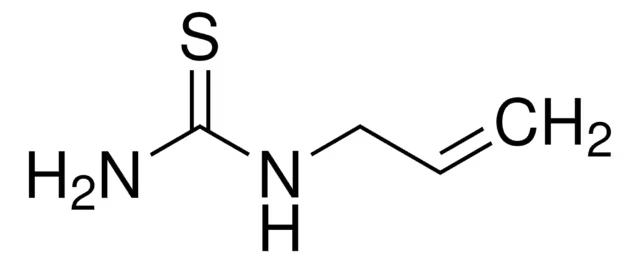
CAS Number109-57-9
Synonyms1-Prop-2-en-1-ylthioharnstoff; prop-2-enylthiourea; Allyl thiourea; Thiosinamine; 1-Allyl-2-thiourea; EINECS 203-683-5; 1-Allylthiourea; MFCD00004940; allylthiourea
Molecular FormulaCH2=CHCH2NHCSNH2
Molecular Weight116.18
Purity98%
Density1.1±0.1 g/cm3
Boiling Point191.3±33.0 °C at 760 mmHg
Melting Point70-72 °C (lit.)
Appearancesolid
EINECS203-683-5
Symbol
Signal WordWarning
| Chemical & Physical Properties | |
|---|---|
| CAS Number | 109-57-9 |
| Catalog No. | 2A-9018681 |
| Chinese Name | 丙烯基脲 |
| Synonyms | 1-Prop-2-en-1-ylthioharnstoff; prop-2-enylthiourea; Allyl thiourea; Thiosinamine; 1-Allyl-2-thiourea; EINECS 203-683-5; 1-Allylthiourea; MFCD00004940; allylthiourea |
| Molecular Formula | CH2=CHCH2NHCSNH2 |
| Molecular Weight | 116.18 |
| Purity | 98 |
| Density | 1.1±0.1 g/cm3 |
| Boiling Point | 191.3±33.0 °C at 760 mmHg |
| Melting Point | 70-72 °C (lit.) |
| Appearance | solid |
| Water Solubility | 67 g/L (20 ºC) |
| Storage Condition | 1. Store in a cool, ventilated warehouse. Keep awa |
| Packaging | III |
| Application | Allylthiourea can selectively inhibit ammonia oxidation. |
| EINECS | 203-683-5 |
| HTC | 29309070 |
| PubChem ID | 24846829 |
| MDL Number | MFCD00004940 |
| SMILES | NC(=S)NCC=C |
| InChI | 1S/C4H8N2S/c1-2-3-6-4(5)7/h2H,1,3H2,(H3,5,6,7) |
| InChI Key | HTKFORQRBXIQHD-UHFFFAOYSA-N |
| Beilstein/REAXYS | 1071470 |
| NACRES Code | NA.22 |
| UNSPSC | 12352100 |
| Hazard Symbols | 6.1 |
| MSDS | msds/18681_1_109_57_9.pdf |
| Bioactivity | Allylthiourea is a metabolic inhibitor that selective inhibits ammonia oxidation.Target: OthersAllylthiourea selectively inhibits ammonia oxidation at concentrations 8-80 μM. Allylthiourea (1 μM)inhibits ammonia oxidation by 80%. Complete inhibition is observed at an Allylthiourea concentration of 86 μM [1]. The inhibition of Allylthiourea on ammonia oxidation probably acts through chelating the copper of the ammonia monooxygenase active site. Allylthiourea is able to produce soluble methane monooxygenase (sMMO) in the presence of copper. Addition of 25 μM Allylthiourea decreases intracellular copper by 48% in Methylosinus trichosporium OB3b, allowing sMMO production at Cu/biomass ratios normally not permitting sMMO synthesis, which achieves a plateau of 320 μmol naphthol formed per gram dry biomass per hour [2]. Related Catalog Signaling Pathways >> Others >> Others Research Areas >> Metabolic Disease References [1]. Ginestet, P., et al., Estimation of nitrifying bacterial activities by measuring oxygen uptake in the presence of the metabolic inhibitors allylthiourea and azide. Appl Environ Microbiol, 1998. 64(6): p. 2266-8. [2]. Yu, Y., J.A. Ramsay, and B.A. Ramsay, Use of allylthiourea to produce soluble methane monooxygenase in the presence of copper. Appl Microbiol Biotechnol, 2009. 82(2): p. 333-9. Chemical & Physical Properties Density 1.1±0.1 g/cm3 Boiling Point 191.3±33.0 °C at 760 mmHg Melting Point 70-72 °C(lit.) Molecular Formula C4H8N2S Molecular Weight 116.185 Flash Point 69.5±25.4 °C Exact Mass 116.040817 PSA 70.14000 LogP 0.12 Vapour Pressure 0.5±0.4 mmHg at 25°C Index of Refraction 1.562 InChIKey HTKFORQRBXIQHD-UHFFFAOYSA-N SMILES C=CCNC(N)=S Stability Stable. Incompatible with strong oxidizing agents. Water Solubility 67 g/L (20 ºC) |
| Use of | Allylthiourea is a metabolic inhibitor that selective inhibits ammonia oxidation.Target: OthersAllylthiourea selectively inhibits ammonia oxidation at concentrations 8-80 μM. Allylthiourea (1 μM)inhibits ammonia oxidation by 80%. Complete inhibition is observed at an Allylthiourea concentration of 86 μM [1]. The inhibition of Allylthiourea on ammonia oxidation probably acts through chelating the copper of the ammonia monooxygenase active site. Allylthiourea is able to produce soluble methane monooxygenase (sMMO) in the presence of copper. Addition of 25 μM Allylthiourea decreases intracellular copper by 48% in Methylosinus trichosporium OB3b, allowing sMMO production at Cu/biomass ratios normally not permitting sMMO synthesis, which achieves a plateau of 320 μmol naphthol formed per gram dry biomass per hour [2]. Properties Articles28 Name Allylthiourea Synonym More Synonyms allylthiourea Biological Activity Description Allylthiourea is a metabolic inhibitor that selective inhibits ammonia oxidation.Target: OthersAllylthiourea selectively inhibits ammonia oxidation at concentrations 8-80 μM. Allylthiourea (1 μM)inhibits ammonia oxidation by 80%. Complete inhibition is observed at an Allylthiourea concentration of 86 μM [1]. The inhibition of Allylthiourea on ammonia oxidation probably acts through chelating the copper of the ammonia monooxygenase active site. Allylthiourea is able to produce soluble methane monooxygenase (sMMO) in the presence of copper. Addition of 25 μM Allylthiourea decreases intracellular copper by 48% in Methylosinus trichosporium OB3b, allowing sMMO production at Cu/biomass ratios normally not permitting sMMO synthesis, which achieves a plateau of 320 μmol naphthol formed per gram dry biomass per hour [2]. Related Catalog Signaling Pathways >> Others >> Others Research Areas >> Metabolic Disease References [1]. Ginestet, P., et al., Estimation of nitrifying bacterial activities by measuring oxygen uptake in the presence of the metabolic inhibitors allylthiourea and azide. Appl Environ Microbiol, 1998. 64(6): p. 2266-8. [2]. Yu, Y., J.A. Ramsay, and B.A. Ramsay, Use of allylthiourea to produce soluble methane monooxygenase in the presence of copper. Appl Microbiol Biotechnol, 2009. 82(2): p. 333-9. Chemical & Physical Properties Molecular Formula C4H8N2S Exact Mass 116.040817 PSA 70.14000 Index of Refraction 1.562 InChIKey HTKFORQRBXIQHD-UHFFFAOYSA-N SMILES C=CCNC(N)=S Stability Stable. Incompatible with strong oxidizing agents. |
| Transport Info | Product name: Purity: 98.0% |
| MSDS Transport Info | Module 14. Shipping information 14.1 UN number European Dangerous Regulations for land transport: 2811 International Dangerous Regulations for sea transport: 2811 International Dangerous Regulations for air transport: 2811 14.2 Names specified by the United Nations (UN) European Land Transport Dangerous Regulations: TOXIC SOLID, ORGANIC, N.O.S. (Tiosinamine) IMDG: TOXIC SOLID, ORGANIC, N.O.S. (Tiosinamine) International air transport hazard regulations: Toxic solid, organic, n.o.s. (Tiosinamine) 14.3 Transport hazard categories European Land Transport Danger Regulations: 6.1 International Maritime Transport Danger Regulations: 6.1 International Air Transport Danger Regulations: 6.1 14.4 Package group European Land Transport Danger Regulations: III International Maritime Transport Danger Regulations: III International Air Transport Danger Regulations: III 14.5 Environmental hazards European Land Transport Dangerous Regulations: No International Maritime Transport Dangerous Regulations Maritime Pollutants: No International Air Transport Risk Regulations: No 14.6 Special precautions for users No data available |
| Related Products in Specialty Chemicals | ||
|---|---|---|
| Dibutyl sebacate | 109-43-3 | 2A-9018674 |
| 1,3-Dibutyl-2-thiourea | 109-46-6 | 2A-9018675 |
| Valeric acid | 109-52-4 | 2A-9018677 |
| Isobutyl vinyl ether | 109-53-5 | 2A-9018678 |
| 3-Chloro-1-(N,N-dimethyl)propylamine | 109-54-6 | 2A-9018679 |
| Propyl acetate | 109-60-4 | 2A-9018683 |
| Propyl chloroformate | 109-61-5 | 2A-9018684 |
| 1-Pentene | 109-67-1 | 2A-9018689 |
| Butyronitrile | 109-74-0 | 2A-9018694 |
| 3-Butenenitrile | 109-75-1 | 2A-9018695 |
| Browse all Specialty Chemicals products » | ||
Phone:
630-322-8886
630-322-8887
Email:
Office Locations:
Chicago, IL, USA
San Francisco, CA, USA


 EN
EN


 SDS
SDS