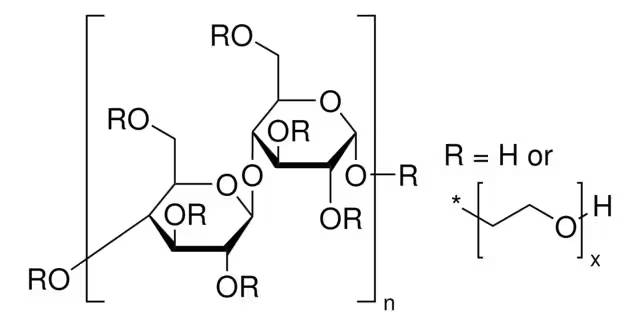
| Chemical & Physical Properties | |
|---|---|
| CAS Number | 9004-62-0 |
| Catalog No. | 2A-9018583 |
| Chinese Name | 羟乙基纤维素 |
| Synonyms | MFCD00072770; 2,2'-Disulfanediyldiethanol; EINECS 618-387-5 |
| Molecular Formula | C4H10O2S2 |
| Molecular Weight | 154.25100 |
| Purity | 98.00 |
| Density | 0.75 g/mL at 25ºC(lit.) |
| Melting Point | 288-290ºC (dec.) |
| Appearance | powder |
| Water Solubility | H2O: ≤5 wt. % at 20 °C |
| Storage Condition | Plastic bag coated kraft paper bag packaging. Stor |
| Application | Hydroxyethyl cellulose is a nonionic, water-soluble modified cellulose polymer used as a thickener in water-based cosmetic and personal care formulations. |
| HTC | 3912390000 |
| MDL Number | MFCD00072770 |
| SMILES | O1C(C(C(C(C1CO)OC)O)OCCO)OC2C(OC(C(C2O)O)OC4C(OC(C(C4O)O)C)CO)COC3OC(C(C(C3O)O)OC)CO |
| InChI | 1S/C29H52O21/c1-10-15(34)16(35)24(13(8-33)45-10)49-28-20(39)18(37)25(50-29-26(43-5-4-30)21(40)23(42-3)12(7-32)47-29)14(48-28)9-44-27-19(38)17(36)22(41-2)11(6-31)46-27/h10-40H,4-9H2,1-3H3 |
| InChI Key | CWSZBVAUYPTXTG-UHFFFAOYSA-N |
| NACRES Code | NA.25 |
| UNSPSC | 12352201 |
| Hazard Symbols | Transport |
| MSDS | msds/18583_1_9004_62_0.pdf |
| Bioactivity | Hydroxyethyl cellulose is a non-ionic, water soluble, modified cellulose polymer used as a thickening agent for aqueous cosmetic and personal care formulations. Related Catalog Signaling Pathways >> Others >> Others Research Areas >> Others In Vitro Stabilization of graphene oxide in physiological solution is performed using hydroxyethyl cellulose to make the resultant nanohybrid suitable for targeted drug delivery purposes. Hydroxyethyl cellulose effectively stabilizes graphene oxid in electrolyte solutions and the mechanism of stabilization appears to be depended on hydroxyethyl cellulose content. Hydroxyethyl cellulose content in the nanohybrid plays an important role in final application to make it applicable either as a carrier for controllable drug release or as a folate-targeted drug carrier[1]. Hydroxyethyl cellulose shows superior cryoprotective effects on LDH during freeze thawing, and considerable lyoprotective effects during the freeze drying process. Annealing has limited influence on the stabilizing effect of hydroxyethyl cellulose. The extensive reconstitution times of the hydroxyethyl cellulose lyophilisates could be greatly improved by incorporation of the surfactant Tween 80 into the formulations prior to freeze drying[2]. References [1]. Mianehrow H, et al. Graphene-oxide stabilization in electrolyte solutions using hydroxyethyl cellulose for drug delivery application. Int J Pharm. 2015 Apr 30;484(1-2):276-82. [2]. Al-Hussein A, et al. Investigation of the stabilizing effects of hydroxyethyl cellulose on LDH during freeze drying and freeze thawing cycles. Pharm Dev Technol. 2015 Jan;20(1):50-9. Chemical & Physical Properties Density 0.75 g/mL at 25ºC(lit.) Melting Point 288-290ºC (dec.) Molecular Formula C4H10O2S2 Molecular Weight 154.25100 Exact Mass 154.01200 PSA 91.06000 LogP 0.35240 InChIKey CWSZBVAUYPTXTG-UHFFFAOYSA-N SMILES COC1C(CO)OC(OCC2OC(OC3C(CO)OC(C)C(O)C3O)C(O)C(O)C2OC2OC(CO)C(OC)C(O)C2OCCO)C(O)C1O Storage condition room temp Stability Stable. Incompatible with strong oxidizing agents, acid chlorides, acid anhydrides Water Solubility H2O: ≤5 wt. % at 20 °C |
| Use of | Hydroxyethyl cellulose is a non-ionic, water soluble, modified cellulose polymer used as a thickening agent for aqueous cosmetic and personal care formulations. Properties Articles35 Name Hydroxyethyl Cellulose Synonym More Synonyms Hydroxyethyl cellulose Biological Activity Description Hydroxyethyl cellulose is a non-ionic, water soluble, modified cellulose polymer used as a thickening agent for aqueous cosmetic and personal care formulations. Related Catalog Signaling Pathways >> Others >> Others Research Areas >> Others In Vitro Stabilization of graphene oxide in physiological solution is performed using hydroxyethyl cellulose to make the resultant nanohybrid suitable for targeted drug delivery purposes. Hydroxyethyl cellulose effectively stabilizes graphene oxid in electrolyte solutions and the mechanism of stabilization appears to be depended on hydroxyethyl cellulose content. Hydroxyethyl cellulose content in the nanohybrid plays an important role in final application to make it applicable either as a carrier for controllable drug release or as a folate-targeted drug carrier[1]. Hydroxyethyl cellulose shows superior cryoprotective effects on LDH during freeze thawing, and considerable lyoprotective effects during the freeze drying process. Annealing has limited influence on the stabilizing effect of hydroxyethyl cellulose. The extensive reconstitution times of the hydroxyethyl cellulose lyophilisates could be greatly improved by incorporation of the surfactant Tween 80 into the formulations prior to freeze drying[2]. References [1]. Mianehrow H, et al. Graphene-oxide stabilization in electrolyte solutions using hydroxyethyl cellulose for drug delivery application. Int J Pharm. 2015 Apr 30;484(1-2):276-82. [2]. Al-Hussein A, et al. Investigation of the stabilizing effects of hydroxyethyl cellulose on LDH during freeze drying and freeze thawing cycles. Pharm Dev Technol. 2015 Jan;20(1):50-9. Chemical & Physical Properties Molecular Formula C4H10O2S2 Exact Mass 154.01200 PSA 91.06000 LogP 0.35240 InChIKey CWSZBVAUYPTXTG-UHFFFAOYSA-N Storage condition room temp Stability Stable. Incompatible with strong oxidizing agents, acid chlorides, acid anhydrides |
| Transport Info | Product name: Purity: 0.0% |
| MSDS Transport Info | Module 14. Shipping information 14.1 UN dangerous goods number European Land Transport Dangerous Regulations: -International Maritime Dangerous Regulations: -International Air Transport Dangerous Regulations: - 14.2 Names specified by the United Nations (UN) European Land Transport Dangerous Regulations: Non-dangerous goods IMDG Code: Non-dangerous goods International air transport dangerous goods regulations: non-dangerous goods 14.3 Transport hazard categories European Land Transport Dangerous Regulations: -International Maritime Dangerous Regulations: -International Air Transport Dangerous Regulations: - 14.4 Package group European Land Transport Dangerous Regulations: -International Maritime Dangerous Regulations: -International Air Transport Dangerous Regulations: - 14.5 Environmental hazards European Land Transport Dangerous Regulations: No International Maritime Transport Dangerous Regulations Maritime Pollutants: No International Air Transport Risk Regulations: No 14.6 Special reminder to users No data available See reverse side of invoice or packing slip. |
| Related Products in Specialty Chemicals | ||
|---|---|---|
| 3-Methyl-2-butenal | 107-86-8 | 2A-9018572 |
| 1,3-Butanediol | 107-88-0 | 2A-0200695 |
| Butanimidamide | 107-90-4 | 2A-9018575 |
| 3-Chloropropionic acid | 107-94-8 | 2A-9018579 |
| Sarcosine | 107-97-1 | 2A-9018582 |
| 2-Chloro-N,N-dimethylethanamine | 107-99-3 | 2A-9018584 |
| 1-Nitropropane | 108-03-2 | 2A-9018587 |
| 1,3-Dimethylbutylamine | 108-09-8 | 2A-9018589 |
| Isovaleryl chloride | 108-12-3 | 2A-9018592 |
| Malonamide | 108-13-4 | 2A-9018593 |
| Browse all Specialty Chemicals products » | ||
Phone:
630-322-8886
630-322-8887
Email:
Office Locations:
Chicago, IL, USA
San Francisco, CA, USA


 EN
EN


 SDS
SDS