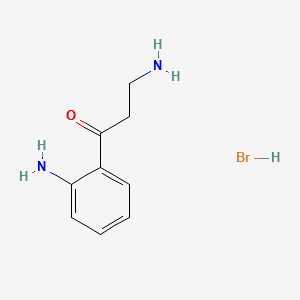
| Chemical & Physical Properties | |
|---|---|
| CAS Number | 304-47-2 |
| Catalog No. | 2A-1184269 |
| Chinese Name | 犬尿胺 二氢溴酸 |
| Synonyms | 3-(2-Aminophenyl)-3-oxopropanamine; 3-amino-1-(2-aminophenyl)propan-1-one,hydrobromide |
| Molecular Formula | C9H14Br2N2O |
| Molecular Weight | 326.02800 |
| Purity | 98.00 |
| Boiling Point | 367.3ºC at 760mmHg |
| Appearance | White, yellow, brown crystal |
| Storage Condition | 20°C |
| Application | Kynuramine (dihydrobromide) is an endogenous amine and a fluorescent substrate and probe for plasma amine oxidase [1][2]. |
| PubChem ID | 24896227 |
| SMILES | Br.Br.NCCC(=O)c1ccccc1N |
| InChI | InChI=1S/C9H12N2O.BrH/c10-6-5-9(12)7-3-1-2-4-8(7)11;/h1-4H,5-6,10-11H2;1H |
| InChI Key | KNLPLQJBAIXOQE-UHFFFAOYSA-N |
| Hazard Symbols | transportation |
| Bioactivity | Kynuramine (dihydrobromide), an endogenously occurring amine, is a fluorescent substrate and probe of plasma amine oxidase[1][2]. Related Catalog Signaling Pathways >> Neuronal Signaling >> Monoamine Oxidase Research Areas >> Metabolic Disease In Vitro Kynuramine (dihydrobromide) inhibits presynaptic and postsynaptic α-adrenergic receptors in vitro[2]. Kynuramine has been shown to be a partial agonist of serotonin receptors in the cerebral arteries of dogs [2]. Kynuramine (20 μg/mL) often causes mild contraction of the ileum but fails to alter the twitching response to cholinergic stimulation [2]. In Vivo Kynuramine (dihydrobromide) (0.064, 0.32, 1.6, or 8 μg; intracerebroventricular; single dose) promotes estrogen-stimulated lordotic behavior in ovariectomized rats [3]. Kynuramine (1.25, 2.5, and 5.0 mg/kg; intravenously; single dose) increases heart rate and blood pressure in rats [4]. Animal Model: Female rats[3]. Dosage: 0.064-8 μg. Administration: Intraventricular injection; single does. Result: Produced facilitation of lordosis behavior. Animal Model: Male rats (about 200g)[4]. Dosage: 1.25-5.0 mg/kg. B Massey, et al. Kynuramine, a fluorescent substrate and probe of plasma amine oxidase. J Biol Chem. 1977 Nov 25;252(22):8081-4. [2]. T D Johnson, An alpha-adrenoceptor inhibitory action of kynuramine. Eur J Pharmacol. 1981 Jul 10;72(4):351-6. [3]. S D Mendelson, et al. Intraventricular administration of l-kynurenine and kynuramine facilitates lordosis in the female rat. Eur J Pharmacol. 1987 Oct 27;142(3):447-51. [4]. T D Johnson, et al. Blood pressure and heart rate effects of kynuramine in pithed rats. Eur J Pharmacol. 1983 Feb 18;87(2-3):323-6. Chemical & Physical Properties Boiling Point 367.3ºC at 760mmHg Molecular Formula C9H14Br2N2O Molecular Weight 326.02800 Flash Point 175.9ºC Exact Mass 323.94700 PSA 69.11000 LogP 3.99800 InChIKey KNLPLQJBAIXOQE-UHFFFAOYSA-N SMILES Br.Br.NCCC(=O)c1ccccc1N Storage condition 20°C |
| Use of | Properties Name Kynuramine dihydrobromide Synonym More Synonyms Kynuramine Dihydrobromide Biological Activity Description Kynuramine (dihydrobromide), an endogenously occurring amine, is a fluorescent substrate and probe of plasma amine oxidase[1][2]. Related Catalog Signaling Pathways >> Neuronal Signaling >> Monoamine Oxidase Research Areas >> Metabolic Disease In Vitro Kynuramine (dihydrobromide) inhibits presynaptic and postsynaptic alpha-adrenergic receptors in vitro[2]. Kynuramine has been shown to be a partial agonist of serotonin receptors in the cerebral arteries of dogs [2]. Kynuramine (20 μg/mL) often causes mild contraction of the ileum but fails to alter the twitching response to cholinergic stimulation [2]. References [1]. J B Massey, et al. Kynuramine, a fluorescent substrate and probe of plasma amine oxidase. J Biol Chem. 1977 Nov 25;252(22):8081-4. [2]. T D Johnson, An alpha-adrenoceptor inhibitory action of kynuramine. Eur J Pharmacol. 1981 Jul 10;72(4):351-6. [3]. S D Mendelson, et al. Intraventricular administration of l-kynurenine and kynuramine facilitates lordosis in the female rat. Eur J Pharmacol. 1987 Oct 27;142(3):447-51. [4]. T D Johnson, et al. Blood pressure and heart rate effects of kynuramine in pitted rats. Eur J Pharmacol. 1983 Feb 18;87(2-3):323-6. Chemical & Physical Properties Molecular Formula C9H14Br2N2O Exact Mass 323.94700 PSA 69.11000 LogP 3.99800 InChIKey KNLPLQJBAIXOQE-UHFFFAOYSA-N |
| Transport Info | Product name: Purity: 97.0% |
| MSDS Transport Info | Module 14. Shipping information 14.1 UN dangerous goods number European Land Transport Dangerous Regulations: -International Maritime Dangerous Regulations: -International Air Transport Dangerous Regulations: - 14.2 Names specified by the United Nations (UN) European Land Transport Dangerous Regulations: Non-dangerous goods IMDG Code: Non-dangerous goods International air transport dangerous goods regulations: non-dangerous goods 14.3 Transport hazard categories European Land Transport Dangerous Regulations: -International Maritime Dangerous Regulations: -International Air Transport Dangerous Regulations: - 14.4 Package group European Land Transport Dangerous Regulations: -International Maritime Dangerous Regulations: -International Air Transport Dangerous Regulations: - 14.5 Environmental hazards European Land Transport Dangerous Regulations: No International Maritime Transport Dangerous Regulations Maritime Pollutants: No International Air Transport Risk Regulations: No 14.6 Special reminder to users No data available |
| Related Products in Specialty Chemicals | ||
|---|---|---|
| Fatty acids, C8-10 | 68937-75-7 | 2A-3184264 |
| Carboxymethylcellulose sodium | 12624-09-8 | 2A-3184265 |
| Decamethoxin | 38146-42-8 | 2A-3184266 |
| carbamoyloxyurea | 4543-62-8 | 2A-1184242 |
| O-Carbamoylhydroxylamine | 683-62-5 | 2A-1184267 |
| TRANS-5-DECENE | 7433-56-9 | 2A-1184270 |
| 3,3'-DICHLOROPIVALIC ACID | 67329-11-7 | 2A-1184271 |
| METHYL 2,3-DICHLOROISONICOTINATE | 603124-78-3 | 2A-3184274 |
| 5-broMo-4-chloronicotinic acid | 1256790-85-8 | 2A-3184275 |
| 5-broMo-4-chloronicotinic acid | 1261562-56-4 | 2A-3184276 |
| Browse all Specialty Chemicals products » | ||
Phone:
630-322-8886
630-322-8887
Email:
Office Locations:
Chicago, IL, USA
San Francisco, CA, USA


 EN
EN


 SDS
SDS