| Chemical & Physical Properties | |
|---|---|
| CAS Number | 34240-05-6 |
| Catalog No. | 2A-0182947 |
| Chinese Name | 腺苷.高碘酸氧化 |
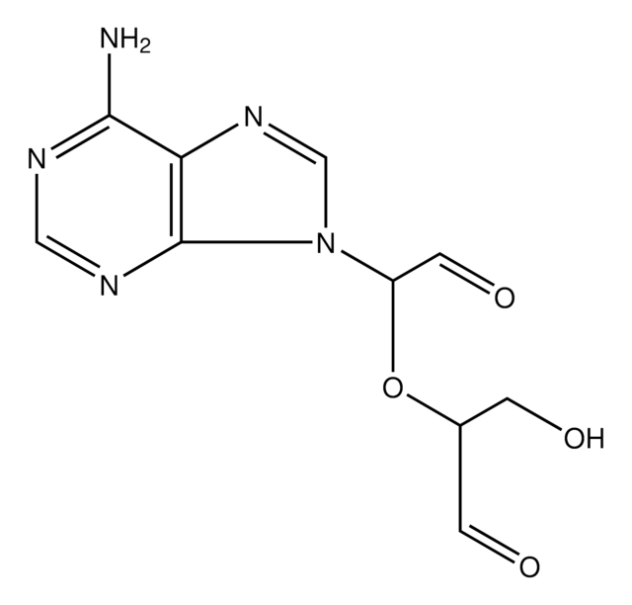
| Synonyms | ADENOSINE, PERIODATE OXIDIZED; α-adenosine 2',3'-dialdehyde; ADENOSINE, PERIODATE OXIDISED; Adenosine Dialdehyde |
| Molecular Formula | C10H11N5O4 |
| Molecular Weight | 265.23 |
| Appearance | powder |
| Storage Condition | -20℃ |
| Application | Adenosine Dialdehyde is a purine nucleoside analogue and an irreversible inhibitor (IC50=40 nM) of S-adenosylhomocysteine hydrolase (SAH). Adenosine Dialdehyde has strong anti-tumor activity and can |
| HTC | 2933990090 |
| PubChem ID | 24891180 |
| MDL Number | MFCD00056960 |
| SMILES | Nc1ncnc2c1ncn2C(C=O)OC(C=O)CO |
| InChI | InChI=1S/C10H11N5O4/c11-9-8-10(13-4-12-9)15(5-14-8)7(3-18)19-6(1-16)2-17/h1,3-7,17H,2H2,(H2,11,12,13) |
| InChI Key | ILMNSCQOSGKTNZ-UHFFFAOYSA-N |
| NACRES Code | NA.51 |
| UNSPSC | 41106305 |
| Hazard Symbols | transportation |
| Bioactivity | Adenosine Dialdehyde is a purine nucleoside analogue and is an irreversible inhibitor of S-adenosylhomocysteine hydrolase (SAH) (IC50=40 nM). Adenosine Dialdehyde exhibits potent anti-tumor activity in vivo and can be used for the cancer research[1][2]. Related Catalog Research Areas >> Cancer Signaling Pathways >> Cell Cycle/DNA Damage >> Nucleoside Antimetabolite/Analog In Vitro Adenosine dialdehyde suppresses MNB cell replication in tissue culture with concentra tions of 1.5 μM with producing 50% inhibition[1]. In Vivo Adenosine dialdehyde (subcutaneous injection; 1.5-2.5 mg/kg; infused over a 7-day period ( minipump infusion)) significantly increases the mean life span of tumor bearing mice from 20.9 days in diluent treated controls to 35.3 days in AD treated animals[2]. Adenosine dialdehyde (subcutaneous injection; 1.5-2.5 mg/kg; two 7-day periods interspersed by a 7-day drug free interval( minipump infusion))increases mean life span 80% in diluent treated controls (controls, 21.3 days; AD treated 38.4 days) in mice[2]. Adenosine dialdehyde (subcutaneous injection; 2-3 mg/kg; infused over a 7-day period ( minipump infusion)) does not exhibit any hematopoietic toxicity in mice, and it can significantly suppress murine neuroblastoma tumor growth with little systemic toxicity[2]. Animal Model: Adult male A/J mice, weighing 20 to 25 g with MNB cells[2] Dosage: 1.5-2.5 mg/kg Administration: Subcutaneous injection; 1.5-2.5 mg/kg; two 7-day periods interspersed by a 7-day drug free interval (minipump infusion) Result: Significantly suppressed murine neuroblastoma tumor growth. Prolongs the life span of tumor bearing mice. Did not suppress hematopoiesis when administered by steady state infusion[2]. References [1]. G V Madhavan, et al. Synthesis and antiviral evaluation of 6'-substituted aristeromycins: potential mechanism-based inhibitors of S-adenosylhomocysteine hydrolase. J Med Chem [2]. B Bostrom, et al. Inhibitory effect of adenosine dialdehyde on in situ murine neuroblastoma growth.Cancer Res. 1988 Nov 1;48(21):5933-6. Chemical & Physical Properties Molecular Formula C10H11N5O4 Molecular Weight 265.22500 Exact Mass 265.08100 PSA 133.22000 InChIKey ILMNSCQOSGKTNZ-UHFFFAOYSA-N SMILES Nc1ncnc2c1ncn2C(C=O)OC(C=O)CO Storage condition -20℃ |
| Use of | Adenosine Dialdehyde is a purine nucleoside analogue and is an irreversible inhibitor of S-adenosylhomocysteine hydrolase (SAH) (IC50=40 nM). Adenosine Dialdehyde exhibits potent anti-tumor activity in vivo and can be used for the cancer research[1][2]. Properties Articles32 Name Adenosine, periodate oxidized Synonym More Synonyms Adenosine dialdehyde Biological Activity Description Adenosine Dialdehyde is a purine nucleoside analogue and is an irreversible inhibitor of S-adenosylhomocysteine hydrolase (SAH) (IC50=40 nM). Adenosine Dialdehyde exhibits potent anti-tumor activity in vivo and can be used for the cancer research[1][2]. Related Catalog Research Areas >> Cancer Signaling Pathways >> Cell Cycle/DNA Damage >> Nucleoside Antimetabolite/Analog In Vitro Adenosine dialdehyde suppresses MNB cell replication in tissue culture with concentra tions of 1.5 μM with producing 50% inhibition[1]. References [1]. G V Madhavan, et al. Synthesis and antiviral evaluation of 6'-substituted aristeromycins: potential mechanism-based inhibitors of S-adenosylhomocysteine hydrolase. J Med Chem [2]. B Bostrom, et al. Inhibitory effect of adenosine dialdehyde on in situ murine neuroblastoma growth.Cancer Res. 1988 Nov 1;48(21):5933-6. Chemical & Physical Properties Molecular Formula C10H11N5O4 Exact Mass 265.08100 PSA 133.22000 InChIKey ILMNSCQOSGKTNZ-UHFFFAOYSA-N Storage condition -20℃ |
| Tax Rebate | 13.0% |
| Supervision | None. MFN tariff: 6.5%. Ordinary tariff: 20.0% |
| Transport Info | Shipping Name: UN |
| MSDS Transport Info | Module 14. Shipping information 14.1 UN dangerous goods number European Land Transport Dangerous Regulations: -International Maritime Dangerous Regulations: -International Air Transport Dangerous Regulations: - 14.2 United Nations shipping name European Land Transport Dangerous Regulations: Non-dangerous goods IMDG Code: Non-dangerous goods International air transport dangerous goods regulations: non-dangerous goods 14.3 Transport hazard categories European Land Transport Dangerous Regulations: -International Maritime Dangerous Regulations: -International Air Transport Dangerous Regulations: - 14.4 Package group European Land Transport Dangerous Regulations: -International Maritime Dangerous Regulations: -International Air Transport Dangerous Regulations: - 14.5 Environmental hazards European Land Transport Danger Regulations: No International Maritime Danger Regulations International Air Transport Danger Regulations: No Marine pollutants (yes/no): No 14.6 Special reminder to users No data available Acute Tox. Acute toxicity Flam. Liq. Flammable liquid H225 Highly Flammable Liquid and Vapor H301 is poisonous if swallowed H311 can be toxic in contact with skin H331 is toxic if inhaled. H370 causes damage to organs. STOT SE Specific Target Organ Systemic Toxicity (Single Exposure) further information Copyright: 2013 Co. LLC. Permission is granted for unlimited paper copies, internal use only. The above information is believed to be correct, but is not all-inclusive and should be used as a guide only. The information in this document is based on our current knowledge and is Correct safety instructions apply to this product. This information does not represent a warranty as to the properties of this product. See reverse side of invoice or packing slip. |
| Related Products in Biotechnology & Diagnostics | ||
|---|---|---|
| 2-Chloro-6-O-methyl-inosine | 15465-92-6 | 2A-0182927 |
| 2-THIO-6-AZAURIDINE | 27089-56-1 | 2A-1182929 |
| 3'-AMINO-D-ADENOSINE | 2504-55-4 | 2A-1182931 |
| 5'-Azido-5'-deoxyguanosine | 42204-44-4 | 2A-1182937 |
| 5'-Deoxy-5'-iodoguanosine | 68200-68-0 | 2A-1182940 |
| CYTIDINE 5'-MONOPHOSPHO-N- | 3063-71-6 | 2A-1182964 |
| FMOC-Amino Acids | 2A-3183088 | 2A-3183088 |
| isocytidine | 489-59-8 | 2A-1183313 |
| 1-METHYLGUANOSINE | 2140-65-0 | 2A-1183315 |
| 2-HYDROXYADENOSINE | 1818-71-9 | 2A-1183316 |
| Browse all Biotechnology & Diagnostics products » | ||
Phone:
630-322-8886
630-322-8887
Email:
Office Locations:
Chicago, IL, USA
San Francisco, CA, USA


 EN
EN


 SDS
SDS