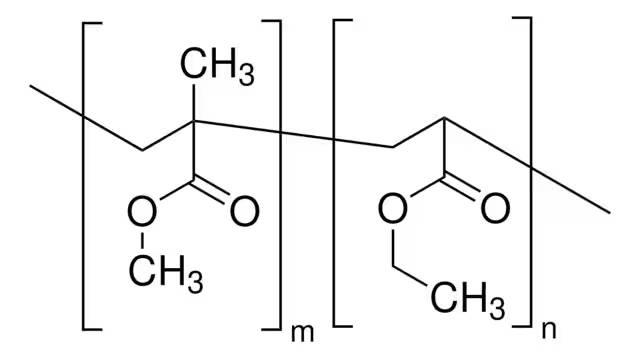
CAS Number9010-88-2
SynonymsEINECS 201-297-1; Primal AC 22; Primal AC 33; Ethyl acrylate methyl methacrylate polymer; Preparation 2817D; Eudragit E 30D; UNII-5KY68S2577; UNII-P2OM2Q86BI; Primal B 52
Molecular Formula[CH2C(CH3)(CO2CH3)]X[CH2CH(CO2C2H5]Y
Molecular Weight200.23200
Density1.2 g/mL at 25ºC(lit.)
Boiling Point99.5ºC at 760mmHg
Melting Point150ºC
Appearancepowder
Symbol
Signal WordWarning
| Chemical & Physical Properties | |
|---|---|
| CAS Number | 9010-88-2 |
| Catalog No. | 2A-2182906 |
| Chinese Name | 聚(甲基丙烯酸甲酯-co-丙烯酸乙酯) |
| Synonyms | EINECS 201-297-1; Primal AC 22; Primal AC 33; Ethyl acrylate methyl methacrylate polymer; Preparation 2817D; Eudragit E 30D; UNII-5KY68S2577; UNII-P2OM2Q86BI; Primal B 52 |
| Molecular Formula | [CH2C(CH3)(CO2CH3)]X[CH2CH(CO2C2H5]Y |
| Molecular Weight | 200.23200 |
| Density | 1.2 g/mL at 25ºC(lit.) |
| Boiling Point | 99.5ºC at 760mmHg |
| Melting Point | 150ºC |
| Appearance | powder |
| Water Solubility | alcohols and aliphatic hydrocarbons: insoluble |
| Storage Condition | Store in airtight, cool and dry place |
| Application | Ethyl acrylate-methyl methacrylate copolymer can be used as excipients, such as sustained-release coating materials, matrix sustained-release tablet binders and retarders. Pharmaceutical excipients, o |
| HTC | 3906100000 |
| PubChem ID | 24850987 |
| MDL Number | MFCD00134349 |
| SMILES | C=C(C)C(=O)OC.C=CC(=O)OCC |
| InChI | InChI=1S/2C5H8O2/c1-4(2)5(6)7-3;1-3-5(6)7-4-2/h1H2,2-3H3;3H,1,4H2,2H3 |
| InChI Key | XPNLOZNCOBKRNJ-UHFFFAOYSA-N |
| NACRES Code | NA.23 |
| UNSPSC | 12162002 |
| Hazard Symbols | transportation |
| Bioactivity | Ethyl acrylate-methyl methacrylate copolymer can be used as an excipient, such as sustained-release coating materials, matrix sustained-release tablet binders and retarders. Pharmaceutical excipients, or pharmaceutical auxiliaries, refer to other chemical substances used in the pharmaceutical process other than pharmaceutical ingredients. Pharmaceutical excipients generally refer to inactive ingredients in pharmaceutical preparations, which can improve the stability, solubility and processability of pharmaceutical preparations. Pharmaceutical excipients also affect the absorption, distribution, metabolism, and elimination (ADME) processes of co-administered drugs[1]. Related Catalog Research Areas >> Others Signaling Pathways >> Others >> Others References [1]. Elder DP, et al. Pharmaceutical excipients - quality, regulatory and biopharmaceutical considerations. Eur J Pharm Sci. 2016 May 25;87:88-99. Chemical & Physical Properties Density 1.2 g/mL at 25ºC(lit.) Boiling Point 99.5ºC at 760mmHg Melting Point 150ºC Molecular Formula (C5H8O2.C5H8O2)x Molecular Weight 200.23200 Flash Point 15.6ºC Exact Mass 200.10500 PSA 52.60000 LogP 1.47100 Appearance of Characters powder Index of Refraction n20/D 1.49 InChIKey XPNLOZNCOBKRNJ-UHFFFAOYSA-N SMILES C=C(C)C(=O)OC.C=CC(=O)OCC Water Solubility alcohols and aliphatic hydrocarbons: insoluble |
| Use of | Ethyl acrylate-methyl methacrylate copolymer can be used as an excipient, such as sustained-release coating materials, matrix sustained-release tablet binders and retarders. Pharmaceutical excipients, or pharmaceutical auxiliaries, refer to other chemical substances used in the pharmaceutical process other than pharmaceutical ingredients. Pharmaceutical excipients generally refer to inactive ingredients in pharmaceutical preparations, which can improve the stability, solubility and processability of pharmaceutical preparations. Pharmaceutical excipients also affect the absorption, distribution, metabolism, and elimination (ADME) processes of co-administered drugs[1]. Properties Name ethyl prop-2-enoate,methyl 2-methylprop-2-enoate Synonym More Synonyms poly(methyl methacrylate) Biological Activity Description Ethyl acrylate-methyl methacrylate copolymer can be used as an excipient, such as sustained-release coating materials, matrix sustained-release tablet binders and retarders. Pharmaceutical excipients, or pharmaceutical auxiliaries, refer to other chemical substances used in the pharmaceutical process other than pharmaceutical ingredients. Pharmaceutical excipients generally refer to inactive ingredients in pharmaceutical preparations, which can improve the stability, solubility and processability of pharmaceutical preparations. Pharmaceutical excipients also affect the absorption, distribution, metabolism, and elimination (ADME) processes of co-administered drugs[1]. Related Catalog Research Areas >> Others Signaling Pathways >> Others >> Others References [1]. Elder DP, et al. Pharmaceutical excipients - quality, regulatory and biopharmaceutical considerations. Eur J Pharm Sci. 2016 May 25;87:88-99. Chemical & Physical Properties Exact Mass 200.10500 PSA 52.60000 LogP 1.47100 Appearance of Characters powder InChIKey XPNLOZNCOBKRNJ-UHFFFAOYSA-N SMILES C=C(C)C(=O)OC.C=CC(=O)OCC Water Solubility alcohols and aliphatic hydrocarbons: insoluble |
| Transport Info | Shipping Name: UN |
| MSDS Transport Info | Module 14. Shipping information 14.1 UN dangerous goods number European Land Transport Dangerous Regulations: -International Maritime Dangerous Regulations: -International Air Transport Dangerous Regulations: - 14.2 United Nations shipping name European Land Transport Dangerous Regulations: Non-dangerous goods IMDG Code: Non-dangerous goods International air transport dangerous goods regulations: non-dangerous goods 14.3 Transport hazard categories European Land Transport Dangerous Regulations: -International Maritime Dangerous Regulations: -International Air Transport Dangerous Regulations: - 14.4 Package group European Land Transport Dangerous Regulations: -International Maritime Dangerous Regulations: -International Air Transport Dangerous Regulations: - 14.5 Environmental hazards European Land Transport Danger Regulations: No International Maritime Danger Regulations International Air Transport Danger Regulations: No Marine pollutants (yes/no): No 14.6 Special reminder to users No data available |
| Related Products in Polymer Intermediates | ||
|---|---|---|
| 3-NITRO-1,8-NAPHTHALIC ANHYDRIDE | 3027-38-1 | 2A-1181331 |
| BISPHENOL F DIGLYCIDYL ETHER | 2095-03-6 | 2A-2181793 |
| GABA (Gamma Aminobutyric Acid) | 2A-3182383 | 2A-3182383 |
| POLY(DIMETHYLAMINE-CO-EPICHLOROHYDRIN-CO-ETHYLENEDIAMINE) | 42751-79-1 | 2A-4182588 |
| pentaerythritol tetraoleate | 19321-40-5 | 2A-1182821 |
| D-Gluconic acid, .gamma.-lactone | 1198-69-2 | 2A-1182972 |
| Bisphenol A diphosphate | 181028-79-5 | 2A-1183134 |
| L-BETA,GAMMA-DIPALMITOYL-ALPHA-PHOSPHATIDIC ACID DISODIUM SALT | 71065-87-7 | 2A-1183256 |
| 4-Hydroxybutyl acrylate glycidyl ether | 119692-59-0 | 2A-1183430 |
| mono-(6-(1,6-hexamethylenediamine)-6-deoxy)-β-Cyclodextrin | 131991-61-2 | 2A-1183519 |
| Browse all Polymer Intermediates products » | ||
Phone:
630-322-8886
630-322-8887
Email:
Office Locations:
Chicago, IL, USA
San Francisco, CA, USA


 EN
EN


 SDS
SDS