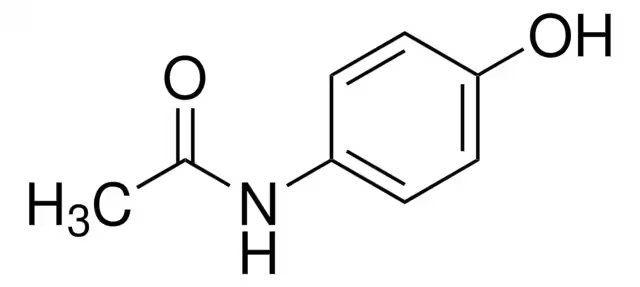
CAS Number103-90-2
SynonymsAPAP; Calpol; NAPAP; p-acetaminophenol; Panadol; Tylenol; Exdol; 4-(Acetylamino)phenol; Fevor; N-(p-hydroxyphenyl)acetamide; Paracetamol; N-(4-Hydroxy-phenyl)-acetamide; Korum; 4-13-00-01091 (Beilstein Handbook Reference); p-hydroxyacetanilide; G 1; p-Acetylaminophenol; MFCD00002328; Panex; QR DMV1; N-(4-Hydroxyphenyl)acetamide; N-Acetyl-4-aminophenol; EINECS 203-157-5; 4'-Hydroxyacetanilide; N-(4-Hydroxyphenyl)acetanilide; Acetaminophen; p-(Acetylamino)phenol; 4-Acetaminophenol; Dirox; 4-Acetamidophenol
Molecular FormulaCH3CONHC6H4OH
Molecular Weight151.16
Purity99.00%
Density1.3±0.1 g/cm3
Boiling Point387.8±25.0 °C at 760 mmHg
Melting Point168-172 °C (lit.)
AppearanceWhite powder or crystal
EINECS203-157-5
Symbol
Signal WordWarning
| Chemical & Physical Properties | |
|---|---|
| CAS Number | 103-90-2 |
| Catalog No. | 2A-9018369 |
| Chinese Name | 对乙酰氨基苯酚 |
| Synonyms | APAP; Calpol; NAPAP; p-acetaminophenol; Panadol; Tylenol; Exdol; 4-(Acetylamino)phenol; Fevor; N-(p-hydroxyphenyl)acetamide; Paracetamol; N-(4-Hydroxy-phenyl)-acetamide; Korum; 4-13-00-01091 (Beilstein Handbook Reference); p-hydroxyacetanilide; G 1; p-Acetylaminophenol; MFCD00002328; Panex; QR DMV1; N-(4-Hydroxyphenyl)acetamide; N-Acetyl-4-aminophenol; EINECS 203-157-5; 4'-Hydroxyacetanilide; N-(4-Hydroxyphenyl)acetanilide; Acetaminophen; p-(Acetylamino)phenol; 4-Acetaminophenol; Dirox; 4-Acetamidophenol |
| Molecular Formula | CH3CONHC6H4OH |
| Molecular Weight | 151.16 |
| Purity | 99.00 |
| Density | 1.3±0.1 g/cm3 |
| Boiling Point | 387.8±25.0 °C at 760 mmHg |
| Melting Point | 168-172 °C (lit.) |
| Appearance | White powder or crystal |
| Water Solubility | 14 g/L (20 ºC) |
| Storage Condition | 1. Store in a cool, ventilated warehouse. Keep awa |
| Packaging | III |
| Application | Acetaminophen (paracetamol) is a selective cyclooxygenase-2 (COX-2) inhibitor with an IC50 value of 25.8 μM. It is a widely used antipyretic and analgesic. |
| EINECS | 203-157-5 |
| HTC | 29242930 |
| PubChem ID | 329823036 |
| MDL Number | MFCD00002328 |
| SMILES | CC(=O)Nc1ccc(O)cc1 |
| InChI | 1S/C8H9NO2/c1-6(10)9-7-2-4-8(11)5-3-7/h2-5,11H,1H3,(H,9,10) |
| InChI Key | RZVAJINKPMORJF-UHFFFAOYSA-N |
| Beilstein/REAXYS | 2208089 |
| NACRES Code | NA.24 |
| UNSPSC | 41116107 |
| Hazard Symbols | Category 9 |
| MSDS | msds/18369_1_103_90_2.pdf |
| Bioactivity | Acetaminophen (paracetamol) is a selective cyclooxygenase-2 (COX-2) inhibitor with an IC50 of 25.8 μM; is a widely used antipyretic and analgesic drug. Related Catalog Signaling Pathways >> Immunology/Inflammation >> COX Research Areas >> Inflammation/Immunology Natural Products >> Phenylpropanoids Target COX-2:25.8 μM (IC50) COX-1:113.7 μM (IC50) Human Endogenous Metabolite In Vitro In vitro, acetaminophen elicites a 4.4-fold selectivity toward COX-2 inhibition (IC50 113.7 μM for COX-1; IC50 25.8 μM for COX-2). Following oral administration of the drug, maximal ex vivo inhibitions are 56% (COX-1) and 83% (COX-2). Acetaminophen plasma concentrations remaine above the in vitro IC50 for COX-2 for at least 5 h postadministration. Ex vivo IC50 values (COX-1: 105.2 μM; COX-2: 26.3 μM) of acetaminophen compared favorably with its in vitro IC50 values. In contrast to previous concepts, acetaminophen inhibited COX-2 by more than 80%, i.e., to a degree comparable to nonsteroidal antiinflammatory drugs (NSAIDs) and selective COX-2 inhibitors. However, a >95% COX-1 blockade relevant for suppression of platelet function is not achieved[1]. MTT assay shows that Acetaminophen (APAP) in a dose of 50 mM significantly (p<0.001) reduces cell viability to 61.5±6.65%. Interestingly, the significant (p<0.01) increase in cell viability to 79.7±2.47% is observed in the Acetaminophen/HV110 co-treated cells, compared to Acetaminophen treated cells[2]. In Vivo Administering Acetaminophen (250 mg/kg, orally) to the mice causes significant (p<0.001) liver damage and necrosis of cells as evidenced by the elevated serum hepatic enzymes alanine aminotransferase (ALT), aminotransferase (AST), alkaline phosphatase (ALP), and gamma-glutamyl transferase (γGT) compared with normal group. Conversely, effects of pretreatment with different doses of citral (125, 250, and 500 mg/kg) exhibited a significant (p<0.05) decrease in serum activities of ALT (91.79%, 93.07%, and 95.61%, resp.), AST (93.40%, 91.89%, and 96.52%, resp.), ALP (39.29%, 37.07%, and 59.80%, resp.), and γGT (92.83%, 91.59%, and 93.0%, resp.), when compared to the Acetaminophen group. Similar results were found in pretreatment with SLM on the activity of ALT (95.90%), AST (95.03%), ALP (70.52%), and γGT (92.69%)[3]. Cell Assay Human hepatoma cell line HepG2 is cultured in low glucose DMEM supplemented with 10% fetal bovine serum (FBS), 100 U/mL Penicillin and 100 μg/mL Streptomycin and 2 mM l-glutamine. The cells are maintained in 75 cm2 flasks at 37°C in a humidified atmosphere containing 5% CO2 and split at 80% confluence every 5 days. Cells are seeded in 24-well plate (2×10⁵ cells) and incubated at 37°C overnight followed by cells pretreatment with complete DMEM containing high glucose concentration in order to downregulate autophagy. After 6 h, cells are treated with different concentrations of postbiotics obtained from Lactobacillus fermentum BGHV110 strain (HV110) in order to select appropriate dose for further experiments. Postbiotic is dissolved in complete DMEM medium and added to the cells in specific final concentration. In all other experiments seeded cells are treated with 50 mM Acetaminophen alone or co-treated with 50 mM Acetaminophen and selected dose of lyophilized HV110. To analyze autophagic flux, simultaneously with treatments, cells are exposed to lysosomotropic agent Chloroquine at a concentration of 25 μM, to inhibit autophagosome-lysosome fusion[2]. Animal Admin Mice[3] Male Swiss mice (30-40 g) are used. The experimental animals are divided into six groups of five animals each. Firstly, each group receive orally during seven days the following treatment: Group I: the mice do not receive any treatment (normal). Group II: the mice receive citral vehicle (0.1% Tween 80 solution). Groups III-V: the mice are pretreated with citral at doses of 125, 250, and 500 mg/kg, respectively. Group VI: the mice are pretreated with the hepatoprotective standard drug Silymarin (SLM) (200 mg/kg). After this time, the animals fasted for 8 h and then receive oral Acetaminophen on the seventh day at a dose of 250 mg/kg in Groups II-VI. Group I orally receive saline that contained 0.1% Tween 80 solution (Acetaminophen vehicle). The stock solution is used as the first concentration of 50 mg/mL and after that is diluted in 0.1% Tween 80 solution to prepare the solutions of 25 and 12.5 mg/mL. After 12 h of Acetaminophen administration, serum samples and liver tissue are collected followed by biochemistry and histological analysis. References [1]. Hinz, B, et al. Acetaminophen (paracetamol) is a selective cyclooxygenase-2 inhibitor in man. FASEB J, 2008. 22(2): p. 383-90. [2]. Dini? M, et al. Lactobacillus fermentum Postbiotic-induced Autophagy as Potential Approach for Treatment ofAcetaminophen Hepatotoxicity. Front Microbiol. 2017 Apr 6;8:594. [3]. Uchida NS, et al. Hepatoprotective Effect of Citral on Acetaminophen-Induced Liver Toxicity in Mice. Evid Based Complement Alternat Med. 2017;2017:1796209. Chemical & Physical Properties Density 1.3±0.1 g/cm3 Boiling Point 387.8±25.0 °C at 760 mmHg Melting Point 168-172 °C(lit.) Molecular Formula C8H9NO2 Molecular Weight 151.163 Flash Point 188.4±23.2 °C Exact Mass 151.063324 PSA 49.33000 LogP 0.34 Vapour Pressure 0.0±0.9 mmHg at 25°C Index of Refraction 1.619 InChIKey RZVAJINKPMORJF-UHFFFAOYSA-N SMILES CC(=O)Nc1ccc(O)cc1 Storage condition Store at RT Water Solubility 14 g/L (20 ºC) |
| Use of | Acetaminophen (paracetamol) is a selective cyclooxygenase-2 (COX-2) inhibitor with an IC50 of 25.8 μM; is a widely used antipyretic and analgesic drug. Properties Articles524 Name paracetamol Synonym More Synonyms 4-Acetamidophenol Biological Activity Description Acetaminophen (paracetamol) is a selective cyclooxygenase-2 (COX-2) inhibitor with an IC50 of 25.8 μM; is a widely used antipyretic and analgesic drug. Related Catalog Signaling Pathways >> Immunology/Inflammation >> COX Research Areas >> Inflammation/Immunology Natural Products >> Phenylpropanoids COX-2:25.8 μM (IC50) COX-1:113.7 μM (IC50) Human Endogenous Metabolite References [1]. Hinz, B, et al. Acetaminophen (paracetamol) is a selective cyclooxygenase-2 inhibitor in man. FASEB J, 2008. 22(2): p. 383-90. [2]. Dini? M, et al. Lactobacillus fermentum Postbiotic-induced Autophagy as Potential Approach for Treatment ofAcetaminophen Hepatotoxicity. Front Microbiol. 2017 Apr 6;8:594. [3]. Uchida NS, et al. Hepatoprotective Effect of Citral on Acetaminophen-Induced Liver Toxicity in Mice. Evid Based Complement Alternat Med. 2017;2017:1796209. Chemical & Physical Properties Molecular Formula C8H9NO2 Exact Mass 151.063324 PSA 49.33000 Index of Refraction 1.619 InChIKey RZVAJINKPMORJF-UHFFFAOYSA-N Storage condition Store at RT |
| Transport Info | Product name: Purity: 98.0% |
| MSDS Transport Info | Module 14. Shipping information United Nations classification: Category 9 Miscellaneous UN number: 3077 Proper shipping name: Environmentally Hazardous Substance, Solid, Not otherwise specified Packing grade: III Marine pollutants: Y |
| Related Products in Plastic & Specialty Additives | ||
|---|---|---|
| Triphenylmethanol | 76-84-6 | 2A-9017154 |
| Triphenylsilyl chloride | 76-86-8 | 2A-9017155 |
| Acetyl tributyl citrate | 77-90-7 | 2A-9017189 |
| Tributyl citrate | 77-94-1 | 2A-9017193 |
| 3-Methyl-1-(3'-sulfoamidophenyl)-5-pyrazolone | 89-29-2 | 2A-9017602 |
| 3,3-Dichloro-1-(4-iodophenyl)piperidin-2-one | 545445-10-1 | 2A-9018528 |
| (2R)-1-[[chloro-(1-oxidopyridin-5-yl)methylidene]amino]oxy-3-(1-piperidyl)propan-2-ol | 289893-25-0 | 2A-9018902 |
| Dioctyl phthalate | 117-81-7 | 2A-9018977 |
| Dioctyl phthalate | 117-84-0 | 2A-9018979 |
| Triphenylene | 217-59-4 | 2A-9021072 |
| Browse all Plastic & Specialty Additives products » | ||
Phone:
630-322-8886
630-322-8887
Email:
Office Locations:
Chicago, IL, USA
San Francisco, CA, USA


 EN
EN


 SDS
SDS