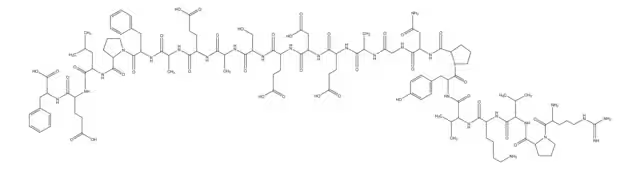
| Chemical & Physical Properties | |
|---|---|
| CAS Number | 53917-42-3 |
| Catalog No. | 2A-1181697 |
| Chinese Name | ACTH(18-39)(人类) |
| Synonyms | CLIP; Adrenocorticotropic hormone fragment 18-39; ACTH (18-39) (HUMAN); Adrenocorticotropic Hormone (ACTH) (18-39), human |
| Molecular Formula | C112H165N27O36 |
| Molecular Weight | 2465.67 |
| Density | 1.49g/cm3 |
| Storage Condition | -20℃ |
| Application | Adrenocorticotropic Hormone (ACTH) (18-39), human is a corticotropin-like midlobe peptide produced in the melanocyte-stimulating cells of the midlobe of the pituitary gland. |
| PubChem ID | 24890445 |
| MDL Number | MFCD00076159 |
| SMILES | CC(C)CC(NC(=O)C1CCCN1C(=O)C(Cc1ccccc1)NC(=O)C(C)NC(=O)C(CCC(=O)O)NC(=O)C(C)NC(=O)C(CO)NC(=O)C(CCC(=O)O)NC(=O)C(CC(=O)O)NC(=O)C(CCC(=O)O)NC(=O)C(C)NC(=O)CNC(=O)C(CC(N)=O)NC(=O)C1CCCN1C(=O)C(Cc1ccc(O)cc1)NC(=O)C(NC(=O)C(CCCCN)NC(=O)C(NC(=O)C1CCCN1C(=O)C(N)CCCNC(=N)N)C(C)C)C(C)C)C(=O)NC(CCC(=O)O)C(=O)NC(Cc1ccccc1)C(=O)O |
| InChI | InChI=1S/C112H165N27O36/c1-56(2)48-72(100(163)125-70(37-41-86(148)149)97(160)133-77(111(174)175)51-63-24-14-11-15-25-63)129-103(166)79-28-20-46-138(79)109(172)75(49-62-22-12-10-13-23-62)131-93(156)61(9)121-95(158)68(35-39-84(144)145)123-92(155)60(8)122-102(165)78(55-140)134-98(161)71(38-42-87(150)151)126-101(164)74(53-88(152)153)128-96(159)69(36-40-85(146)147)124-91(154)59(7)120-83(143)54-119-94(157)73(52-82(115)142)130-104(167)80-29-21-47-139(80)110(173)76(50-64-31-33-65(141)34-32-64)132-107(170)89(57(3)4)135-99(162)67(27-16-17-43-113)127-106(169)90(58(5)6)136-105(168)81-30-19-45-137(81)108(171)66(114)26-18-44-118-112(116)117/h10-15,22-25,31-34,56-61,66-81,89-90,140-141H,16-21,26-30,35-55,113-114H2,1-9H3,(H2,115,142)(H,119,157)(H,120,143)(H,121,158)(H,122,165)(H,123,155)(H,124,154)(H,125,163)(H,126,164)(H,127,169)(H,128,159)(H,129,166)(H,130,167)(H,131,156)(H,132,170)(H,133,160)(H,134,161)(H,135,162)(H,136,168)(H,144,145)(H,146,147)(H,148,149)(H,150,151)(H,152,153)(H,174,175)(H4,116,1 |
| InChI Key | ZYDMZKPAPSZILB-WKNDHWIVSA-N |
| NACRES Code | NA.32 |
| UNSPSC | 51111800 |
| Hazard Symbols | transportation |
| Bioactivity | Adrenocorticotropic Hormone (ACTH) (18-39), human is a corticotropinlike intermediate lobe peptide, which is is produced in the melanotrophs of the intermediate lobe of the pituitary. Related Catalog Signaling Pathways >> Others >> Others Research Areas >> Metabolic Disease Peptides In Vitro The ACTH family of polypeptides consists of ACTH(1-39) (adrenocorticotropin), ACTH (1-13)amide (α-melanotropin;α-MSH); and ACTH (18-39) (corticotropinlike intermediate lobe peptide, CLIP). These polypeptides are derived from a common precursor, proopiomelanocortin. In corticotropic cells of the pars distalis, proopiomelanocortin (POMC) undergoes a series of proteolytic cleavage reactions to yield ACTH (1-39) as a major end product. However, in the melanotropic cells of the pars intermedia, an additional set of proteolytic reactions results in the conversion of ACTH (1-39) to ACTH (1-13) amide and ACTH (18-39). In several species of vertebrates, ACTH (1-13) amide undergoes end product modification to yield mono- and diacetylated forms ofα-MSH as major end products in the pars intermedia[1]. References [1]. Dores RM, et al. Analysis of ACTH-related and CLIP-related peptides partially purified from the pituitary of the Australian lungfish, Neoceratodus forsteri. Gen Comp Endocrinol. 1990 Jul;79(1):64-73. Chemical & Physical Properties Density 1.49g/cm3 Molecular Formula C112H165N27O36 Molecular Weight 2465.67000 Exact Mass 2464.19000 PSA 1006.02000 LogP 1.91620 Index of Refraction 1.665 InChIKey ZYDMZKPAPSZILB-WKNDHWIVSA-N SMILES CC(C)CC(NC(=O)C1CCCN1C(=O)C(Cc1ccccc1)NC(=O)C(C)NC(=O)C(CCC(=O)O)NC(=O)C(C)NC(=O)C(CO)NC(=O)C(CCC(=O)O)NC(=O)C(CC(=O)O)NC(=O)C(CCC(=O)O)NC(=O)C(C)NC(=O)CNC(=O)C(CC(N)=O)NC(=O)C1CCCN1C(=O)C(Cc1ccc(O)cc1)NC(=O)C(NC(=O)C(CCCCN)NC(=O)C(NC(=O)C1CCCN1C(=O)C(N)CCCNC(=N)N)C(C)C)C(C)C)C(=O)NC(CCC(=O)O)C(=O)NC(Cc1ccccc1)C(=O)O Storage condition -20℃ |
| Use of | Adrenocorticotropic Hormone (ACTH) (18-39), human is a corticotropinlike intermediate lobe peptide, which is is produced in the melanotrophs of the intermediate lobe of the pituitary. Properties Articles36 Name Adrenocorticotropic Hormone Synonym More Synonyms ACTH (18-39) (human) Biological Activity Description Adrenocorticotropic Hormone (ACTH) (18-39), human is a corticotropinlike intermediate lobe peptide, which is is produced in the melanotrophs of the intermediate lobe of the pituitary. Related Catalog Signaling Pathways >> Others >> Others Research Areas >> Metabolic Disease In Vitro The ACTH family of polypeptides consists of ACTH(1-39) (adrenocorticotropin), ACTH (1-13)amide (α-melanotropin;α-MSH); and ACTH (18-39) (corticotropinlike intermediate lobe peptide, CLIP). These polypeptides are derived from a common precursor, proopiomelanocortin. In corticotropic cells of the pars distalis, proopiomelanocortin (POMC) undergoes a series of proteolytic cleavage reactions to yield ACTH (1-39) as a major end product. However, in the melanotropic cells of the pars intermedia, an additional set of proteolytic reactions results in the conversion of ACTH (1-39) to ACTH (1-13) amide and ACTH (18-39). In several species of vertebrates, ACTH (1-13) amide undergoes end product modification to yield mono- and diacetylated forms ofα-MSH as major end products in the pars intermedia[1]. References [1]. Dores RM, et al. Analysis of ACTH-related and CLIP-related peptides partially purified from the pituitary of the Australian lungfish, Neoceratodus forsteri. Gen Comp Endocrinol. 1990 Jul;79(1):64-73. Chemical & Physical Properties Molecular Formula C112H165N27O36 Exact Mass 2464.19000 PSA 1006.02000 LogP 1.91620 Index of Refraction 1.665 InChIKey ZYDMZKPAPSZILB-WKNDHWIVSA-N Storage condition -20℃ |
| Transport Info | Product name: Purity: 95.0% |
| MSDS Transport Info | Module 14. Shipping information 14.1 UN dangerous goods number European Land Transport Dangerous Regulations: -International Maritime Dangerous Regulations: -International Air Transport Dangerous Regulations: - 14.2 Names specified by the United Nations (UN) European Land Transport Dangerous Regulations: Non-dangerous goods IMDG Code: Non-dangerous goods International air transport dangerous goods regulations: non-dangerous goods 14.3 Transport hazard categories European Land Transport Dangerous Regulations: -International Maritime Dangerous Regulations: -International Air Transport Dangerous Regulations: - 14.4 Package group European Land Transport Dangerous Regulations: -International Maritime Dangerous Regulations: -International Air Transport Dangerous Regulations: - 14.5 Environmental hazards European Land Transport Dangerous Regulations: No International Maritime Transport Dangerous Regulations Maritime Pollutants: No International Air Transport Risk Regulations: No 14.6 Special reminder to users No data available |
| Related Products in Specialty Chemicals | ||
|---|---|---|
| Microcystin YR | 101064-48-6 | 2A-1181685 |
| ACRYLIC ACID DICYCLOPENTANYL ESTER | 7398-56-3 | 2A-1181686 |
| ACTH (1-10) | 2791-05-1 | 2A-1181693 |
| ACTH (1-13) | 22006-64-0 | 2A-1181694 |
| MET-GLU-HIS-PHE-ARG-TRP-GLY | 4037-01-8 | 2A-1181696 |
| ADRENOCORTICOTROPIC HORMONE RAT | 77465-10-2 | 2A-1181698 |
| ACTH (1-16) | 5576-42-1 | 2A-1181699 |
| ACTH (1-17) | 7266-47-9 | 2A-1181700 |
| H-ALA-ARG-LEU-ASP-VAL-ALA-SER-GLU-PHE-ARG-LYS-LYS-TRP-ASN-LYS-TRP-ALA-LEU-SER-ARG-NH2 | 150238-87-2 | 2A-1181702 |
| AMYLIN (8-37) (HUMAN) | 135702-23-7 | 2A-1181703 |
| Browse all Specialty Chemicals products » | ||
Phone:
630-322-8886
630-322-8887
Email:
Office Locations:
Chicago, IL, USA
San Francisco, CA, USA


 EN
EN


 SDS
SDS