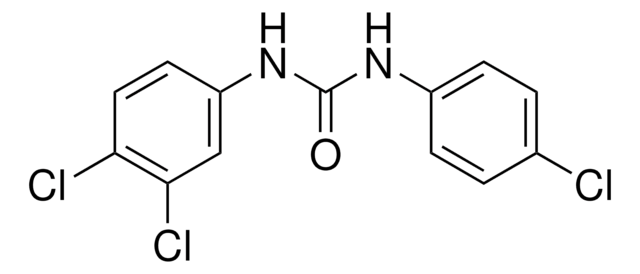
CAS Number101-20-2
Synonyms3,4,4'-Trichlorocarbanilide; N-(4-Chlorophenyl)-N'-(3,4-dichlorophenyl)carbamimidic acid; 3,4,4′-Trichlorocarbanilide; 3,4,4'-trichlorodiphenylurea; cusiter; MFCD00013254; Triclocarban; Nobacter; genoface; GR DMVMR CG DG; Procutene; TCC; CUTISAN; N-(4-Chlorophenyl)-N-(3,4-dichlorophenyl)-Urea; EINECS 202-924-1; 1-(4-Chlorophenyl)-3-(3,4-dichlorophenyl)urea; 3,4,4-Trichlorocarbanilide; N-(4-Chlorophenyl)-N'-(3,4-dichlorophenyl)urea
Molecular FormulaCl2C6H3NHCONHC6H4Cl
Molecular Weight315.58
Purity99%
Density1.4±0.1 g/cm3
Boiling Point475.3±55.0 °C at 760 mmHg
Melting Point254-256 °C (lit.)
Appearancesolid
Symbol
Signal WordWarning
| Chemical & Physical Properties | |
|---|---|
| CAS Number | 101-20-2 |
| Catalog No. | 2A-9018245 |
| Chinese Name | 三氯卡班 |
| Synonyms | 3,4,4'-Trichlorocarbanilide; N-(4-Chlorophenyl)-N'-(3,4-dichlorophenyl)carbamimidic acid; 3,4,4′-Trichlorocarbanilide; 3,4,4'-trichlorodiphenylurea; cusiter; MFCD00013254; Triclocarban; Nobacter; genoface; GR DMVMR CG DG; Procutene; TCC; CUTISAN; N-(4-Chlorophenyl)-N-(3,4-dichlorophenyl)-Urea; EINECS 202-924-1; 1-(4-Chlorophenyl)-3-(3,4-dichlorophenyl)urea; 3,4,4-Trichlorocarbanilide; N-(4-Chlorophenyl)-N'-(3,4-dichlorophenyl)urea |
| Molecular Formula | Cl2C6H3NHCONHC6H4Cl |
| Molecular Weight | 315.58 |
| Purity | 99 |
| Density | 1.4±0.1 g/cm3 |
| Boiling Point | 475.3±55.0 °C at 760 mmHg |
| Melting Point | 254-256 °C (lit.) |
| Appearance | solid |
| Water Solubility | <0.1 g/100 mL at 26 ºC |
| Storage Condition | Refrigerator |
| Application | Triclocarban is an antibacterial agent used in personal cleaning products. |
| HTC | 2924299090 |
| PubChem ID | 24846715 |
| MDL Number | MFCD00013254 |
| SMILES | Clc1ccc(NC(=O)Nc2ccc(Cl)c(Cl)c2)cc1 |
| InChI | 1S/C13H9Cl3N2O/c14-8-1-3-9(4-2-8)17-13(19)18-10-5-6-11(15)12(16)7-10/h1-7H,(H2,17,18,19) |
| InChI Key | ICUTUKXCWQYESQ-UHFFFAOYSA-N |
| NACRES Code | NA.22 |
| UNSPSC | 12352100 |
| Hazard Symbols | 9.0 |
| MSDS | msds/18245_1_101_20_2.pdf |
| Bioactivity | Triclocarban is an antimicrobial agent used in personal cleaning products. Related Catalog Signaling Pathways >> Anti-infection >> Bacterial Research Areas >> Infection Target Bacterial[1] In Vitro Triclocarban at 300 nM potentiates the cytotoxicity of 300 µM H2O2 in rat thymocytes. 300 nM triclocarban itself does not increase the population of death cells, it facilitates the process of cell death induced by H2O2, resulting in further increase in the population of dead cells[1]. Triclocarban exertes estrogenic activities by inducing luciferase activities in an ER reporter gene assay, promoting the proliferation of the MCF-7 cells, up-regulating the expression of pS2 and down-regulating ERα expression at both the mRNA and protein levels in the MCF-7 cells[2]. In Vivo Triclocarban is absorbed significantly from soap used during showering in human subjects and that its Cmax in their whole blood ranges from 23 nM to 530 nM[1]. Gestational triclocarban exposure does not affect the ability of dams to carry offspring to term but triclocarban exposure during lactation has adverse consequences on the survival of offspring[3]. Animal Admin Rats: Sprague Dawley rats are provided control, 0.2% weight/weight (w/w), or 0.5% w/w triclocarban -supplemented chow through a series of 3 experiments that limited exposure to critical growth periods: gestation, gestation and lactation, or lactation only (cross-fostering) to determine the susceptible windows of exposure for developmental consequences[3]. References [1]. Kanbara Y, et al. Nanomolar concentration of triclocarban increases the vulnerability of rat thymocytes to oxidative stress. J Toxicol Sci. 2013 Feb;38(1):49-55. [2]. Huang H, et al. The in vitro estrogenic activities of triclosan and triclocarban. J Appl Toxicol. 2014 Sep;34(9):1060-7. [3]. Kennedy RC, et al. Early life triclocarban exposure during lactation affects neonate rat survival. Reprod Sci. 2015 Jan;22(1):75-89. Chemical & Physical Properties Density 1.4±0.1 g/cm3 Boiling Point 475.3±55.0 °C at 760 mmHg Melting Point 254-256 °C(lit.) Molecular Formula C13H9Cl3N2O Molecular Weight 315.582 Flash Point 241.2±31.5 °C Exact Mass 313.978058 PSA 41.13000 LogP 5.66 Vapour Pressure 0.0±1.2 mmHg at 25°C Index of Refraction 1.630 InChIKey ICUTUKXCWQYESQ-UHFFFAOYSA-N SMILES O=C(Nc1ccc(Cl)cc1)Nc1ccc(Cl)c(Cl)c1 Storage condition Refrigerator Stability Stable. Combustible. Incompatible with strong oxidizing agents strong bases. Water Solubility <0.1 g/100 mL at 26 ºC |
| Use of | Triclocarban is an antimicrobial agent used in personal cleaning products. Properties Articles141 Name triclocarban Synonym More Synonyms Triclocarban Biological Activity Description Triclocarban is an antimicrobial agent used in personal cleaning products. Related Catalog Signaling Pathways >> Anti-infection >> Bacterial Research Areas >> Infection Bacterial[1] In Vivo Triclocarban is absorbed significantly from soap used during showering in human subjects and that its Cmax in their whole blood ranges from 23 nM to 530 nM[1]. Gestational triclocarban exposure does not affect the ability of dams to carry offspring to term but triclocarban exposure during lactation has adverse consequences on the survival of offspring[3]. Animal Admin Rats: Sprague Dawley rats are provided control, 0.2% weight/weight (w/w), or 0.5% w/w triclocarban -supplemented chow through a series of 3 experiments that limited exposure to critical growth periods: gestation, gestation and lactation, or lactation only (cross-fostering) to determine the susceptible windows of exposure for developmental consequences[3]. References [1]. Kanbara Y, et al. Nanomolar concentration of triclocarban increases the vulnerability of rat thymocytes to oxidative stress. J Toxicol Sci. 2013 Feb;38(1):49-55. [2]. Huang H, et al. The in vitro estrogenic activities of triclosan and triclocarban. J Appl Toxicol. 2014 Sep;34(9):1060-7. [3]. Kennedy RC, et al. Early life triclocarban exposure during lactation affects neonate rat survival. Reprod Sci. 2015 Jan;22(1):75-89. Chemical & Physical Properties Exact Mass 313.978058 PSA 41.13000 Index of Refraction 1.630 InChIKey ICUTUKXCWQYESQ-UHFFFAOYSA-N Storage condition Refrigerator Stability Stable. Combustible. Incompatible with strong oxidizing agents strong bases. |
| Tax Rebate | 13.0% |
| Supervision | None. MFN tariff: 6.5%. Ordinary tariff: 30.0% |
| Transport Info | Shipping Name: UN |
| MSDS Transport Info | Module 14. Shipping information 14.1 UN dangerous goods number European Land Transport Danger Regulations: 3077 International Maritime Transport Danger Regulations: 3077 International Air Transport Danger Regulations: 3077 14.2 United Nations shipping name European land transport hazard regulations: ENVIRONMENTALLY HAZARDOUS SUBSTANCE, SOLID, N.O.S. (1-(4-Chloro-phenyl)-3- (3,4-dichloro-phenyl)-urea) IMDG Code: ENVIRONMENTALLY HAZARDOUS SUBSTANCE, SOLID, N.O.S. (1-(4-Chloro-phenyl)-3- (3,4-dichloro-phenyl)-urea) International air transport hazard regulations: Environmentally hazardous substance, solid, n.o.s. (1-(4-Chloro-phenyl)-3-(3,4-dichloro- phenyl)-urea) 14.3 Transport hazard categories European land transport Dangerous Regulations: 9 International sea transport Dangerous Regulations: 9 International air transport Dangerous Regulations: 9 14.4 Package group European Land Transport Danger Regulations: III International Maritime Transport Danger Regulations: III International Air Transport Danger Regulations: III 14.5 Environmental hazards European Land Transport Dangerous Regulations: Yes International Maritime Transport Dangerous Regulations International Air Transport Dangerous Regulations: Yes Marine Pollutants (Yes/No): Yes 14.6 Special reminder to users further information Dangerous goods are individually packaged, with liquids exceeding 5 liters or solids exceeding 5 kilograms. The outer packaging of each independent package and the combined independent inner package must have EHS on it. Identification (according to European ADR Regulation 2.2.9.1.10, IMDG Regulation 2.10.3), |
| Related Products in Specialty Chemicals | ||
|---|---|---|
| 2-(3-Chlorophenoxy)-propionic acid | 101-10-0 | 2A-9018240 |
| N-Ethyl-N-benzylaniline-3'-sulfonic acid | 101-11-1 | 2A-9018241 |
| 4,4'-Methylene bis(2-chloroaniline) | 101-14-4 | 2A-9018242 |
| 3-Methoxydiphenylamine | 101-16-6 | 2A-9018243 |
| 3-Hydroxydiphenylamine | 101-18-8 | 2A-9018244 |
| Chlorpropham | 101-21-3 | 2A-9018246 |
| Triallyl cyanurate | 101-37-1 | 2A-9018250 |
| 2,6-Dichloroquinone-4-chloroimide | 101-38-2 | 2A-9018251 |
| Cyclohexyl methacrylate | 101-43-9 | 2A-9018254 |
| 4-Bromophenyl phenyl ether | 101-55-3 | 2A-9018258 |
| Browse all Specialty Chemicals products » | ||
Phone:
630-322-8886
630-322-8887
Email:
Office Locations:
Chicago, IL, USA
San Francisco, CA, USA


 EN
EN


 SDS
SDS