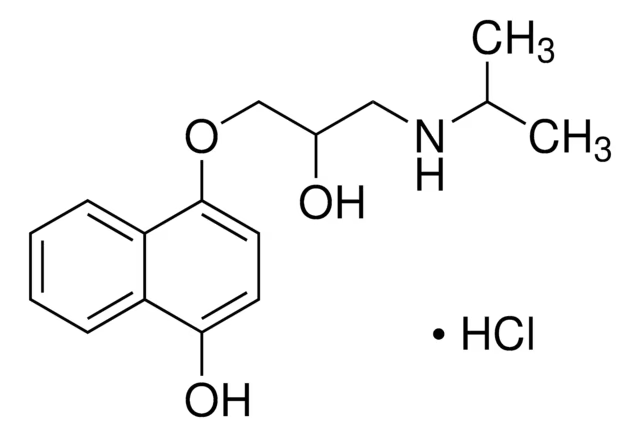
CAS Number14133-90-5
Synonyms2-Propanol, 1-((4-hydroxy-1-naphthyl)oxy)-3-(isopropylamino)-, hydrochloride; 4-(2-Hydroxy-3-((1-methylethyl)amino)propoxy)-1-naphthalenol hydrochloride; 1-Naphthalenol, 4-[2-hydroxy-3-[(1-methylethyl)amino]propoxy]-, hydrochloride (1:1); 4-hydroxy propranolol hcl; 1-Naphthalenol, 4-(2-hydroxy-3-((1-methylethyl)amino)propoxy)-, hydrochloride; 4-[2-Hydroxy-3-(isopropylamino)propoxy]-1-naphthol hydrochloride (1:1)
Molecular FormulaC16H22ClNO3
Molecular Weight311.80
Purity98.00%
Density1.168g/cm3
Boiling Point487.5ºC at 760mmHg
Melting Point156-158ºC
Symbol
Signal WordWarning
| Chemical & Physical Properties | |
|---|---|
| CAS Number | 14133-90-5 |
| Catalog No. | 2A-1180759 |
| Chinese Name | (±)-4-羟基普萘洛尔盐酸盐 |
| Synonyms | 2-Propanol, 1-((4-hydroxy-1-naphthyl)oxy)-3-(isopropylamino)-, hydrochloride; 4-(2-Hydroxy-3-((1-methylethyl)amino)propoxy)-1-naphthalenol hydrochloride; 1-Naphthalenol, 4-[2-hydroxy-3-[(1-methylethyl)amino]propoxy]-, hydrochloride (1:1); 4-hydroxy propranolol hcl; 1-Naphthalenol, 4-(2-hydroxy-3-((1-methylethyl)amino)propoxy)-, hydrochloride; 4-[2-Hydroxy-3-(isopropylamino)propoxy]-1-naphthol hydrochloride (1:1) |
| Molecular Formula | C16H22ClNO3 |
| Molecular Weight | 311.80 |
| Purity | 98.00 |
| Density | 1.168g/cm3 |
| Boiling Point | 487.5ºC at 760mmHg |
| Melting Point | 156-158ºC |
| Storage Condition | 2-8°C |
| Application | 4-Hydroxypropranolol hydrochloride is the active metabolite of Propranolol. 4-Hydroxypropranolol hydrochloride is as potent as Propranolol. 4-Hydroxypropranolol hydrochloride inhibits β1- and β2-adren |
| HTC | 2922509090 |
| PubChem ID | 329747156 |
| MDL Number | MFCD06656370 |
| SMILES | CC(C)NCC(O)COc1ccc(O)c2ccccc12.Cl |
| InChI | InChI=1S/C16H21NO3.ClH/c1-11(2)17-9-12(18)10-20-16-8-7-15(19)13-5-3-4-6-14(13)16;/h3-8,11-12,17-19H,9-10H2,1-2H3;1H |
| InChI Key | ROUJENUXWIFONU-UHFFFAOYSA-N |
| Beilstein/REAXYS | 4036845 |
| NACRES Code | NA.24 |
| UNSPSC | 41116107 |
| Hazard Symbols | transportation |
| Bioactivity | 4-Hydroxypropranolol hydrochlorid is an active metabolite of Propranolol. 4-Hydroxypropranolol hydrochlorid is of comparable potency to Propranolol. 4-Hydroxypropranolol hydrochlorid inhibits β1- and β2-adrenergic receptors with pA2 values of 8.24 and 8.26, respectively. 4-Hydroxypropranolol hydrochlorid has intrinsic sympathomimetic activity, membrane stabilizing activity and potent antioxidant properties[1][2][3]. Related Catalog Signaling Pathways >> GPCR/G Protein >> Adrenergic Receptor Research Areas >> Neurological Disease Target pA2: 8.24 (β1-adrenergic receptor) and 8.26 (β2-adrenergic receptor)[2] References [1]. Fitzgerald JD, et al. Pharmacology of 4-hydroxypropranolol, a metabolite of propranolol. Br J Pharmacol. 1971 Sep;43(1):222-35. [2]. Nelson WL, et al. The 3,4-catechol derivative of propranolol, a minor dihydroxylated metabolite. J Med Chem. 1984 Jul;27(7):857-61. [3]. Ivan Tong Mak, et al. Potent Antioxidant Properties of 4-Hydroxyl-propranolol. Journal of Pharmacology and Experimental Therapeutics. 2004, 308(1):85-90. Chemical & Physical Properties Density 1.168g/cm3 Boiling Point 487.5ºC at 760mmHg Melting Point 156-158ºC Molecular Formula C16H22ClNO3 Molecular Weight 311.804 Flash Point 248.6ºC Exact Mass 311.128815 PSA 61.72000 LogP 3.47600 InChIKey ROUJENUXWIFONU-UHFFFAOYSA-N SMILES CC(C)NCC(O)COc1ccc(O)c2ccccc12.Cl Storage condition 2-8°C |
| Use of | 4-Hydroxypropranolol hydrochlorid is an active metabolite of Propranolol. 4-Hydroxypropranolol hydrochlorid is of comparable potency to Propranolol. 4-Hydroxypropranolol hydrochlorid inhibits β1- and β2-adrenergic receptors with pA2 values of 8.24 and 8.26, respectively. 4-Hydroxypropranolol hydrochlorid has intrinsic sympathomimetic activity, membrane stabilizing activity and potent antioxidant properties[1][2][3]. Properties Articles25 Name rac-4-Hydroxy Propranolol Hydrochloride Synonym More Synonyms 4-hydroxy propranolol hcl Biological Activity Description 4-Hydroxypropranolol hydrochlorid is an active metabolite of Propranolol. 4-Hydroxypropranolol hydrochlorid is of comparable potency to Propranolol. 4-Hydroxypropranolol hydrochlorid inhibits β1- and β2-adrenergic receptors with pA2 values of 8.24 and 8.26, respectively. 4-Hydroxypropranolol hydrochlorid has intrinsic sympathomimetic activity, membrane stabilizing activity and potent antioxidant properties[1][2][3]. Related Catalog Signaling Pathways >> GPCR/G Protein >> Adrenergic Receptor Research Areas >> Neurological Disease pA2: 8.24 (β1-adrenergic receptor) and 8.26 (β2-adrenergic receptor)[2] References [1]. Fitzgerald JD, et al. Pharmacology of 4-hydroxypropranolol, a metabolite of propranolol. Br J Pharmacol. 1971 Sep;43(1):222-35. [2]. Nelson WL, et al. The 3,4-catechol derivative of propranolol, a minor dihydroxylated metabolite. J Med Chem. 1984 Jul;27(7):857-61. [3]. Ivan Tong Mak, et al. Potent Antioxidant Properties of 4-Hydroxyl-propranolol. Journal of Pharmacology and Experimental Therapeutics. 2004, 308(1):85-90. Chemical & Physical Properties Exact Mass 311.128815 PSA 61.72000 LogP 3.47600 InChIKey ROUJENUXWIFONU-UHFFFAOYSA-N |
| Tax Rebate | 13.0% |
| Supervision | A. Customs clearance form for inbound goods B. Customs clearance form for outbound goods |
| Inspection | R. Hygiene supervision and inspection of imported food S. Hygiene supervision and inspection of exported food |
| Transport Info | Shipping Name: UN |
| MSDS Transport Info | Module 14. Shipping information 14.1 UN dangerous goods number European Land Transport Dangerous Regulations: -International Maritime Dangerous Regulations: -International Air Transport Dangerous Regulations: - 14.2 United Nations shipping name European Land Transport Dangerous Regulations: Non-dangerous goods IMDG Code: Non-dangerous goods International air transport dangerous goods regulations: non-dangerous goods 14.3 Transport hazard categories European Land Transport Dangerous Regulations: -International Maritime Dangerous Regulations: -International Air Transport Dangerous Regulations: - 14.4 Package group European Land Transport Dangerous Regulations: -International Maritime Dangerous Regulations: -International Air Transport Dangerous Regulations: - 14.5 Environmental hazards European Land Transport Danger Regulations: No International Maritime Danger Regulations International Air Transport Danger Regulations: No Marine pollutants (yes/no): No 14.6 Special reminder to users No data available |
| Related Products in API & Advanced Intermediates | ||
|---|---|---|
| Tenofovir Alafenamide O-Desphenyl Impurity | 376633-26-0 | 2A-3180822 |
| prednisolone 17-ethylcarbonate | 104286-02-4 | 2A-3180823 |
| 2,3-Dehydroxy Atorvastatin Sodium Salt | 1105067-93-3 | 2A-3180824 |
| N-DESMETHYL ROSUVASTATIN-D3 | 371775-74-5 | 2A-3180827 |
| Edoxaban | 912273-65-5 | 2A-3180832 |
| indomethacin farnesil | 85801-02-1 | 2A-2181385 |
| Emtricitabine Triphosphate Triethylammonium Salt | 2A-1181619 | 2A-1181619 |
| 5-epi EMtricitabine | 145986-26-1 | 2A-1181620 |
| (-)-EMtricitabine S-Oxide (Mixture of DiastereoMers) | 152128-77-3 | 2A-1181621 |
| ent-Emtricitabine | 137530-41-7 | 2A-1181622 |
| Browse all API & Advanced Intermediates products » | ||
Phone:
630-322-8886
630-322-8887
Email:
Office Locations:
Chicago, IL, USA
San Francisco, CA, USA


 EN
EN


 SDS
SDS