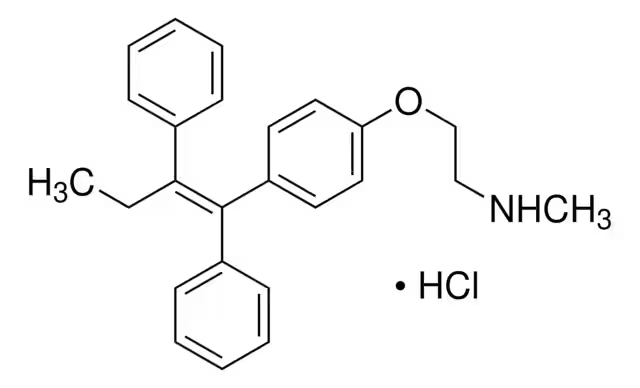
CAS Number15917-65-4
Synonyms(Z)-2-[4-(1,2-Diphenyl-1-butenyl)phenoxy]-N-methylethanamine Hydrochloride; N-Demethyltamoxifen Hydrochlorid; (Z)-2-(p-(1,2-Diphenyl-1-butenyl)phenoxy)-N-methylethylamine ICI 55,548
Molecular FormulaC25H28ClNO
Molecular Weight393.95
Purity≥98 (HPLC)%
Density1.047g/cm3
Boiling Point485.8ºC at 760mmHg
Melting Point225-227ºC
Appearancesolid
Symbol
Signal WordWarning
| Chemical & Physical Properties | |
|---|---|
| CAS Number | 15917-65-4 |
| Catalog No. | 2A-1179138 |
| Chinese Name | (Z)-2-(4-(1,2-二苯基丁-1-烯-1-基)苯氧基)-N-甲基乙胺盐酸盐 |
| Synonyms | (Z)-2-[4-(1,2-Diphenyl-1-butenyl)phenoxy]-N-methylethanamine Hydrochloride; N-Demethyltamoxifen Hydrochlorid; (Z)-2-(p-(1,2-Diphenyl-1-butenyl)phenoxy)-N-methylethylamine ICI 55,548 |
| Molecular Formula | C25H28ClNO |
| Molecular Weight | 393.95 |
| Purity | ≥98 (HPLC) |
| Density | 1.047g/cm3 |
| Boiling Point | 485.8ºC at 760mmHg |
| Melting Point | 225-227ºC |
| Appearance | solid |
| Storage Condition | room temperature |
| Application | N-Desmethyltamoxifen hydrochloride is the main metabolite of Tamoxifen in the human body. N-Desmethyltamoxifen, a weaker anti-estrogen, is a protein kinase C (PKC) inhibitor that is ten times more pot |
| PubChem ID | 329798889 |
| MDL Number | MFCD03423594 |
| SMILES | Cl.CC\C(c1ccccc1)=C(/c2ccccc2)c3ccc(OCCNC)cc3 |
| InChI | 1S/C25H27NO.ClH/c1-3-24(20-10-6-4-7-11-20)25(21-12-8-5-9-13-21)22-14-16-23(17-15-22)27-19-18-26-2;/h4-17,26H,3,18-19H2,1-2H3;1H/b25-24-; |
| InChI Key | GMLHJWZEYLTNJW-BJFQDICYSA-N |
| NACRES Code | NA.77 |
| UNSPSC | 12352203 |
| Hazard Symbols | transportation |
| MSDS | msds/179867_1_15917_65_4.pdf |
| Bioactivity | N-Desmethyltamoxifen hydrochloride is the major metabolite of tamoxifen in humans. N-Desmethyltamoxifen, a poor antiestrogen, is a ten-fold more potent protein kinase C (PKC) inhibitor than Tamoxifen. N-Desmethyltamoxifen hydrochloride is also a potent regulator of ceramide metabolism in human AML cells, limiting ceramide glycosylation, hydrolysis, and sphingosine phosphorylation[1][2][3]. Related Catalog Signaling Pathways >> Others >> Estrogen Receptor/ERR Signaling Pathways >> Epigenetics >> PKC Research Areas >> Cancer Signaling Pathways >> TGF-beta/Smad >> PKC In Vitro N-desmethyltamoxifen hydrochloride (20-500 ng/ml; 48 hours) has a profound inhibitory effect upon all seven glioma lines (T98G, U87, U138, U373, ALW, AUK, CAS cells)[1]. N-desmethyltamoxifen hydrochloride (1.5-10 μM; 114 hours) inhibits growth of MCF 7 human mammary carcinoma cells[2]. N-desmethyltamoxifen hydrochloride, resulting from the CYP3A4/5-mediated catalysis of tamoxifen, is the major primary quantitative metabolite of tamoxifen[3]. Cell Viability Assay[2] Cell Line: MCF 7 human mammary carcinoma cells Concentration: 1.5, 2.5, 5, 7.5, 10 μM Incubation Time: 114 hours Result: Inhibits growth of MCF 7 human mammary carcinoma cells Chemical & Physical Properties Density 1.047g/cm3 Boiling Point 485.8ºC at 760mmHg Melting Point 225-227ºC Molecular Formula C25H28ClNO Molecular Weight 393.94900 Flash Point 213.2ºC Exact Mass 393.18600 PSA 21.26000 LogP 6.84680 Vapour Pressure 8.21E-11mmHg at 25°C InChIKey GMLHJWZEYLTNJW-BJFQDICYSA-N SMILES CCC(=C(c1ccccc1)c1ccc(OCCNC)cc1)c1ccccc1.Cl |
| Use of | N-Desmethyltamoxifen hydrochloride is the major metabolite of tamoxifen in humans. N-Desmethyltamoxifen, a poor antiestrogen, is a ten-fold more potent protein kinase C (PKC) inhibitor than Tamoxifen. N-Desmethyltamoxifen hydrochloride is also a potent regulator of ceramide metabolism in human AML cells, limiting ceramide glycosylation, hydrolysis, and sphingosine phosphorylation[1][2][3]. Properties Name N-Desmethyl Tamoxifen Hydrochloride Synonym More Synonyms N-Desmethyltamoxifen hydrochloride Biological Activity Description N-Desmethyltamoxifen hydrochloride is the major metabolite of tamoxifen in humans. N-Desmethyltamoxifen, a poor antiestrogen, is a ten-fold more potent protein kinase C (PKC) inhibitor than Tamoxifen. N-Desmethyltamoxifen hydrochloride is also a potent regulator of ceramide metabolism in human AML cells, limiting ceramide glycosylation, hydrolysis, and sphingosine phosphorylation[1][2][3]. Related Catalog Signaling Pathways >> Others >> Estrogen Receptor/ERR Signaling Pathways >> Epigenetics >> PKC Research Areas >> Cancer Signaling Pathways >> TGF-beta/Smad >> PKC Chemical & Physical Properties Exact Mass 393.18600 PSA 21.26000 LogP 6.84680 InChIKey GMLHJWZEYLTNJW-BJFQDICYSA-N |
| Transport Info | Product name: Purity: 98.0% |
| MSDS Transport Info | Module 14. Shipping information 14.1 UN dangerous goods number European Land Transport Danger Regulations: 3077 International Maritime Transport Danger Regulations: 3077 International Air Transport Danger Regulations: 3077 14.2 Names specified by the United Nations (UN) European land transport hazard regulations: ENVIRONMENTALLY HAZARDOUS SUBSTANCE, SOLID, N.O.S. (N-Desmethyltamoxifen HCl) IMDG: ENVIRONMENTALLY HAZARDOUS SUBSTANCE, SOLID, N.O.S. (N-Desmethyltamoxifen HCl) International air transport hazard regulations: Environmentally hazardous substance, solid, n.o.s. (N-Desmethyltamoxifen HCl) 14.3 Transport hazard categories European land transport Dangerous Regulations: 9 International sea transport Dangerous Regulations: 9 International air transport Dangerous Regulations: 9 14.4 Package group European Land Transport Danger Regulations: III International Maritime Transport Danger Regulations: III International Air Transport Danger Regulations: III 14.5 Environmental hazards European Land Transport Dangerous Regulations: Yes International Maritime Transport Dangerous Regulations Maritime Pollutants: Yes International Air Transport Dangerous Regulations: Yes 14.6 Special reminder to users further information Dangerous goods are individually packaged, with liquids exceeding 5 liters or solids exceeding 5 kilograms. The outer packaging of each independent package and the combined independent inner package must have EHS on it. Identification (according to European ADR Regulation 2.2.9.1.10, IMDG Regulation 2.10.3), See reverse side of invoice or packing slip. |
| Related Products in API & Advanced Intermediates | ||
|---|---|---|
| OFLOXACIN | 83380-47-6 | 2A-1179084 |
| NORFLOXACIN LACTATE | 97867-34-0 | 2A-1179085 |
| Palonosetron Diastereomers(R.S) | 135729-73-6 | 2A-3179117 |
| PALONOSETRON HCL | 135729-75-8 | 2A-3179118 |
| N-Desmethyl-4hydroxy Tamoxifen | 170171-12-7 | 2A-1179096 |
| 6-O-Benzyl-4-dehydroxy-4-diMethylphenylsilyl Entecavir | 649761-24-0 | 2A-3179295 |
| Budesonide iMpurity | 192057-49-1 | 2A-3179302 |
| 1,2-Dehydrobudesonide | 137174-25-5 | 2A-3179306 |
| (S)-N-Methyl-N-(3-(naphthalen-1-yloxy)-3-(thiophen-2-yl)propyl)formamide/N-formyl-(S)-Duloxetine | 1243540-89-7 | 2A-3179309 |
| Daclatasvir Di-Descarbamate Impurity | 1009119-18-9 | 2A-3179354 |
| Browse all API & Advanced Intermediates products » | ||
Phone:
630-322-8886
630-322-8887
Email:
Office Locations:
Chicago, IL, USA
San Francisco, CA, USA


 EN
EN


 SDS
SDS