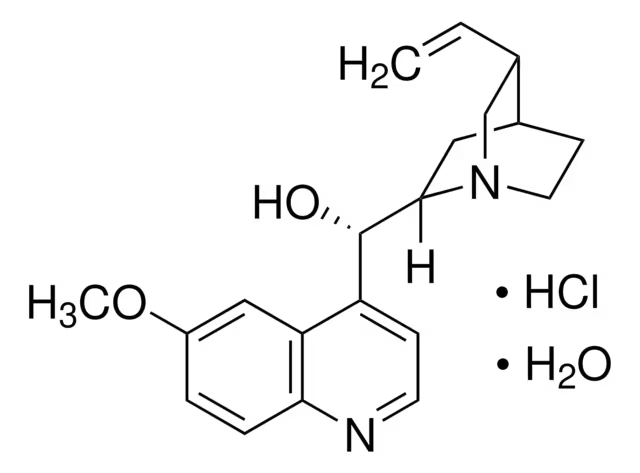
| Chemical & Physical Properties | |
|---|---|
| CAS Number | 6151-40-2 |
| Catalog No. | 2A-2178643 |
| Chinese Name | 奎寧定鹽酸鹽 |
| Synonyms | Quinidine monohydrate hydrochloride; QUINIDINE HYDROCHLORIDE MONOHYDRATE |
| Molecular Formula | C20H27ClN2O3 |
| Molecular Weight | 378.89 |
| Boiling Point | 495.9ºC at 760 mmHg |
| Melting Point | 258-259ºC |
| Storage Condition | 2-8℃ |
| Application | Quinidine hydrochloride monohydrate is a clinical antiarrhythmic drug and an effective blocker of K+ channel, with an IC50 value of 19.9 μM. |
| EINECS | 205-001-1 |
| PubChem ID | 57654579 |
| MDL Number | MFCD00198101 |
| SMILES | O.Cl.[H][C@@]1(C[C@@H]2CC[N@H]1C[C@@H]2C=C)[C@@H](O)c3ccnc4ccc(OC)cc34 |
| InChI | 1S/C20H24N2O2.ClH.H2O/c1-3-13-12-22-9-7-14(13)10-19(22)20(23)16-6-8-21-18-5-4-15(24-2)11-17(16)18;;/h3-6,8,11,13-14,19-20,23H,1,7,9-10,12H2,2H3;1H;1H2/t13-,14-,19+,20-;;/m0../s1 |
| InChI Key | SGVZDMWHXVXUBY-KAIFKDDSSA-N |
| NACRES Code | NA.22 |
| UNSPSC | 12352100 |
| MSDS | msds/179336_1_6151_40_2.pdf |
| Bioactivity | Quinidine hydrochloride monohydrate is a clinical anti-arrythmic drug which is also a potent blocker of K+ channel with an IC50 of 19.9 μM. Related Catalog Signaling Pathways >> Membrane Transporter/Ion Channel >> Potassium Channel Research Areas >> Cardiovascular Disease Research Areas >> Infection Target IC50: 19.9 μM (K+ channel)[1] In Vitro Quinidine hydrochloride monohydrate blocks WT mSlo3 (KCa5.1) channels with an IC50 of 19.9±1.41 μM and Hill slope of 1.15±0.15 (n=7). Again, the potency of inhibition by Quinidine hydrochloride monohydrate is higher for F304Y mSlo3 (IC50 of 2.42±0.60 μM, n=9, P<0.005; Hill slope of 0.98±0.12), but lower with R196Q mSlo3 (IC50 of 38.4±6.77 μM, n=5, P<0.001; Hill slope of 1.05±0.16). The inhibition of F304Y mSlo3 by Quinidine hydrochloride monohydrate is observed to have some time dependence[1]. In Vivo Direct application of Quinidine hydrochloride monohydrate on the sciatic nerve produces a dose-related decrease in amplitude at ascending somato-sensory evoked potential (SSEP) and descending compound muscle action potentials (CMAP) when comparing baseline with other time points, or when comparing the experimental left limb to the right contra-lateral glucose-treated limb. The latencies of SSEPs and CMAP potentials after Quinidine hydrochloride monohydrate applications are increased compare to baseline and the contralateral side[2]. Cell Assay Mouse (m) Slo3 (KCa5.1) channels or mutant forms are expressed in Xenopus oocytes and currents recorded with 2-electrode voltage-clamp. Gain-of-function mSlo3 mutations are used to explore the state-dependence of the inhibition. The interaction between Quinidine hydrochloride monohydrate and mSlo3 channels is modelled by in silico docking[1]. Animal Admin 24 rats are randomly divided into three groups with eight rats in each group. Groups Q1, Q3, and Q5 receive Quinidine hydrochloride monohydrate 1, 3, and 5 μmol, respectively, in 5 % glucose 0.1 mL. The sciatic nerve is exposed by making an incision from the left sciatic notch to the distal thigh. The subcutaneous tissue is bluntly dissected to expose the biceps femoris. The sciatic nerve is freed from its investing fascia. The procedure is then repeated on the right side. The somato-sensory evoked potential (SSEP) and compound muscle action potentials (CMAP) are recorded at baseline, immediately after Quinidine hydrochloride monohydrate treatment, then every 15 min thereafter for 1 h, then every 30 min thereafter for 3 h. The animals are allowed to recover and then kept separately for 2 weeks. After performing behavioral examinations, electrophysiological examinations are performed with the animals under intra-peritoneal anesthesia[2]. References [1]. Wrighton DC, et al. Mechanism of inhibition of mouse Slo3 (KCa 5.1) potassium channels by quinine, quinidine and barium. Br J Pharmacol. 2015 Sep;172(17):4355-63. [2]. Cheng KI, et al. Application of quinidine on rat sciatic nerve decreases the amplitude and increases the latency of evoked responses. J Anesth. 2014 Aug;28(4):559-68. Chemical & Physical Properties Boiling Point 495.9ºC at 760 mmHg Melting Point 258-259ºC Molecular Formula C20H27ClN2O3 Molecular Weight 378.89300 Flash Point 253.7ºC Exact Mass 378.17100 PSA 54.82000 LogP 3.84880 InChIKey SGVZDMWHXVXUBY-KAIFKDDSSA-N SMILES C=CC1CN2CCC1CC2C(O)c1ccnc2ccc(OC)cc12.Cl.O Storage condition 2-8℃ |
| Use of | Quinidine hydrochloride monohydrate is a clinical anti-arrythmic drug which is also a potent blocker of K+ channel with an IC50 of 19.9 μM. Properties Name quinidine hydrochloride Synonym More Synonyms Quinidine hydrochloride monohydrate Biological Activity Description Quinidine hydrochloride monohydrate is a clinical anti-arrythmic drug which is also a potent blocker of K+ channel with an IC50 of 19.9 μM. Related Catalog Signaling Pathways >> Membrane Transporter/Ion Channel >> Potassium Channel Research Areas >> Cardiovascular Disease Research Areas >> Infection IC50: 19.9 μM (K+ channel)[1] In Vivo Direct application of Quinidine hydrochloride monohydrate on the sciatic nerve produces a dose-related decrease in amplitude at ascending somato-sensory evoked potential (SSEP) and descending compound muscle action potentials (CMAP) when comparing baseline with other time points, or when comparing the experimental left limb to the right contra-lateral glucose-treated limb. The latencies of SSEPs and CMAP potentials after Quinidine hydrochloride monohydrate applications are increased compare to baseline and the contralateral side[2]. References [1]. Wrighton DC, et al. Mechanism of inhibition of mouse Slo3 (KCa 5.1) potassium channels by quinine, quinidine and barium. Br J Pharmacol. 2015 Sep;172(17):4355-63. [2]. Cheng KI, et al. Application of quinidine on rat sciatic nerve decreases the amplitude and increases the latency of evoked responses. J Anesth. 2014 Aug;28(4):559-68. Chemical & Physical Properties Exact Mass 378.17100 PSA 54.82000 LogP 3.84880 InChIKey SGVZDMWHXVXUBY-KAIFKDDSSA-N Storage condition 2-8℃ |
| Transport Info | Product Name: Quinidine Hydrochloride Monohydrate |
| Related Products in Alkaloids | ||
|---|---|---|
| rac-N-Deacetyl Colchiceine | 2A-3177445 | 2A-3177445 |
| Dihydroergotamine Mesylate Impurity D (2_-epi- 9, 10 -dihydroergotamine) | 2A-3177610 | 2A-3177610 |
| Isopilocarpine | 2A-3177679 | 2A-3177679 |
| ergotamine | 113-15-5 | 2A-1177722 |
| pyrrolizidine-7α-acetic acid methyl ester | 78449-76-0 | 2A-4178450 |
| Taxol C | 153415-45-3 | 2A-3180295 |
| NITINE(BENZYL ANALOG OF TAXOL)(P) | 173101-56-9 | 2A-3180299 |
| XYLOTAXOL, 7-(RG) | 90332-66-4 | 2A-3180302 |
| BUTYL ANALOG OF TAXOL, n-(RG) | 173101-55-8 | 2A-3180304 |
| Betaxolol Impurity | 131564-69-7 | 2A-3180446 |
| Browse all Alkaloids products » | ||
Phone:
630-322-8886
630-322-8887
Email:
Office Locations:
Chicago, IL, USA
San Francisco, CA, USA


 EN
EN


 SDS
SDS