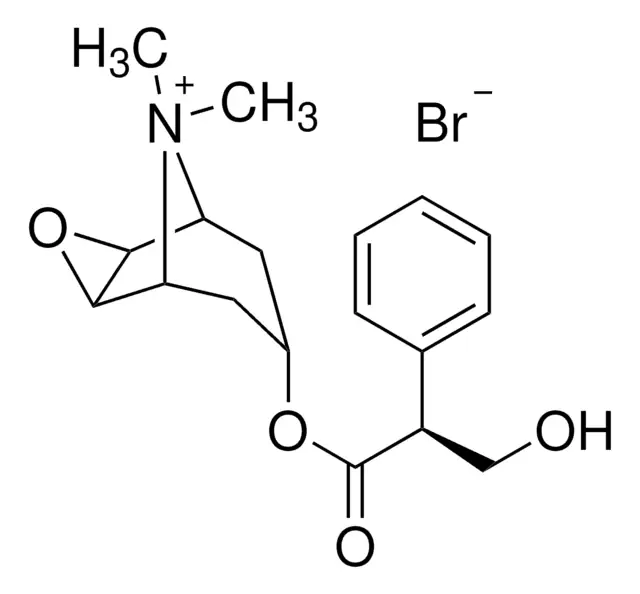
CAS Number155-41-9
SynonymsEpoxymethamine bromide; Nutrop; Methylscopolamine bromide; N-Methylscopolamine Bromide; (-)-Scopolamine Methobromide; Neo-avagal; N-Methylhyoscine bromide; N-methyl scopolammonium bromide; Scopolamine methobromide; Methscopolamine (bromide); Restropin; Scopolamin methylbromide; scopolamine methylbromide; Holopan; (−)-Scopolamine methyl bromide Hyoscine methyl bromide Methscopolamine bromide; 6b,7b-Epoxy-3a-hydroxy-8-methyl-1aH,5aH-tropanium Bromide; Paraspan; EINECS 205-844-5; Lescopine bromide; (-)-N-methylscopolamine bromide; Methylbromide Scopolamine; Pamine; Pamine Bromide; Methscopolamine Bromide; Blocan; N-Methylscopolammonium bromide; Methscopolamine methylbromide; MFCD00078560; Diopal; Holopon
Molecular FormulaC18H24BrNO4
Molecular Weight398.29
Appearancewhite powder
| Chemical & Physical Properties | |
|---|---|
| CAS Number | 155-41-9 |
| Catalog No. | 2A-2178639 |
| Chinese Name | 甲溴东莨菪碱 |
| Synonyms | Epoxymethamine bromide; Nutrop; Methylscopolamine bromide; N-Methylscopolamine Bromide; (-)-Scopolamine Methobromide; Neo-avagal; N-Methylhyoscine bromide; N-methyl scopolammonium bromide; Scopolamine methobromide; Methscopolamine (bromide); Restropin; Scopolamin methylbromide; scopolamine methylbromide; Holopan; (−)-Scopolamine methyl bromide Hyoscine methyl bromide Methscopolamine bromide; 6b,7b-Epoxy-3a-hydroxy-8-methyl-1aH,5aH-tropanium Bromide; Paraspan; EINECS 205-844-5; Lescopine bromide; (-)-N-methylscopolamine bromide; Methylbromide Scopolamine; Pamine; Pamine Bromide; Methscopolamine Bromide; Blocan; N-Methylscopolammonium bromide; Methscopolamine methylbromide; MFCD00078560; Diopal; Holopon |
| Molecular Formula | C18H24BrNO4 |
| Molecular Weight | 398.29 |
| Appearance | white powder |
| Water Solubility | H2O: 50 mg/mL |
| Storage Condition | Room temperature, sealed, dry |
| Packaging | III |
| Application | Methscopolamine (Pamine) is a muscarinic acetylcholine receptor (mAChR) blocker. |
| HTC | 2934999090 |
| MDL Number | MFCD00078560 |
| SMILES | [Br-].[H][C@]12C[C@@H](C[C@]([H])([C@@]3([H])O[C@@]13[H])[N+]2(C)C)OC(=O)[C@H](CO)c4ccccc4 |
| InChI | 1S/C18H24NO4.BrH/c1-19(2)14-8-12(9-15(19)17-16(14)23-17)22-18(21)13(10-20)11-6-4-3-5-7-11;/h3-7,12-17,20H,8-10H2,1-2H3;1H/q+1;/p-1/t12-,13-,14-,15+,16-,17+;/m1./s1 |
| InChI Key | CXYRUNPLKGGUJF-RAFJPFSSSA-M |
| NACRES Code | NA.24 |
| UNSPSC | 41116107 |
| MSDS | msds/179325_1_155_41_9.pdf |
| Bioactivity | Methscopolamine (Pamine) is a muscarinic acetylcholine receptor blocker. Target: mAChRMethylscopolamine is an oral medication used along with other medications to treat peptic ulcers by reducing stomach acid secretion. With the advent of proton pump inhibitors and antihistamine medications it is rarely used for this. It can also be used for stomach or intestinal spasms, to reduce salivation, and to treat motion sickness. From Wikipedia.Methscopolamine (Pamine), an anti-acetylcholine drug, prevented ulcer formation, reduced further volume and acid output but produced a 3-4 fold increase in hexosamine concentration. Tissue (corpus and antrum) hexosamine was moderately reduced by restraint. In the corpus, this was counteracted by methscopolamine but antrum hexosamine was not influenced by this drug. The anti-ulcer property of methscopolamine may be due not only to its effect on acid secretion but also to the rise in gastric mucus concentration that it produced [1]. Related Catalog Signaling Pathways >> GPCR/G Protein >> mAChR Signaling Pathways >> Neuronal Signaling >> mAChR Research Areas >> Inflammation/Immunology References [1]. Robert, A. and J.E. Nezamis, Effect of an Anti-Acetylcholine Drug, Methscopolamine Bromide, on Ulcer Formation and Gastric Mucus. J Pharm Pharmacol, 1964. 16: p. 690-5. [2]. Kong Q, et al. Effects of pharmacological treatments on hippocampal NCAM1 and ERK2 expression in epileptic rats with cognitive dysfunction. Oncol Lett. 2016 Sep;12(3):1783-1791. Chemical & Physical Properties Molecular Formula C18H24BrNO4 Molecular Weight 398.292 Exact Mass 397.088867 PSA 59.06000 Index of Refraction -24 ° (C=1, H2O) InChIKey LZCOQTDXKCNBEE-XJMZPCNVSA-N SMILES C[N+]1(C)C2CC(OC(=O)C(CO)c3ccccc3)CC1C1OC12 Water Solubility H2O: 50 mg/mL |
| Use of | Methscopolamine (Pamine) is a muscarinic acetylcholine receptor blocker. Target: mAChRMethylscopolamine is an oral medication used along with other medications to treat peptic ulcers by reducing stomach acid secretion. With the advent of proton pump inhibitors and antihistamine medications it is rarely used for this. It can also be used for stomach or intestinal spasms, to reduce salivation, and to treat motion sickness. From Wikipedia.Methscopolamine (Pamine), an anti-acetylcholine drug, prevented ulcer formation, reduced further volume and acid output but produced a 3-4 fold increase in hexosamine concentration. Tissue (corpus and antrum) hexosamine was moderately reduced by restraint. In the corpus, this was counteracted by methscopolamine but antrum hexosamine was not influenced by this drug. The anti-ulcer property of methscopolamine may be due not only to its effect on acid secretion but also to the rise in gastric mucus concentration that it produced [1]. Properties Articles38 Name scopolamine methobromide Synonym More Synonyms Methscopolamine (bromide) Biological Activity Description Methscopolamine (Pamine) is a muscarinic acetylcholine receptor blocker. Target: mAChRMethylscopolamine is an oral medication used along with other medications to treat peptic ulcers by reducing stomach acid secretion. With the advent of proton pump inhibitors and antihistamine medications it is rarely used for this. It can also be used for stomach or intestinal spasms, to reduce salivation, and to treat motion sickness. From Wikipedia.Methscopolamine (Pamine), an anti-acetylcholine drug, prevented ulcer formation, reduced further volume and acid output but produced a 3-4 fold increase in hexosamine concentration. Tissue (corpus and antrum) hexosamine was moderately reduced by restraint. In the corpus, this was counteracted by methscopolamine but antrum hexosamine was not influenced by this drug. The anti-ulcer property of methscopolamine may be due not only to its effect on acid secretion but also to the rise in gastric mucus concentration that it produced [1]. Related Catalog Signaling Pathways >> GPCR/G Protein >> mAChR Signaling Pathways >> Neuronal Signaling >> mAChR Research Areas >> Inflammation/Immunology References [1]. Robert, A. and J.E. Nezamis, Effect of an Anti-Acetylcholine Drug, Methscopolamine Bromide, on Ulcer Formation and Gastric Mucus. J Pharm Pharmacol, 1964. 16: p. 690-5. [2]. Kong Q, et al. Effects of pharmacological treatments on hippocampal NCAM1 and ERK2 expression in epileptic rats with cognitive dysfunction. Oncol Lett. 2016 Sep;12(3):1783-1791. Chemical & Physical Properties Molecular Formula C18H24BrNO4 Exact Mass 397.088867 PSA 59.06000 InChIKey LZCOQTDXKCNBEE-XJMZPCNVSA-N |
| Tax Rebate | 13.0% |
| Supervision | None. MFN tariff: 6.5%. Ordinary tariff: 20.0% |
| Transport Info | Product name: Purity: 98.0% |
| MSDS Transport Info | Module 14. Shipping information United Nations classification: Item 1 Poisons. UN number: 1544 Formal shipping name: Alkaloid, solid, not otherwise specified Packing grade: III |
| Related Products in Specialty Chemicals | ||
|---|---|---|
| 1-BROMO-2-(2,2-DIETHOXY-ETHYLSULFANYL)-BENZENE | 137105-52-3 | 2A-1178633 |
| 5-amino-2-phenylpyridazin-3(2H)-one | 13589-77-0 | 2A-1178636 |
| HYDROXYHEXAMIDE | 3168-01-2 | 2A-2178634 |
| ETHAMIVAN | 304-84-7 | 2A-2178637 |
| 1,4-dibroMo-2,3-difluoro-5,6-dinitrobenzene | 1283598-32-2 | 2A-1178640 |
| Methyl 4-carbaMiMidoylbenzoate acetate | 1172889-96-1 | 2A-1178643 |
| DICHLORISONE ACETATE | 79-61-8 | 2A-2178648 |
| Q-VD-OPh hydrate | 1135695-98-5 | 2A-2178649 |
| 2-bromo-4-chlorobutyrophenone | 1011-26-3 | 2A-1178650 |
| 4,4'-VINYLIDENEBIS(N,N-DIMETHYLANILINE) | 7478-69-5 | 2A-1178654 |
| Browse all Specialty Chemicals products » | ||
Phone:
630-322-8886
630-322-8887
Email:
Office Locations:
Chicago, IL, USA
San Francisco, CA, USA


 EN
EN


 SDS
SDS