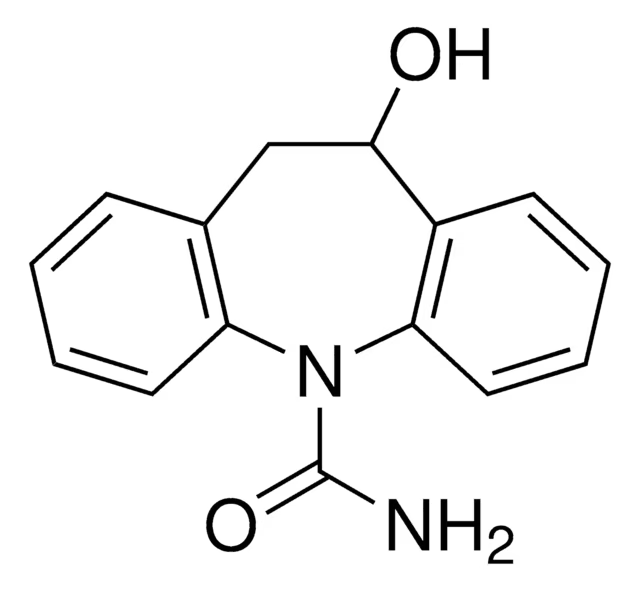
CAS Number29331-92-8
Synonyms10,11-Dihydro-10-hydroxy-5H-dibenz[b,f]azepine-5-carboxamide,Licarbazepine; Licarbazepine,10,11-Dihydro-10-hydroxy-5H-dibenz(Z)[b,f]azepin-5-carboxamide; 10,11-Dihydro-10-hydroxy Carbamazepine; 10,11-Dihydro-10-hydroxycarbamazepine
Molecular FormulaC15H14N2O2
Molecular Weight254.28
Density1.336g/cm3
Boiling Point431.3ºC at 760mmHg
Melting Point186-189ºC
Appearanceliquid
Symbol
Signal WordWarning
| Chemical & Physical Properties | |
|---|---|
| CAS Number | 29331-92-8 |
| Catalog No. | 2A-3177350 |
| Chinese Name | 10-羟基-10,11-二氢-5H-二苯并[b,f]氮杂卓-5-甲酰胺 |
| Synonyms | 10,11-Dihydro-10-hydroxy-5H-dibenz[b,f]azepine-5-carboxamide,Licarbazepine; Licarbazepine,10,11-Dihydro-10-hydroxy-5H-dibenz(Z)[b,f]azepin-5-carboxamide; 10,11-Dihydro-10-hydroxy Carbamazepine; 10,11-Dihydro-10-hydroxycarbamazepine |
| Molecular Formula | C15H14N2O2 |
| Molecular Weight | 254.28 |
| Density | 1.336g/cm3 |
| Boiling Point | 431.3ºC at 760mmHg |
| Melting Point | 186-189ºC |
| Appearance | liquid |
| Storage Condition | Store at RT |
| Application | Ricarbadipine (BIA 2-005; GP 47779) is a voltage-gated sodium channel blocker with anticonvulsant and mood-stabilizing effects [1]. |
| HTC | 2933990090 |
| PubChem ID | 329798649 |
| MDL Number | MFCD00871817 |
| SMILES | OC1C2=C(C=CC=C2)N(C(N)=O)C3=C(C=CC=C3)C1 |
| InChI | 1S/C15H14N2O2/c16-15(19)17-12-7-3-1-5-10(12)9-14(18)11-6-2-4-8-13(11)17/h1-8,14,18H,9H2,(H2,16,19) |
| InChI Key | BMPDWHIDQYTSHX-UHFFFAOYSA-N |
| NACRES Code | NA.24 |
| UNSPSC | 41116107 |
| Hazard Symbols | transportation |
| MSDS | msds/177918_1_29331_92_8.pdf |
| Bioactivity | Licarbazepine (BIA 2-005; GP 47779) is a voltage-gated sodium channel blocker with anticonvulsant and mood-stabilizing effects[1]. Related Catalog Signaling Pathways >> Membrane Transporter/Ion Channel >> Sodium Channel Research Areas >> Neurological Disease Target Sodium Channel[1] In Vivo Eslicarbazepine acetate (ESL) is an oral pro-drug that is rapidly and extensively metabolized by the liver via a hydrolytic first-pass metabolism into S-Licarbazepine, the biologically active drug. The plasma level of the prodrug remains below quantification[1]. ESL is a potent antiepileptic agent with a spectrum of action essentially limited to partial-onset and generalized tonic-clonic seizures. Its main mechanism of action is by blocking the voltage-gated sodium channel. ESL works by blocking the voltage-gated sodium channel, which play an essential role in the generation and propagation of the epileptic discharge. ESL is well absorbed after oral administration with a bio-availability about 16% higher than that observed after an equivalent dose of Oxcarbazepine (OXC)[1]. References [1]. Rajinder P Singh, et al. A review of eslicarbazepine acetate for the adjunctive treatment of partial-onset epilepsy. J Cent Nerv Syst Dis. 2011 Jul 20;3:179-87. Chemical & Physical Properties Density 1.336g/cm3 Boiling Point 431.3ºC at 760mmHg Melting Point 186-189ºC Molecular Formula C15H14N2O2 Molecular Weight 254.28400 Flash Point 214.6ºC Exact Mass 254.10600 PSA 66.56000 LogP 3.25820 Vapour Pressure 3.33E-08mmHg at 25°C Index of Refraction 1.677 InChIKey BMPDWHIDQYTSHX-UHFFFAOYSA-N SMILES NC(=O)N1c2ccccc2CC(O)c2ccccc21 Storage condition Store at RT |
| Use of | Licarbazepine (BIA 2-005; GP 47779) is a voltage-gated sodium channel blocker with anticonvulsant and mood-stabilizing effects[1]. Properties Name Licarbazepine Synonym More Synonyms Licarbazepine Biological Activity Description Licarbazepine (BIA 2-005; GP 47779) is a voltage-gated sodium channel blocker with anticonvulsant and mood-stabilizing effects[1]. Related Catalog Signaling Pathways >> Membrane Transporter/Ion Channel >> Sodium Channel Research Areas >> Neurological Disease Sodium Channel[1] In Vivo Eslicarbazepine acetate (ESL) is an oral pro-drug that is rapidly and extensively metabolized by the liver via a hydrolytic first-pass metabolism into S-Licarbazepine, the biologically active drug. The plasma level of the prodrug remains below quantification[1]. ESL is a potent antiepileptic agent with a spectrum of action essentially limited to partial-onset and generalized tonic-clonic seizures. Its main mechanism of action is by blocking the voltage-gated sodium channel. ESL works by blocking the voltage-gated sodium channel, which play an essential role in the generation and propagation of the epileptic discharge. ESL is well absorbed after oral administration with a bio-availability about 16% higher than that observed after an equivalent dose of Oxcarbazepine (OXC)[1]. References [1]. Rajinder P Singh, et al. A review of eslicarbazepine acetate for the adjunctive treatment of partial-onset epilepsy. J Cent Nerv Syst Dis. 2011 Jul 20;3:179-87. Chemical & Physical Properties Molecular Formula C15H14N2O2 Exact Mass 254.10600 PSA 66.56000 LogP 3.25820 Index of Refraction 1.677 InChIKey BMPDWHIDQYTSHX-UHFFFAOYSA-N Storage condition Store at RT |
| Tax Rebate | 13.0% |
| Supervision | None. MFN tariff: 6.5%. Ordinary tariff: 20.0% |
| Transport Info | Shipping Name: UN |
| MSDS Transport Info | Module 14. Shipping information 14.1 UN dangerous goods number European Land Transport Danger Regulations: 3077 International Maritime Transport Danger Regulations: 3077 International Air Transport Danger Regulations: 3077 14.2 United Nations shipping name European land transport hazard regulations: ENVIRONMENTALLY HAZARDOUS SUBSTANCE, SOLID, N.O.S. (10,11-Dihydro-10- Hydroxycarbamazepine) IMDG: ENVIRONMENTALLY HAZARDOUS SUBSTANCE, SOLID, N.O.S. (10,11-Dihydro-10- Hydroxycarbamazepine) International air transport hazard regulations: Environmentally hazardous substance, solid, n.o.s. (10,11-Dihydro-10- Hydroxycarbamazepine) 14.3 Transport hazard categories European land transport Dangerous Regulations: 9 International sea transport Dangerous Regulations: 9 International air transport Dangerous Regulations: 9 14.4 Package group European Land Transport Danger Regulations: III International Maritime Transport Danger Regulations: III International Air Transport Danger Regulations: III 14.5 Environmental hazards European Land Transport Dangerous Regulations: Yes International Maritime Transport Dangerous Regulations International Air Transport Dangerous Regulations: Yes Marine Pollutants (Yes/No): Yes 14.6 Special reminder to users further information Dangerous goods are individually packaged, with liquids exceeding 5 liters or solids exceeding 5 kilograms. The outer packaging of each independent package and the combined independent inner package must have EHS on it. Identification (according to European ADR Regulation 2.2.9.1.10, IMDG Regulation 2.10.3), |
| Related Products in Specialty Chemicals | ||
|---|---|---|
| IN-QCC64 (5B intermediate) | 117428-95-2 | 2A-1177318 |
| 5-METHYL-3-HEPTANONE | 541-85-5 | 2A-1177322 |
| Bumadizon sodium | 14467-30-2 | 2A-3177324 |
| Bupivacaine N-Oxide | 1346597-81-6 | 2A-3177325 |
| Cabergoline N-oxide | 2A-3177331 | 2A-3177331 |
| N-Acetyl SLB-1 | 28291-60-3 | 2A-3177351 |
| (1H-indol-3-yl)(2,2,3,3-tetramethylcyclopropyl)methanone | 895152-66-6 | 2A-2177352 |
| N-Acetyl SLB | 2A-3177353 | 2A-3177353 |
| 4-Hydroxy Carbazeran | 96724-43-5 | 2A-3177354 |
| AKOS B033273 | 524955-09-7 | 2A-2177366 |
| Browse all Specialty Chemicals products » | ||
Phone:
630-322-8886
630-322-8887
Email:
Office Locations:
Chicago, IL, USA
San Francisco, CA, USA


 EN
EN


 SDS
SDS