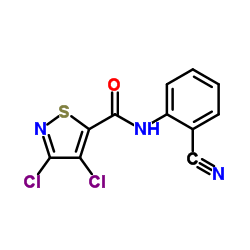
CAS Number224049-04-1
Synonyms3,4-Dichloro-2 inverted exclamation marka-cyano-1,2-thiazole-5-carboxanilide; 5-Isothiazolecarboxamide,3,4-dichloro-N-(2-cyanophenyl); 3,4-dichloro-N-(2-cyanophenyl)isothiazole-5-carboxamide; T5NSJ CVMR BCN& DG EG; 3,4-Dichloro-N-(2-cyanophenyl)-5-Isothiazolecarboxamide; 3,4-dichloro-2-cyano-1,2-thiazole-5-carboxanilide; 3,4-dichloro-isothiazol-5-carboxylic acid-(2-cyano-phenyl)-amide; 3,4-dichloro-N-(2-cyano-phenyl)-isothiazol-5-carboxamide; 3,4-Dichloro-N-(2-cyanophenyl)-1,2-thiazole-5-carboxamide; 3,4-dichloro-2'-cyano-1,2-thiazole-5-carboxanilide; 3,4-dichloro-isothiazole-5-cyanoanilide; UNII-482Y0NQC01; isotianil; Isotianil [ISO]; 3,4-Dichloro-2'-cyano-1,2-thiazole-5-carboxanilide
Molecular FormulaC11H5Cl2N3OS
Molecular Weight298.148
Density1.6±0.1 g/cm3
Boiling Point322.8±42.0 °C at 760 mmHg
Symbol
Signal WordWarning
| Chemical & Physical Properties | |
|---|---|
| CAS Number | 224049-04-1 |
| Catalog No. | 2A-1177308 |
| Chinese Name | 异噻菌胺 |
| Synonyms | 3,4-Dichloro-2 inverted exclamation marka-cyano-1,2-thiazole-5-carboxanilide; 5-Isothiazolecarboxamide,3,4-dichloro-N-(2-cyanophenyl); 3,4-dichloro-N-(2-cyanophenyl)isothiazole-5-carboxamide; T5NSJ CVMR BCN& DG EG; 3,4-Dichloro-N-(2-cyanophenyl)-5-Isothiazolecarboxamide; 3,4-dichloro-2-cyano-1,2-thiazole-5-carboxanilide; 3,4-dichloro-isothiazol-5-carboxylic acid-(2-cyano-phenyl)-amide; 3,4-dichloro-N-(2-cyano-phenyl)-isothiazol-5-carboxamide; 3,4-Dichloro-N-(2-cyanophenyl)-1,2-thiazole-5-carboxamide; 3,4-dichloro-2'-cyano-1,2-thiazole-5-carboxanilide; 3,4-dichloro-isothiazole-5-cyanoanilide; UNII-482Y0NQC01; isotianil; Isotianil [ISO]; 3,4-Dichloro-2'-cyano-1,2-thiazole-5-carboxanilide |
| Molecular Formula | C11H5Cl2N3OS |
| Molecular Weight | 298.148 |
| Density | 1.6±0.1 g/cm3 |
| Boiling Point | 322.8±42.0 °C at 760 mmHg |
| Application | Isotianil is a plant defense inducer that has no direct antibacterial effect but activates typical plant defense responses. Isotianil can be used as a plant protection agent to control rice blast [1]. |
| SMILES | N#Cc1ccccc1NC(=O)c1snc(Cl)c1Cl |
| InChI Key | WLPCAERCXQSYLQ-UHFFFAOYSA-N |
| Hazard Symbols | transportation |
| MSDS | msds/177875_2_224049_04_1.pdf |
| Bioactivity | Isotianil is a plant defense inducer that has no direct antimicrobial effect but instead activates typical plant defense responses. Isotianil can be used as a plant protection agent for controlling rice blast[1]. Related Catalog Research Areas >> Others Signaling Pathways >> Others >> Others In Vitro Isotianil (0.1-100 ppm, 2 days) can induce the accumulation of endogenous plant disease resistance-related enzymes such as lipoxygenase, phenylalanine ammonia-lyase and chitinase in rice tissues. Induces disease resistance-related genes, including WRKY45[1]. Isotianil has good preventive effects against leaf blast at lower doses and shows plant resistance induction against a variety of bacterial diseases, including bacterial seedling rot caused by Burkholderia [1]. Isotianil effectively protects seedling wheat plants against the virulent MoT isolate BR32, preventing the invasive growth of MoT from progressing from the initially attacked epidermal cells to the mesophyll [2]. References [1]. Ogawa M, Kadowaki A, Yamada T, et al. 1-15. [2]. Katharina Portz, et al. Wheat blast caused by Magnaporthe oryzae pathovar Triticum is efficiently controlled by the plant defense inducer isotianil. Journal of Plant Diseases and Protection volume 128, pages249-259 (2021). Chemical & Physical Properties Density 1.6±0.1 g/cm3 Boiling Point 322.8±42.0 °C at 760 mmHg Molecular Formula C11H5Cl2N3OS Molecular Weight 298.148 Flash Point 149.0±27.9 °C Exact Mass 296.953033 PSA 97.51000 LogP 2.13 Vapor Pressure 0.0±0.7 mmHg at 25°C Index of Refraction 1.675 InChIKey WLPCAERCXQSYLQ-UHFFFAOYSA-N SMILES N#Cc1ccccc1NC(=O)c1snc(Cl)c1Cl |
| Use of | Isotianil is a plant defense inducer that has no direct antimicrobial effect but instead activates typical plant defense responses. Properties Name isotianil Synonym More Synonyms isotianil Biological Activity Description Isotianil is a plant defense inducer that has no direct antimicrobial effect but instead activates typical plant defense responses. Catalog Research Areas >> Others Signaling Pathways >> Others >> Others In Vitro Isotianil (0.1-100 ppm, 2 days) can induce the accumulation of endogenous plant disease resistance-related enzymes such as lipoxygenase, phenylalanine ammonia lyase and chitinase in rice tissues. Induces disease resistance-related genes, including WRKY45[1]. Isotianil has good preventive effects against leaf blast at lower doses and shows plant resistance induction against a variety of bacterial diseases, including bacterial seedling rot caused by Burkholderia [1]. Isotianil effectively protects seedling wheat plants against the virulent MoT isolate BR32, preventing the invasive growth of MoT from progressing from the initially attacked epidermal cells to the mesophyll [2]. References [1]. Ogawa M, Kadowaki A, Yamada T, et al. 1-15. [2]. Katharina Portz, et al. Wheat blast caused by Magnaporthe oryzae pathovar Triticum is efficiently controlled by the plant defense inducer isotianil. Journal of Plant Diseases and Protection volume 128, pages249-259 (2021). Chemical & Physical Properties Exact Mass 296.953033 PSA 97.51000 Index of Refraction 1.675 InChIKey WLPCAERCXQSYLQ-UHFFFAOYSA-N |
| Transport Info | Product name: Purity: 98.0% |
| MSDS Transport Info | Module 14. Shipping information 14.1 UN dangerous goods number European Land Transport Dangerous Regulations: -International Maritime Dangerous Regulations: -International Air Transport Dangerous Regulations: - 14.2 Names specified by the United Nations (UN) European Land Transport Dangerous Regulations: Non-dangerous goods IMDG Code: Non-dangerous goods International air transport dangerous goods regulations: non-dangerous goods 14.3 Transport hazard categories European Land Transport Dangerous Regulations: -International Maritime Dangerous Regulations: -International Air Transport Dangerous Regulations: - 14.4 Package group European Land Transport Dangerous Regulations: -International Maritime Dangerous Regulations: -International Air Transport Dangerous Regulations: - 14.5 Environmental hazards European Land Transport Dangerous Regulations: No International Maritime Transport Dangerous Regulations Maritime Pollutants: No International Air Transport Risk Regulations: No 14.6 Special reminder to users No data available |
| Related Products in Specialty Chemicals | ||
|---|---|---|
| Fluoxastrobin | 193740-76-0 | 2A-1177298 |
| Benthiavalicarb-isopropyl | 177406-68-7 | 2A-1177299 |
| Benalaxyl-M | 98243-83-5 | 2A-1177301 |
| DIMOXYSTROBIN PESTANAL | 149961-52-4 | 2A-1177305 |
| DIFLUMETORIM | 130339-07-0 | 2A-1177307 |
| Metaflumizone | 139968-49-3 | 2A-1177312 |
| prothioconazole-desthio | 120983-64-4 | 2A-1177316 |
| N/A | 193741-67-2 | 2A-1177317 |
| IN-QCC64 (5B intermediate) | 117428-95-2 | 2A-1177318 |
| 5-METHYL-3-HEPTANONE | 541-85-5 | 2A-1177322 |
| Browse all Specialty Chemicals products » | ||
Phone:
630-322-8886
630-322-8887
Email:
Office Locations:
Chicago, IL, USA
San Francisco, CA, USA


 EN
EN


 SDS
SDS