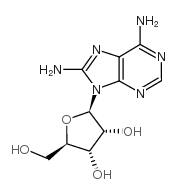
CAS Number3868-33-5
Synonyms8-Amino-adenosin; 8-Amino Adenosine; 8-Aminoadenosine; 8-Amino-D-adenosine
Molecular FormulaC10H14N6O4
Molecular Weight282.26
Purity≥98 (HPLC)%
Density2.25g/cm3
Boiling Point747.1ºC at 760mmHg
Melting Point180-185ºC dec.
Appearancepowder
Symbol
Signal WordWarning
| Chemical & Physical Properties | |
|---|---|
| CAS Number | 3868-33-5 |
| Catalog No. | 2A-2176232 |
| Chinese Name | 8-氨基腺苷酸 |
| Synonyms | 8-Amino-adenosin; 8-Amino Adenosine; 8-Aminoadenosine; 8-Amino-D-adenosine |
| Molecular Formula | C10H14N6O4 |
| Molecular Weight | 282.26 |
| Purity | ≥98 (HPLC) |
| Density | 2.25g/cm3 |
| Boiling Point | 747.1ºC at 760mmHg |
| Melting Point | 180-185ºC dec. |
| Appearance | powder |
| Water Solubility | H2O: soluble2mg/mL, clear (warmed) |
| Storage Condition | -20?C Freezer |
| Application | 8-Aminoadenosine (8-NH2-Ado), an RNA-directed nucleoside analog, reduces cellular ATP levels and inhibits mRNA synthesis. 8-Aminoadenosine blocks Akt/mTOR signaling and induces autophagy and apoptosis |
| SMILES | [n]2(c3ncnc(c3nc2N)N)C1OC(C(C1O)O)CO |
| InChI | 1S/C10H14N6O4/c11-7-4-8(14-2-13-7)16(10(12)15-4)9-6(19)5(18)3(1-17)20-9/h2-3,5-6,9,17-19H,1H2,(H2,12,15)(H2,11,13,14) |
| InChI Key | DVGWFQILDUEEGX-UHFFFAOYSA-N |
| NACRES Code | NA.77 |
| UNSPSC | 12352200 |
| Hazard Symbols | transportation |
| MSDS | msds/176742_1_3868_33_5.pdf |
| Bioactivity | 8-Aminoadenosine (8-NH2-Ado), a RNA-directed nucleoside analogue, reduces cellular ATP levels and inhibits mRNA synthesis. 8-Aminoadenosine blocks Akt/mTOR signaling and induces autophagy and apoptosis in a p53-independent manner. 8-Aminoadenosine has antitumor activity[1][2][3]. Related Catalog Signaling Pathways >> PI3K/Akt/mTOR >> mTOR Signaling Pathways >> Apoptosis >> Apoptosis Research Areas >> Cancer Signaling Pathways >> Cell Cycle/DNA Damage >> DNA/RNA Synthesis Signaling Pathways >> Autophagy >> Autophagy Signaling Pathways >> PI3K/Akt/mTOR >> Akt Target Akt mTOR In Vitro 8-Aminoadenosine (8-NH2-Ado; 0.1-10 μM; for 48 h) has IC50s of 1.5 μM and 8.88 μM in MM.1S and U266 cells, respectively[1]. 8-Aminoadenosine (10 μM; for 24 h) induces significant apoptotic death of MCF-7 cells in p53-independent pathway. 8-Aminoadenosine causes PARP cleavage in MCF-7 cells[2]. 8-Aminoadenosine (3 μM; 0.5-4 h) induces autophagy in the MM.1S cell line[1]. 8-Aminoadenosine (3 μM; 2-16 h) causes a greater drop in ATP levels in the MM.1S cells[1]. 8-Aminoadenosine (3 μM; 5 h) causes a 50% reduction in glucose consumption in MM.1S cells[1]. 8-Aminoadenosine (3 μM; 5 h) indicates a time-dependent decrease in GLUT1 expression at 5 h, whereas at 24 h there was a down-regulation of both transporters (GLUT1 and GLUT4) in MM.1S cells[1]. 8-Aminoadenosine inhibits cell proliferation, activated cell death, and does not activate transcription of the p53 target gene p21 or increase protein levels of either p53 or p21[1]. The toxic effects of 8-Aminoadenosine require adenosine kinase activity to convert 8-Aminoadenosine to 8-NH2-ATP in adenosine kinase-deficient cells[1]. Cell Viability Assay[1] Cell Line: MM.1S and U266 cells Concentration: 0.1, 0.3, 1, 3, 10 μM Incubation Time: For 48 hours Result: Had IC50s of 1.5 μM and 8.88 μM in MM.1S and U266 cells, respectively. Apoptosis Analysis[2] Cell Line: MCF-7 cells Concentration: 10 μM Incubation Time: For 24 hours Result: Induced significant apoptotic death. Apoptosis was not inhibited by knockdown of functional p53. Apoptosis Analysis[1] Cell Line: MM.1S cell line Concentration: 3 μM Incubation Time: 0.5, 1, 1.5, 2, 2.5, 3, 3.5, 4 hours Result: Induced the formation of LC3-II protein. Caused the appearance of a population with a high AVO content with 1 μM for 24 hours. References [1]. Mala Shanmugam, et al. Targeting glucose consumption and autophagy in myeloma with the novel nucleoside analogue 8-aminoadenosine. J Biol Chem. 2009 Sep 25;284(39):26816-30. [2]. Alla Polotskaia, et al. 8-Amino-adenosine activates p53-independent cell death of metastatic breast cancers. Mol Cancer Ther. 2012 Nov;11(11):2495-504. [3]. Jennifer Ann Frey, et al. 8-Amino-adenosine inhibits multiple mechanisms of transcription. Mol Cancer Ther. 2010 Jan;9(1):236-45. Chemical & Physical Properties Density 2.25g/cm3 Boiling Point 747.1ºC at 760mmHg Melting Point 180-185ºC dec. Molecular Formula C10H14N6O4 Molecular Weight 282.26 Flash Point 405.6ºC Exact Mass 282.10800 PSA 165.56000 Appearance of Characters white to beige InChIKey DVGWFQILDUEEGX-UUOKFMHZSA-N SMILES Nc1ncnc2c1nc(N)n2C1OC(CO)C(O)C1O Storage condition -20?C Freezer Water Solubility H2O: soluble2mg/mL, clear (warmed) |
| Use of | 8-Aminoadenosine (8-NH2-Ado), a RNA-directed nucleoside analogue, reduces cellular ATP levels and inhibits mRNA synthesis. 8-Aminoadenosine blocks Akt/mTOR signaling and induces autophagy and apoptosis in a p53-independent manner. 8-Aminoadenosine has antitumor activity[1][2][3]. Properties Articles10 Name 8-aminoadenosine Synonym More Synonyms 8-Aminoadenosine Biological Activity Description 8-Aminoadenosine (8-NH2-Ado), a RNA-directed nucleoside analogue, reduces cellular ATP levels and inhibits mRNA synthesis. 8-Aminoadenosine blocks Akt/mTOR signaling and induces autophagy and apoptosis in a p53-independent manner. 8-Aminoadenosine has antitumor activity[1][2][3]. Related Catalog Signaling Pathways >> PI3K/Akt/mTOR >> mTOR Signaling Pathways >> Apoptosis >> Apoptosis Research Areas >> Cancer Signaling Pathways >> Cell Cycle/DNA Damage >> DNA/RNA Synthesis Signaling Pathways >> Autophagy >> Autophagy Signaling Pathways >> PI3K/Akt/mTOR >> Akt References [1]. Mala Shanmugam, et al. Targeting glucose consumption and autophagy in myeloma with the novel nucleoside analogue 8-aminoadenosine. J Biol Chem. 2009 Sep 25;284(39):26816-30. [2]. Alla Polotskaia, et al. 8-Amino-adenosine activates p53-independent cell death of metastatic breast cancers. Mol Cancer Ther. 2012 Nov;11(11):2495-504. [3]. Jennifer Ann Frey, et al. 8-Amino-adenosine inhibits multiple mechanisms of transcription. Mol Cancer Ther. 2010 Jan;9(1):236-45. Chemical & Physical Properties Molecular Formula C10H14N6O4 Exact Mass 282.10800 PSA 165.56000 Appearance of Characters white to beige InChIKey DVGWFQILDUEEGX-UUOKFMHZSA-N Storage condition -20?C Freezer |
| Transport Info | Shipping Name: UN |
| MSDS Transport Info | Module 14. Shipping information European Dangerous Regulations for land transport: 2811 International Dangerous Regulations for sea transport: 2811 International Dangerous Regulations for air transport: 2811 14.2 United Nations shipping name European Land Transport Dangerous Regulations: TOXIC SOLID, ORGANIC, N.O.S. (8-Aminoadenosine) IMDG Code: TOXIC SOLID, ORGANIC, N.O.S. (8-Aminoadenosine) International air transport hazard regulations: Toxic solid, organic, n.o.s. (8-Aminoadenosine) 14.3 Transport hazard categories European Land Transport Danger Regulations: 6.1 International Maritime Transport Danger Regulations: 6.1 International Air Transport Danger Regulations: 6.1 14.4 Package group European Land Transport Danger Regulations: III International Maritime Transport Danger Regulations: III International Air Transport Danger Regulations: III 14.5 Environmental hazards European Land Transport Danger Regulations: No International Maritime Danger Regulations International Air Transport Danger Regulations: No Marine pollutants (yes/no): No 14.6 Special reminder to users No data available |
| Related Products in Biotechnology & Diagnostics | ||
|---|---|---|
| 2-Boc-amino-4-formylpyridine | 304873-65-2 | 2A-2175899 |
| N-alpha-Fmoc-N-epsilon-4-methoxytrityl-L-lysine | 159857-60-0 | 2A-2176103 |
| 3-(Boc-amino)-5-trifluoromethyl-pyridine | 1187055-61-3 | 2A-2176112 |
| 6-Boc-1,6-diazaspiro[3.4] | 1158749-79-1 | 2A-2176221 |
| N-FMOC-L-2-AMINOPHENYLPENTANIOC ACID | 959578-11-1 | 2A-2176228 |
| Boc-D-tert-Leucino | 142618-92-6 | 2A-2176506 |
| 1-BOC-4-(4-BROMO-PHENYLAMINO)-PIPERIDINE | 443998-65-0 | 2A-1176525 |
| FMoc-PNA-A(Bhoc)-OH | 186046-82-2 | 2A-2176543 |
| FMoc-PNA-C(Bhoc)-OH | 186046-81-1 | 2A-2176544 |
| FMoc-PNA-G(Bhoc)-OH | 186046-83-3 | 2A-2176546 |
| Browse all Biotechnology & Diagnostics products » | ||
Phone:
630-322-8886
630-322-8887
Email:
Office Locations:
Chicago, IL, USA
San Francisco, CA, USA


 EN
EN


 SDS
SDS