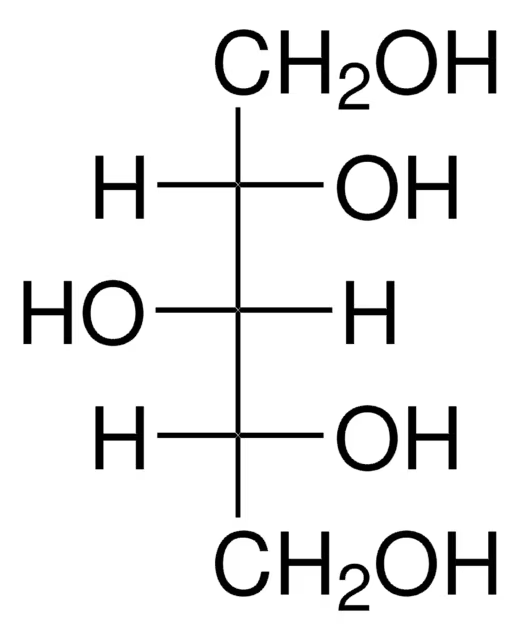
CAS Number87-99-0
Synonymskannit; EINECS 201-788-0; (2R,3r,4S)-1,2,3,4,5-Pentanepentol; Xylo-oligosaccharide; 1,2,3,4,5-PENTAHYDROXYPENTANE; MFCD00064292; xylo-Pentane-1,2,3,4,5-pentol; newtol; D-Xylitol; Klinit; Kylit; Xylitol; (2R,3r,4S)-1,2,3,4,5-Pentanpentol; Meso-X; XYLIT; (2R,3r,4S)-pentane-1,2,3,4,5-pentol; XYLITOL, CERTIFIED REFERENCE MATERIAL; eutrit; Xilite; XYLITE; meso-xylitol; Q1YQYQYQ1Q &&Xylo Form
Molecular FormulaHOCH2[CH(OH)]3CH2OH
Molecular Weight152.15
Purity≥99 (GC)%
Density1.5±0.1 g/cm3
Boiling Point494.5±40.0 °C at 760 mmHg
Melting Point94-97 °C (lit.)
Appearancecrystalline
EINECS201-788-0
Symbol
Signal WordWarning
| Chemical & Physical Properties | |
|---|---|
| CAS Number | 87-99-0 |
| Catalog No. | 2A-9017546 |
| Chinese Name | 木糖醇 |
| Synonyms | kannit; EINECS 201-788-0; (2R,3r,4S)-1,2,3,4,5-Pentanepentol; Xylo-oligosaccharide; 1,2,3,4,5-PENTAHYDROXYPENTANE; MFCD00064292; xylo-Pentane-1,2,3,4,5-pentol; newtol; D-Xylitol; Klinit; Kylit; Xylitol; (2R,3r,4S)-1,2,3,4,5-Pentanpentol; Meso-X; XYLIT; (2R,3r,4S)-pentane-1,2,3,4,5-pentol; XYLITOL, CERTIFIED REFERENCE MATERIAL; eutrit; Xilite; XYLITE; meso-xylitol; Q1YQYQYQ1Q &&Xylo Form |
| Molecular Formula | HOCH2[CH(OH)]3CH2OH |
| Molecular Weight | 152.15 |
| Purity | ≥99 (GC) |
| Density | 1.5±0.1 g/cm3 |
| Boiling Point | 494.5±40.0 °C at 760 mmHg |
| Melting Point | 94-97 °C (lit.) |
| Appearance | crystalline |
| Water Solubility | SOLUBLE |
| Storage Condition | Solid products are packaged in double-layer kraft |
| Application | Xylitol can be classified as polyols and sugar alcohols. |
| EINECS | 201-788-0 |
| HTC | 2905491000 |
| PubChem ID | 24902140 |
| MDL Number | MFCD00064292 |
| SMILES | OC[C@@H](O)[C@H](O)[C@@H](O)CO |
| InChI | 1S/C5H12O5/c6-1-3(8)5(10)4(9)2-7/h3-10H,1-2H2/t3-,4+,5+ |
| InChI Key | HEBKCHPVOIAQTA-SCDXWVJYSA-N |
| Beilstein/REAXYS | 1720523 |
| NACRES Code | NA.25 |
| UNSPSC | 12352201 |
| Hazard Symbols | Transport |
| MSDS | msds/17546_1_87_99_0.pdf |
| Bioactivity | Xylitol is a chemical categorized as a polyalcohol or sugar alcohol.Target: OthersXylitol is a chemical categorized as a polyalcohol or sugar alcohol (alditol). Xylitol has the formula (CHOH)3(CH2OH)2 and is an achiral isomer of pentane-1,2,3,4,5-pentol. Xylitol is used as a diabetic sweetener which is roughly as sweet as sucrose with 33% fewer calories. Unlike other natural or synthetic sweeteners, xylitol is actively beneficial for dental health by reducing caries to a third in regular use and helpful to remineralization. Xylitol is naturally found in low concentrations in the fibers of many fruits and vegetables, and can be extracted from various berries, oats, and mushrooms, as well as fibrous material such as corn husks and sugar cane bagasse and birch. Related Catalog Signaling Pathways >> Autophagy >> Autophagy Research Areas >> Others Natural Products >> Saccharides and Glycosides References [1]. http://en.wikipedia.org/wiki/Xylitol Chemical & Physical Properties Density 1.5±0.1 g/cm3 Boiling Point 494.5±40.0 °C at 760 mmHg Melting Point 94-97 °C(lit.) Molecular Formula C5H12O5 Molecular Weight 152.146 Flash Point 261.9±21.9 °C Exact Mass 152.068466 PSA 101.15000 LogP -3.77 Vapour Pressure 0.0±2.9 mmHg at 25°C Index of Refraction 1.571 Storage condition 2-8°C Water Solubility SOLUBLE |
| Use of | Xylitol is a chemical categorized as a polyalcohol or sugar alcohol.Target: OthersXylitol is a chemical categorized as a polyalcohol or sugar alcohol (alditol). Xylitol has the formula (CHOH)3(CH2OH)2 and is an achiral isomer of pentane-1,2,3,4,5-pentol. Xylitol is used as a diabetic sweetener which is roughly as sweet as sucrose with 33% fewer calories. Unlike other natural or synthetic sweeteners, xylitol is actively beneficial for dental health by reducing caries to a third in regular use and helpful to remineralization. Xylitol is naturally found in low concentrations in the fibers of many fruits and vegetables, and can be extracted from various berries, oats, and mushrooms, as well as fibrous material such as corn husks and sugar cane bagasse and birch. Properties Articles85 Name xylitol Synonym More Synonyms Xylitol Biological Activity Description Xylitol is a chemical categorized as a polyalcohol or sugar alcohol.Target: OthersXylitol is a chemical categorized as a polyalcohol or sugar alcohol (alditol). Xylitol has the formula (CHOH)3(CH2OH)2 and is an achiral isomer of pentane-1,2,3,4,5-pentol. Xylitol is used as a diabetic sweetener which is roughly as sweet as sucrose with 33% fewer calories. Unlike other natural or synthetic sweeteners, xylitol is actively beneficial for dental health by reducing caries to a third in regular use and helpful to remineralization. Xylitol is naturally found in low concentrations in the fibers of many fruits and vegetables, and can be extracted from various berries, oats, and mushrooms, as well as fibrous material such as corn husks and sugar cane bagasse and birch. Related Catalog Signaling Pathways >> Autophagy >> Autophagy Research Areas >> Others Natural Products >> Saccharides and Glycosides References [1]. http://en.wikipedia.org/wiki/Xylitol Chemical & Physical Properties Molecular Formula C5H12O5 Exact Mass 152.068466 PSA 101.15000 LogP -3.77 Index of Refraction 1.571 Water Solubility SOLUBLE |
| Tax Rebate | 9.0% |
| Supervision | A. Customs clearance form for inbound goods B. Customs clearance form for outbound goods |
| Inspection | R. Hygiene supervision and inspection of imported food S. Hygiene supervision and inspection of exported food |
| Transport Info | Product name: Purity: 0.0% |
| MSDS Transport Info | Module 14. Shipping information 14.1 UN dangerous goods number European Land Transport Dangerous Regulations: -International Maritime Dangerous Regulations: -International Air Transport Dangerous Regulations: - 14.2 Names specified by the United Nations (UN) European Land Transport Dangerous Regulations: Non-dangerous goods IMDG Code: Non-dangerous goods International air transport dangerous goods regulations: non-dangerous goods 14.3 Transport hazard categories European Land Transport Dangerous Regulations: -International Maritime Dangerous Regulations: -International Air Transport Dangerous Regulations: - 14.4 Package group European Land Transport Dangerous Regulations: -International Maritime Dangerous Regulations: -International Air Transport Dangerous Regulations: - 14.5 Environmental hazards European Land Transport Dangerous Regulations: No International Maritime Transport Dangerous Regulations Maritime Pollutants: No International Air Transport Risk Regulations: No 14.6 Special reminder to users No data available |
| Related Products in Specialty Chemicals | ||
|---|---|---|
| D-Glucaric acid | 87-73-0 | 2A-9017537 |
| Mannitol | 87-78-5 | 2A-9017538 |
| L-(-)-Sorbose | 87-79-6 | 2A-9017539 |
| D-Tagatose | 87-81-0 | 2A-9017540 |
| Dibutyl L-(+)-tartrate | 87-92-3 | 2A-9017545 |
| 4-Chloro-3,5-dimethylphenol | 88-04-0 | 2A-9017547 |
| 2,4,6-Trimethylaniline | 88-05-1 | 2A-9017548 |
| 2-Ethylbutyric acid | 88-09-5 | 2A-9017550 |
| 2-Furoic acid | 88-14-2 | 2A-9017555 |
| 2-Chlorobenzotrifluoride | 88-16-4 | 2A-9017557 |
| Browse all Specialty Chemicals products » | ||
Phone:
630-322-8886
630-322-8887
Email:
Office Locations:
Chicago, IL, USA
San Francisco, CA, USA


 EN
EN


 SDS
SDS