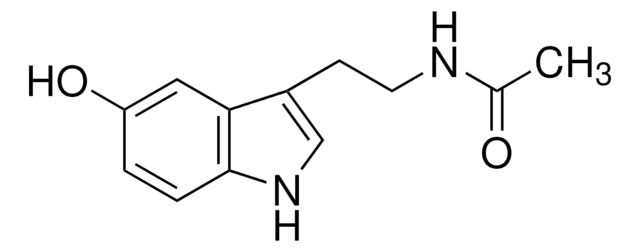
CAS Number1210-83-9
SynonymsEINECS 214-916-5; N-acetyl-5-HT; N-Acetylserotonin; 3-(2-Acetamidoethyl)-5-hydroxyindole; Normelatonin; N-Acetylserotonin,Normelatonin; N-Acetylserotonin Normelatonin; N-[2-(5-Hydroxy-1H-indol-3-yl)ethyl]acetamide; N-Acetyl-5-hydroxytryptamine; N-acetyl-serotonin; MFCD00005656; 5-Hydroxymelatonin; 5-Hydroxy-N-acetyltryptamine; N-ACETYL SEROTONIN
Molecular FormulaC12H14N2O2
Molecular Weight218.25
Purity≥99 (HPLC)%
Density1.3±0.1 g/cm3
Boiling Point556.8±40.0 °C at 760 mmHg
Melting Point120-122 °C (lit.)
Appearancepowder
EINECS214-916-5
Symbol
Signal WordWarning
| Chemical & Physical Properties | |
|---|---|
| CAS Number | 1210-83-9 |
| Catalog No. | 2A-2174682 |
| Chinese Name | N-乙酰-5-羟基色胺 |
| Synonyms | EINECS 214-916-5; N-acetyl-5-HT; N-Acetylserotonin; 3-(2-Acetamidoethyl)-5-hydroxyindole; Normelatonin; N-Acetylserotonin,Normelatonin; N-Acetylserotonin Normelatonin; N-[2-(5-Hydroxy-1H-indol-3-yl)ethyl]acetamide; N-Acetyl-5-hydroxytryptamine; N-acetyl-serotonin; MFCD00005656; 5-Hydroxymelatonin; 5-Hydroxy-N-acetyltryptamine; N-ACETYL SEROTONIN |
| Molecular Formula | C12H14N2O2 |
| Molecular Weight | 218.25 |
| Purity | ≥99 (HPLC) |
| Density | 1.3±0.1 g/cm3 |
| Boiling Point | 556.8±40.0 °C at 760 mmHg |
| Melting Point | 120-122 °C (lit.) |
| Appearance | powder |
| Water Solubility | ethanol: 50 mg/mL |
| Storage Condition | 1. Store sealed at 2 ºC-8 ºC |
| Application | N-Acetyl-5-hydroxytryptamine is a melatonin precursor that effectively activates TrkB receptors. |
| EINECS | 214-916-5 |
| HTC | 2933990090 |
| PubChem ID | 24278209 |
| MDL Number | MFCD00005656 |
| SMILES | CC(=O)NCCc1c[nH]c2ccc(O)cc12 |
| InChI | 1S/C12H14N2O2/c1-8(15)13-5-4-9-7-14-12-3-2-10(16)6-11(9)12/h2-3,6-7,14,16H,4-5H2,1H3,(H,13,15) |
| InChI Key | MVAWJSIDNICKHF-UHFFFAOYSA-N |
| NACRES Code | NA.32 |
| UNSPSC | 12352209 |
| Hazard Symbols | transportation |
| MSDS | msds/175049_1_1210_83_9.pdf |
| Bioactivity | N-Acetyl-5-hydroxytryptamine is a Melatonin precursor, and that it can potently activate TrkB receptor. Related Catalog Signaling Pathways >> Protein Tyrosine Kinase/RTK >> Trk Receptor Research Areas >> Neurological Disease Natural Products >> Others Target Human Endogenous Metabolite TrkB In Vitro N-Acetyl-5-hydroxytryptamine (NAS), a precursor of Melatonin, is acetylated from serotonin by AANAT (arylalkylamine N-acetyltransferase). N-acetylserotonin activates TrkB receptor in a circadian rhythm. N-Acetyl-5-hydroxytryptamine swiftly activates TrkB in a circadian manner and exhibits antidepressant effect in a TrkB-dependent manner. N-Acetyl-5-hydroxytryptamine rapidly activates TrkB, but not TrkA or TrkC, in a neurotrophin- and MT3 receptor-independent manner[1]. In Vivo To explore whether N-Acetyl-5-hydroxytryptamine, can trigger TrkB activation in vivo, TrkB F616A knockin mice are employed, where it has been shown that TrkB F616A activation can be selectively blocked by 1NMPP1, a derivative of kinase inhibitor PP1, leading to TrkB-null phenotypes. To assess whether N-Acetyl-5-hydroxytryptamine can mimic BDNF, cortical neurons from TrkB F616A knockin mice are prepared. In alignment with a previous report, BDNF- and NAS-mediated TrkB phosphorylation are selectively reduced by 1NMPP1 but not by K252a, whereas serotonin or Melatonin had no effect . These findings suggest that NAS strongly provokes both wild-type TrkB and TrkB F616A tyrosine phosphorylation and activation[1]. Animal Admin Mice[1] Two-month-old TrkB F616A mice are pretreated with 1NMPP1 in drinking water (50 μM) 1 day before the experiment, followed by administration of N-Acetyl-5-hydroxytryptamine (20 mg/kg, i.p.) or Melatonin (1 mg/kg, i.p.). Mice are killed at 1 h. The brain homogenates are analyzed by immunoblotting with anti-p-TrkB. Two- to three-month-old BDNF forebrain conditional knockout mice are injected i.p. with N-Acetyl-5-hydroxytryptamine or Melatonin. Mice are killed at 0, 0.5, 1, or 2 h following drug administration. Brain lysates are prepared and analyzed by immunoblotting with anti-phospho-TrkB Y816[1]. References [1]. Jang SW, et al. N-acetylserotonin activates TrkB receptor in a circadian rhythm. Proc Natl Acad Sci U S A. 2010 Feb 23;107(8):3876-81. Chemical & Physical Properties Density 1.3±0.1 g/cm3 Boiling Point 556.8±40.0 °C at 760 mmHg Melting Point 120-122 °C(lit.) Molecular Formula C12H14N2O2 Molecular Weight 218.252 Flash Point 290.6±27.3 °C Exact Mass 218.105530 PSA 65.12000 LogP -0.13 Vapour Pressure 0.0±1.6 mmHg at 25°C Index of Refraction 1.651 InChIKey MVAWJSIDNICKHF-UHFFFAOYSA-N SMILES CC(=O)NCCc1c[nH]c2ccc(O)cc12 Storage condition 2-8°C Water Solubility ethanol: 50 mg/mL |
| Use of | N-Acetyl-5-hydroxytryptamine is a Melatonin precursor, and that it can potently activate TrkB receptor. Properties Articles37 Name N-acetylserotonin Synonym More Synonyms N-Acetylserotonin Biological Activity Description N-Acetyl-5-hydroxytryptamine is a Melatonin precursor, and that it can potently activate TrkB receptor. Related Catalog Signaling Pathways >> Protein Tyrosine Kinase/RTK >> Trk Receptor Research Areas >> Neurological Disease Natural Products >> Others Human Endogenous Metabolite In Vitro N-Acetyl-5-hydroxytryptamine (NAS), a precursor of Melatonin, is acetylated from serotonin by AANAT (arylalkylamine N-acetyltransferase). N-acetylserotonin activates TrkB receptor in a circadian rhythm. N-Acetyl-5-hydroxytryptamine swiftly activates TrkB in a circadian manner and exhibits antidepressant effect in a TrkB-dependent manner. N-Acetyl-5-hydroxytryptamine rapidly activates TrkB, but not TrkA or TrkC, in a neurotrophin- and MT3 receptor-independent manner[1]. In Vivo To explore whether N-Acetyl-5-hydroxytryptamine, can trigger TrkB activation in vivo, TrkB F616A knockin mice are employed, where it has been shown that TrkB F616A activation can be selectively blocked by 1NMPP1, a derivative of kinase inhibitor PP1, leading to TrkB-null phenotypes. To assess whether N-Acetyl-5-hydroxytryptamine can mimic BDNF, cortical neurons from TrkB F616A knockin mice are prepared. In alignment with a previous report, BDNF- and NAS-mediated TrkB phosphorylation are selectively reduced by 1NMPP1 but not by K252a, whereas serotonin or Melatonin had no effect . These findings suggest that NAS strongly provokes both wild-type TrkB and TrkB F616A tyrosine phosphorylation and activation[1]. References [1]. Jang SW, et al. N-acetylserotonin activates TrkB receptor in a circadian rhythm. Proc Natl Acad Sci U S A. 2010 Feb 23;107(8):3876-81. Chemical & Physical Properties Molecular Formula C12H14N2O2 Exact Mass 218.105530 PSA 65.12000 LogP -0.13 Index of Refraction 1.651 InChIKey MVAWJSIDNICKHF-UHFFFAOYSA-N |
| Tax Rebate | 13.0% |
| Supervision | None. MFN tariff: 6.5%. Ordinary tariff: 20.0% |
| Transport Info | Product name: Purity: 98.0% |
| MSDS Transport Info | Module 14. Shipping information 14.1 UN dangerous goods number European Land Transport Dangerous Regulations: -International Maritime Dangerous Regulations: -International Air Transport Dangerous Regulations: - 14.2 Names specified by the United Nations (UN) European Land Transport Dangerous Regulations: Non-dangerous goods IMDG Code: Non-dangerous goods International air transport dangerous goods regulations: non-dangerous goods 14.3 Transport hazard categories European Land Transport Dangerous Regulations: -International Maritime Dangerous Regulations: -International Air Transport Dangerous Regulations: - 14.4 Package group European Land Transport Dangerous Regulations: -International Maritime Dangerous Regulations: -International Air Transport Dangerous Regulations: - 14.5 Environmental hazards European Land Transport Dangerous Regulations: No International Maritime Transport Dangerous Regulations Maritime Pollutants: No International Air Transport Risk Regulations: No 14.6 Special reminder to users No data available |
| Related Products in Specialty Chemicals | ||
|---|---|---|
| Ruthenium, [1,3-bis(2,4,6-trimethylphenyl)-2-imidazolidinylidene]dichloro[[2-(1-methylethoxy-κO)-5-n | 502964-52-5 | 2A-3174659 |
| Ruthenium, carbonylchlorohydro[Bis(tricyclohexylphosphine)] | 40935-25-9 | 2A-2174661 |
| Ruthenium, carbonylchloro[1,3-dihydro-1,3-bis(2,4,6-trimethylphenyl)-2H-imidazol-2-ylidene]hydro(tricyclohexylphosphine) | 330197-31-4 | 2A-3174662 |
| Ruthenium, [1,3-bis(2,4,6-trimethylphenyl)-2-imidazolidinylidene]carbonylchlorohydro(tricyclohexylphosphine)-, (SP-5-53)- | 508172-17-6 | 2A-3174663 |
| Cycloheptene-5-one | 19686-79-4 | 2A-2174680 |
| RACEMIC-4,12-DIBROMO[2,2]PARACYCLOPHANE | 23927-40-4 | 2A-3174698 |
| N,N-Dimethyl-3-cyclopenten-1-amine | 220247-88-1 | 2A-3174702 |
| 2-hexyl-decanoic acid | 25354-97-6 | 2A-3174704 |
| Ascorbyl3-AminopropylhydrogenPhosphate | 220644-17-7 | 2A-3174705 |
| Sodium Polyglutamate | 28829-38-1 | 2A-3174706 |
| Browse all Specialty Chemicals products » | ||
Phone:
630-322-8886
630-322-8887
Email:
Office Locations:
Chicago, IL, USA
San Francisco, CA, USA


 EN
EN


 SDS
SDS