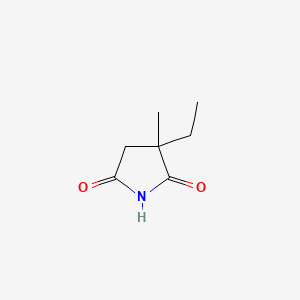
CAS Number77-67-8
Synonyms(±)-Ethosuximide; 2-Methyl-2-ethylsuccinimide; 3-Ethyl-3-methylpyrrolidine-2,5-dione; 2-Ethyl-2-methylsuccinimide; MFCD00072123; Ethymal; Zarontin; α-Ethyl-α-methylsuccinimide; Etosuximida; Zarondan; Petinimid; Suxilep; 3-ethyl-3-methyl-pyrrolidine-2,5-dione; Ethosuximide; Emeside; thosuximide; Suxinutin; EINECS 201-048-7; UNII:5SEH9X1D1D; 3-ethyl-3-methylsuccinimide; (±)-2-Ethyl-2-methylsuccinimide; 3-Aethyl-3-methyl-pyrrolidin-2,5-dion; Petnidan; 3-Ethyl-3-methyl-2,5-pyrrolidinedione
Molecular FormulaC7H11NO2
Molecular Weight141.168
Purity98%%
Density1.1±0.1 g/cm3
Boiling Point265.3±9.0 °C at 760 mmHg
Melting Point51ºC
AppearanceSolid;White to Almost white powder to crystal
Symbol
Signal WordWarning
| Chemical & Physical Properties | |
|---|---|
| CAS Number | 77-67-8 |
| Catalog No. | 2A-1172351 |
| Chinese Name | 乙琥胺 |
| Synonyms | (±)-Ethosuximide; 2-Methyl-2-ethylsuccinimide; 3-Ethyl-3-methylpyrrolidine-2,5-dione; 2-Ethyl-2-methylsuccinimide; MFCD00072123; Ethymal; Zarontin; α-Ethyl-α-methylsuccinimide; Etosuximida; Zarondan; Petinimid; Suxilep; 3-ethyl-3-methyl-pyrrolidine-2,5-dione; Ethosuximide; Emeside; thosuximide; Suxinutin; EINECS 201-048-7; UNII:5SEH9X1D1D; 3-ethyl-3-methylsuccinimide; (±)-2-Ethyl-2-methylsuccinimide; 3-Aethyl-3-methyl-pyrrolidin-2,5-dion; Petnidan; 3-Ethyl-3-methyl-2,5-pyrrolidinedione |
| Molecular Formula | C7H11NO2 |
| Molecular Weight | 141.168 |
| Purity | 98% |
| Density | 1.1±0.1 g/cm3 |
| Boiling Point | 265.3±9.0 °C at 760 mmHg |
| Melting Point | 51ºC |
| Appearance | Solid;White to Almost white powder to crystal |
| Water Solubility | ethanol: 100 mg/mL |
| Storage Condition | This product should be stored in a sealed containe |
| Application | Ethosuximide is a widely used antiepileptic drug that improves the phenotypes of multiple neurodegenerative disease models and blocks low-voltage-activated T-type calcium channels. |
| HTC | 2925190090 |
| PubChem ID | 9708 |
| SMILES | CCC1(C)CC(=O)NC1=O |
| InChI | InChI=1S/C7H11NO2/c1-3-7(2)4-5(9)8-6(7)10/h3-4H2,1-2H3,(H,8,9,10) |
| InChI Key | HAPOVYFOVVWLRS-UHFFFAOYSA-N |
| Hazard Symbols | transportation |
| MSDS | msds/172604_2_77_67_8.pdf |
| Bioactivity | Ethosuximide, a widely prescribed anti-epileptic drug, improves the phenotypes of multiple neurodegenerative disease models and blocks the low voltage activated T-type calcium channel. Related Catalog Signaling Pathways >> Membrane Transporter/Ion Channel >> Calcium Channel Research Areas >> Neurological Disease Target calcium channel[1] In Vitro The efficacy of Ethosuximide in generalized absence epilepsy is thought to be due to blockade of the low voltage activated T-type calcium channel. There is no reduction in total Tau levels in Ethosuximide treated Tau transgenic worms as compare to vehicle controls. The rescuing effect of Ethosuximide is therefore not due to transgene suppression or reduced expression of toxic mutant Tau protein. Quantification of the amount of soluble and insoluble (RIPA-extractable) Tau relative to total Tau levels reveals a significant reduction in aberrantly-folded, insoluble Tau and a corresponding increase in soluble Tau in Ethosuximide-treated compare with untreated worms[1]. Concentrations of 2 μM or more of Ethosuximide not only are found to be less effective than 1 μM concentration of Ethosuximide, but also induce cell toxicity. GABA staining immunofluorescence images show that after treatment with Ethosuximide, GABA positive neuron increases by 3 and 6.5 fold for concentrations of 0.1 and 1 μM, respectively. BrdU staining shows nuclei proliferation after 2 to 3 days of Ethosuximide exposure. The mean of nuclei is 15.98±0.41 for the low concentration of Ethosuximide while it is 25.27±0.48 for the high concentration after Brdu staining. This number is 11.05±0.2 for lithium chloride[2]. Kinase Assay Vehicle- and Ethosuximide-treated Tau V337M worms are lysed and separated into soluble and insoluble fractions. Fractions are separated by SDS-PAGE and western blotted using anti-human Tau T46 and anti-actin antibodies. The abundance of Tau protein in each fraction is quantified by densitometry and normalized against beta-actin. Total Tau levels in lysates are expressed as the percentage of actin-normalized Tau relative to vehicle control lysates; Tau levels in sequentially extracted fractions are expressed as the percentage of actin-normalized Tau relative to the sum of both fractions (soluble+RIPA) combined[1]. Cell Assay Neuronal stem cells from the forebrain Cortex of a 3-day-old rat are used in this study. The cells are differentiated by withdrawal of basic fibroblastic growth factor (bFGF) and exposed to Ethosuximide at two concentrations of 0.1 μM and 1 μM. Before drug treatment, the cells are rinsed once with PBS, and the medium is replaced with fresh, bFGF-free DMEM/F12 medium containing different concentration of Ethosuximide. Medium exchange is done every day for 6 days with medium containing Ethosuximide. Then, cells are fixed for immunocytochemistry[2]. References [1]. Chen X, et al. Ethosuximide ameliorates neurodegenerative disease phenotypes by modulating DAF-16/FOXO target gene expression. Mol Neurodegener. 2015 Sep 29;10:51. [2]. Sondossi K, et al. Analysis of the antiepileptic, ethosuximide impacts on neurogenesis of rat forebrain stem cells. Fundam Clin Pharmacol. 2014 Oct;28(5):512-8. Chemical & Physical Properties Density 1.1±0.1 g/cm3 Boiling Point 265.3±9.0 °C at 760 mmHg Melting Point 51ºC Molecular Formula C7H11NO2 Molecular Weight 141.168 Flash Point 123.8±18.9 °C Exact Mass 141.078979 PSA 46.17000 LogP 0.38 Vapour Pressure 0.0±0.5 mmHg at 25°C Index of Refraction 1.451 InChIKey HAPOVYFOVVWLRS-UHFFFAOYSA-N SMILES CCC1(C)CC(=O)NC1=O Storage condition Refrigerator Water Solubility ethanol: 100 mg/mL |
| Use of | Ethosuximide, a widely prescribed anti-epileptic drug, improves the phenotypes of multiple neurodegenerative disease models and blocks the low voltage activated T-type calcium channel. Properties Articles47 Name ethosuximide Synonym More Synonyms Ethosuximide Biological Activity Description Ethosuximide, a widely prescribed anti-epileptic drug, improves the phenotypes of multiple neurodegenerative disease models and blocks the low voltage activated T-type calcium channel. Related Catalog Signaling Pathways >> Membrane Transporter/Ion Channel >> Calcium Channel Research Areas >> Neurological Disease calcium channel[1] Kinase Assay Vehicle- and Ethosuximide-treated Tau V337M worms are lysed and separated into soluble and insoluble fractions. Fractions are separated by SDS-PAGE and western blotted using anti-human Tau T46 and anti-actin antibodies. The abundance of Tau protein in each fraction is quantified by densitometry and normalized against beta-actin. Total Tau levels in lysates are expressed as the percentage of actin-normalized Tau relative to vehicle control lysates; Tau levels in sequentially extracted fractions are expressed as the percentage of actin-normalized Tau relative to the sum of both fractions (soluble+RIPA) combined[1]. References [2]. Sondossi K, et al. Analysis of the antiepileptic, ethosuximide impacts on neurogenesis of rat forebrain stem cells. Fundam Clin Pharmacol. 2014 Oct;28(5):512-8. Chemical & Physical Properties Molecular Formula C7H11NO2 Exact Mass 141.078979 PSA 46.17000 Index of Refraction 1.451 InChIKey HAPOVYFOVVWLRS-UHFFFAOYSA-N SMILES CCC1(C)CC(=O)NC1=O Storage condition Refrigerator |
| Tax Rebate | 9.0% |
| Supervision | None MFN tariff: 6.5% Ordinary tariff: 30.0% |
| Transport Info | Shipping Name: UN |
| MSDS Transport Info | Module 14. Shipping information 14.1 UN dangerous goods number European Land Transport Danger Regulations: 1230 International Maritime Transport Danger Regulations: 1230 International Air Transport Danger Regulations: 1230 14.2 United Nations shipping name European Land Transport Dangerous Regulations: METHANOL, solution IMDG Code: METHANOL, solution IFRS: Methanol, solution 14.3 Transport hazard categories European land transport risk code: 3 (6.1) International sea transport risk code: 3 (6.1) International air transport risk code: 3 (6.1) 14.4 Package group European Dangerous Regulations for land transport: II International Dangerous Regulations for sea transport: II International Dangerous Regulations for air transport: II 14.5 Environmental hazards European Land Transport Danger Regulations: No International Maritime Danger Regulations International Air Transport Danger Regulations: No Marine pollutants (yes/no): No 14.6 Special reminder to users No data available |
| Related Products in Specialty Chemicals | ||
|---|---|---|
| Ruthenium(II) chloride mesitylene dimer | 52462-31-4 | 2A-1172340 |
| (1,3-BIS-(2,4,6-TRIMETHYLPHENYL)-2-IMIDAZOLIDINYLIDENE)DICHLORO(O-ISOPROPOXYPHENYLMETHYLENE)RUTHENIUM | 301224-40-8 | 2A-1172341 |
| 4-CHLORO-2-(4-METHOXY-PHENYLAMINO)-BENZOIC ACID | 91-38-3 | 2A-1172344 |
| Iso Cyclosporin H Ditrifluoroacetate | 83602-43-1 | 2A-1172332 |
| ENOXAPARIN SODIUM | 679809-58-6 | 2A-1172349 |
| 9-phenyl-carbazol-3-amine | 1318253-36-9 | 2A-1172352 |
| 2,2'-Di(9H-carbazol-9-yl)biphenyl | 592551-54-7 | 2A-1172359 |
| 1-BAPC | 1333002-41-7 | 2A-1172366 |
| Treprostinil Diolamine | 830354-48-8 | 2A-1172354 |
| ethyl pent-4-ynoate | 63093-41-4 | 2A-1172375 |
| Browse all Specialty Chemicals products » | ||
Phone:
630-322-8886
630-322-8887
Email:
Office Locations:
Chicago, IL, USA
San Francisco, CA, USA


 EN
EN


 SDS
SDS