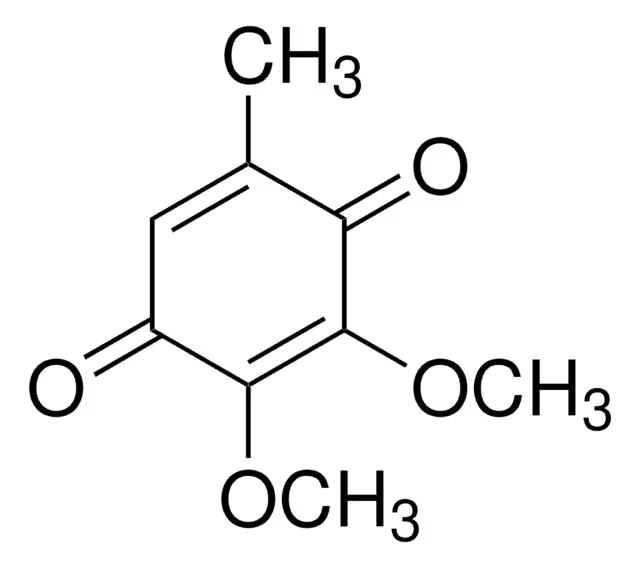
CAS Number605-94-7
Synonyms1,2,3-Dimethoxy-5-methyl-1,4-benzoquinone; EINECS 210-100-8; 2,3-dimethoxy-5-methyl-1,4-benzoquinone; 2,3-Dimethoxy-5-methylcyclohexa-2,5-dien-1,4-dion; 2,3-Dimethoxy-5-Methyl-p-Benzoquinone; Ubiquinone Q0; 2,3-dimethoxy-5-methylcyclohexa-2,5-diene-1,4-dione; MFCD00001595
Molecular FormulaC9H10O4
Molecular Weight182.17
Purity98%
Density1.2±0.1 g/cm3
Boiling Point331.4±42.0 °C at 760 mmHg
Melting Point58-60 °C (lit.)
Appearancepowder
EINECS210-100-8
Symbol
Signal WordWarning
| Chemical & Physical Properties | |
|---|---|
| CAS Number | 605-94-7 |
| Catalog No. | 2A-9001721 |
| Chinese Name | 2,3-二甲氧基-5-甲基-1,4-苯醌 |
| Synonyms | 1,2,3-Dimethoxy-5-methyl-1,4-benzoquinone; EINECS 210-100-8; 2,3-dimethoxy-5-methyl-1,4-benzoquinone; 2,3-Dimethoxy-5-methylcyclohexa-2,5-dien-1,4-dion; 2,3-Dimethoxy-5-Methyl-p-Benzoquinone; Ubiquinone Q0; 2,3-dimethoxy-5-methylcyclohexa-2,5-diene-1,4-dione; MFCD00001595 |
| Molecular Formula | C9H10O4 |
| Molecular Weight | 182.17 |
| Purity | 98 |
| Density | 1.2±0.1 g/cm3 |
| Boiling Point | 331.4±42.0 °C at 760 mmHg |
| Melting Point | 58-60 °C (lit.) |
| Appearance | powder |
| Storage Condition | 2. Storage Sealed with argon and stored dry at 4°C |
| Application | Coenzyme Q0 (CoQ0) is a potent orally active ubiquinone compound extracted from the cinnamon sinus worm. Coenzyme Q0 induces apoptosis and autophagy and inhibits HER-2/AKT/mTOR signaling to enhance ap |
| EINECS | 210-100-8 |
| HTC | 2914.69.6000 |
| PubChem ID | 24894261 |
| MDL Number | MFCD00001595 |
| SMILES | COC1=C(OC)C(=O)C(C)=CC1=O |
| InChI | 1S/C9H10O4/c1-5-4-6(10)8(12-2)9(13-3)7(5)11/h4H,1-3H3 |
| InChI Key | UIXPTCZPFCVOQF-UHFFFAOYSA-N |
| Beilstein/REAXYS | 1640422 |
| NACRES Code | NA.51 |
| UNSPSC | 12352204 |
| Hazard Symbols | Xi |
| Risk Codes | R36/37/38 |
| Safety Description | S26;S36 |
| MSDS | msds/1721_1_605_94_7.pdf |
| Bioactivity | Coenzyme Q0 (CoQ0) is a potent, oral active ubiquinone compound can be derived from Antrodia cinnamomea. Coenzyme Q0 induces apoptosis and autophagy, suppresses of HER-2/AKT/mTOR signaling to potentiate the apoptosis and autophagy mechanisms. Coenzyme Q0 regulates NFκB/AP-1 activation and enhances Nrf2 stabilization in attenuation of inflammation and redox imbalance. Coenzyme Q0 has anti-angiogenic activity through downregulation of MMP-9/NF-κB and upregulation of HO-1 signaling[1][2][3]. Related Catalog Signaling Pathways >> Immunology/Inflammation >> Interleukin Related Signaling Pathways >> Protein Tyrosine Kinase/RTK >> EGFR Signaling Pathways >> Autophagy >> Autophagy Signaling Pathways >> Apoptosis >> Caspase Signaling Pathways >> Cell Cycle/DNA Damage >> PARP Signaling Pathways >> PI3K/Akt/mTOR >> mTOR Signaling Pathways >> Apoptosis >> Bcl-2 Family Signaling Pathways >> Apoptosis >> Apoptosis Research Areas >> Cancer Signaling Pathways >> JAK/STAT Signaling >> EGFR Signaling Pathways >> Epigenetics >> PARP Signaling Pathways >> Immunology/Inflammation >> NO Synthase Signaling Pathways >> PI3K/Akt/mTOR >> Akt Research Areas >> Inflammation/Immunology Signaling Pathways >> Immunology/Inflammation >> COX Signaling Pathways >> Metabolic Enzyme/Protease >> MMP Research Areas >> Neurological Disease In Vitro Coenzyme Q0 (0-40 µM; 24 h) and inhibits viability and growth of human ovarian carcinoma cells[1]. Coenzyme Q0 (CoQ0) (0-30 µM; 24 h; SKOV-3 cells) has anti-proliferative activity through induction of G2/M cell-cycle arrest and reduction of cell-cycle regulatory proteins[1]. Coenzyme Q0 (CoQ0) (0-30 µM; 0-30 min; SKOV-3 cells) increases intracellular ROS levels to promote SKOV-3 cell death[1]. Coenzyme Q0 (CoQ0) (0-30 µM; 24 h; SKOV-3 cells) induces autophagy by increase accumulation of LC3-II, GFP-LC3 puncta, AVOs formation and Beclin-1/Bcl-2 dysregulation[1]. Coenzyme Q0 (CoQ0) (0-30 µM; 24 h; SKOV-3 cells) induces apoptosis by mitochondrial (caspase-3, PARP and Bax/Bcl-2 dysregulation) and ER stress (caspase-12 and Hsp70) signals[1]. Coenzyme Q0 (CoQ0) (30 µM; 24 h; SKOV-3 cells) suppresses of HER-2/AKT/mTOR signaling to potentiate the apoptosis and autophagy mechanisms[1]. Coenzyme Q0 (CoQ0) (0-10 µM; 0.5-18 h; RAW264.7 cells) regulates NFκB/AP-1 activation and enhances Nrf2 stabilization[2]. Coenzyme Q0 (CoQ0) (5 µM; 0-12 h; EA.hy 926 cells) has anti-angiogenic activity in EA.hy 926 cells[3]. Cell Viability Assay[1] Cell Line: SKOV-3, A2780 and A2870/CP70 cells Concentration: 0, 10, 20, 30 and 40 µM Incubation Time: 24 hours Result: Decreased viability with the IC50 values of 26.6 µM, 27.3 µM and 28.4 µM for SKOV-3, A2780 and A2870/CP70 cells, respectively. Cell Cycle Analysis[1] Cell Line: SKOV-3, A2780 and A2870/CP70 cells Concentration: 0, 10, 20 and 30 µM Incubation Time: 24 hours Result: Arrested cell cycle at G2/M phase and reduced cell-cycle proteins in SKOV-3 cells. Apoptosis Analysis[1] Cell Line: SKOV-3, A2780 and A2870/CP70 cells Concentration: 0, 5, 15 and 30 µM Incubation Time: 24 hours Result: Promoted the conversion of LC3-1 to LC3-II and increased the LC3-II accumulation. Increased Bax/Bcl-2 ratio in a dose-dependent manner. Apoptosis Analysis[1] Cell Line: SKOV-3 cells Concentration: 0, 10, 20 and 30 µM Incubation Time: 24 hours Result: Had the percentage of early apoptotic cells are 25.1%, 34% and 36% for 10, 20 and 30 µM, respectively. Western Blot Analysis[1] Cell Line: SKOV-3 cells Concentration: 0, 5, 15 and 30 µM Incubation Time: 24 hours Result: Activated of caspase-3 and cleavaged of PARP. Increased the expressions of caspase-12, HSP-70 and Bax in a dose-dependent manner, decreased the expressions of Bcl-2. Western Blot Analysis[1] Cell Line: SKOV-3 cells Concentration: 30 µM Incubation Time: 24 hours Result: Decreased the phosphorylated HER-2 (Y1221) levels, p-AKT (Ser473) and p-mTOR (S2448) levels. Western Blot Analysis[2] Cell Line: RAW264.7 cells Concentration: 0, 2.5, 5 and 10 µM Incubation Time: 0.5-18 hours Result: Inhibited iNOS/COX-2 protein expressions with reductions of NO, PGE2, TNF-α and IL-1β secretions. Western Blot Analysis[3] Cell Line: EA.hy 926 cells Concentration: 5 µM Incubation Time: 0, 1, 3, 6 and 12 hours Result: Increased expressions of heme oxygenase-1 (HO-1) and γ-glutamylcysteine synthetase (γ-GCLC), inhibits protein expressions of matrix metalloproteinase-9 (MMP-9), reduces TNF-α-induced nuclear translocation and transcriptional activation of nuclear factor-κB (NF-κB). In Vivo Coenzyme Q0 (CoQ0) (1.5 and 2.5 mg/kg; i.p.; once every four days, for 52 d) suppresses tumor growth in SKOV-3 xenografted nude mice[1]. Coenzyme Q0(CoQ0) (5 mg/kg; p.o.; for 4 h) has anti-inflammatory activities through Nrf2 activation and NFκB inhibition in liver and spleen of LPS-treated mice[2]. Animal Model: SKOV-3 xenografted nude mice[1] Dosage: 1.5 and 2.5 mg/kg Administration: Intraperitoneal injection; Once every four days, for 52 days Result: Inhibited the tumor growth at 1.5 and 2.5 mg/kg. Animal Model: LPS-treated female FVB mice[2] Dosage: 5 mg/kg Administration: Oral administration; for 4 hours Result: Down-regulates inflammatory genes in liver and spleen tissues of LPS injected mice. References [1]. Yang HL, et, al. Coenzyme Q0 regulates NFκB/AP-1 activation and enhances Nrf2 stabilization in attenuation of LPS-induced inflammation and redox imbalance: Evidence from in vitro and in vivo studies. Biochim Biophys Acta. 2016 Feb;1859(2):246-61. [2]. Yang HL, et, al. Coenzyme Q0 regulates NFκB/AP-1 activation and enhances Nrf2 stabilization in attenuation of LPS-induced inflammation and redox imbalance: Evidence from in vitro and in vivo studies. Biochim Biophys Acta. 2016 Feb;1859(2):246-61. [3]. Yang HL, et, al. Anti-angiogenic properties of coenzyme Q0 through downregulation of MMP-9/NF-κB and upregulation of HO-1 signaling in TNF-α-activated human endothelial cells. Biochem Pharmacol. 2015 Nov 1;98(1):144-56. Chemical & Physical Properties Density 1.2±0.1 g/cm3 Boiling Point 331.4±42.0 °C at 760 mmHg Melting Point 58-60 °C(lit.) Molecular Formula C9H10O4 Molecular Weight 182.173 Flash Point 148.6±27.9 °C Exact Mass 182.057907 PSA 52.60000 LogP 0.12 Vapour Pressure 0.0±0.7 mmHg at 25°C Index of Refraction 1.498 InChIKey UIXPTCZPFCVOQF-UHFFFAOYSA-N SMILES COC1=C(OC)C(=O)C(C)=CC1=O Storage condition 2-8°C Stability Stable. Combustible. Incompatible with strong oxidizing agents, reducing agents. |
| Use of | Properties Articles30 Name ubiquinone-0 Synonym More Synonyms Ubiquinone Q0 Biological Activity Related Catalog Signaling Pathways >> Immunology/Inflammation >> Interleukin Related Signaling Pathways >> Protein Tyrosine Kinase/RTK >> EGFR Signaling Pathways >> Autophagy >> Autophagy Signaling Pathways >> Apoptosis >> Caspase Signaling Pathways >> Cell Cycle/DNA Damage >> PARP Signaling Pathways >> PI3K/Akt/mTOR >> mTOR Signaling Pathways >> Apoptosis >> Bcl-2 Family Signaling Pathways >> Apoptosis >> Apoptosis Research Areas >> Cancer Signaling Pathways >> JAK/STAT Signaling >> EGFR Signaling Pathways >> Epigenetics >> PARP Signaling Pathways >> Immunology/Inflammation >> NO Synthase Signaling Pathways >> PI3K/Akt/mTOR >> Akt Research Areas >> Inflammation/Immunology Signaling Pathways >> Immunology/Inflammation >> COX Signaling Pathways >> Metabolic Enzyme/Protease >> MMP Research Areas >> Neurological Disease References [1]. Yang HL, et, al. Coenzyme Q0 regulates NFκB/AP-1 activation and enhances Nrf2 stabilization in attenuation of LPS-induced inflammation and redox imbalance: Evidence from in vitro and in vivo studies. Biochim Biophys Acta. 2016 Feb;1859(2):246-61. [2]. Yang HL, et, al. Coenzyme Q0 regulates NFκB/AP-1 activation and enhances Nrf2 stabilization in attenuation of LPS-induced inflammation and redox imbalance: Evidence from in vitro and in vivo studies. Biochim Biophys Acta. 2016 Feb;1859(2):246-61. Chemical & Physical Properties Molecular Formula C9H10O4 Exact Mass 182.057907 PSA 52.60000 Index of Refraction 1.498 InChIKey UIXPTCZPFCVOQF-UHFFFAOYSA-N SMILES COC1=C(OC)C(=O)C(C)=CC1=O Stability Stable. Combustible. Incompatible with strong oxidizing agents, reducing agents. |
| Transport Info | Product name: Purity: 97.0% |
| MSDS Transport Info | Module 14. Shipping information United Nations classification: inconsistent with United Nations classification standards UN number: not specified |
| Related Products in Specialty Chemicals | ||
|---|---|---|
| 2',3'-Difluoropropiophenone | 101712-19-0 | 2A-9001703 |
| 2,3-Dihydro-1,4-benzodioxin-6-ylmethylamine | 17413-10-4 | 2A-9001707 |
| 2,3-Dihydro-1,4-benzodioxine-6-carbonylchloride | 6761-70-2 | 2A-9001708 |
| 2,3-Dihydro-1,4-benzodioxine-6-sulphonylchloride | 63758-12-3 | 2A-9001709 |
| 2,3-Dihydroxybenzoic acid | 303-38-8 | 2A-0201465 |
| 2,3-Dimethoxy-5-sulfamoylbenzoic acid | 66644-80-2 | 2A-9001722 |
| 2,3-Dimethoxybenzoic acid | 1521-38-6 | 2A-9001724 |
| 2,3-Dimethoxycinnamic acid | 7345-82-6 | 2A-9001725 |
| 2,3-Dimethoxyphenol | 5150-42-5 | 2A-9001726 |
| 2,3-Dimethyl-2-isopropylbutanenitrile | 55897-64-8 | 2A-9001728 |
| Browse all Specialty Chemicals products » | ||
Phone:
630-322-8886
630-322-8887
Email:
Office Locations:
Chicago, IL, USA
San Francisco, CA, USA


 EN
EN


 SDS
SDS