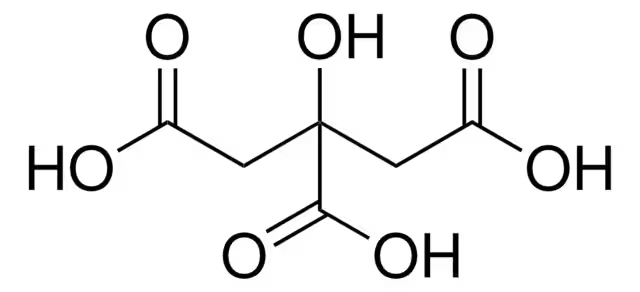
CAS Number77-92-9
Synonyms3'-hydroxybiphenyl-3-carboxylic acid; MFCD00163176; 3-hydroxy-3-carboxy-pentanedioic acid; 3'-hydroxy-3-biphenylcarboxylic acid; Citric acid; EINECS 201-069-1
Molecular FormulaHOC(COOH)(CH2COOH)2
Molecular Weight192.12
Purity99.5-100.5 (based on anhydrous substance)%
Density1.8±0.1 g/cm3
Boiling Point309.6±42.0 °C at 760 mmHg
Melting Point153-159 °C (lit.)
Appearancegrit
EINECS201-069-1


Please Login or Create an Account to: See VlP prices and availability
US Stock: ship in 0-1 business day
Global Stock: ship in 5-7 days
| Chemical & Physical Properties | |
|---|---|
| CAS Number | 77-92-9 |
| Catalog No. | 2A-0201848 |
| Chinese Name | 柠檬酸 |
| Synonyms | 3'-hydroxybiphenyl-3-carboxylic acid; MFCD00163176; 3-hydroxy-3-carboxy-pentanedioic acid; 3'-hydroxy-3-biphenylcarboxylic acid; Citric acid; EINECS 201-069-1 |
| Molecular Formula | HOC(COOH)(CH2COOH)2 |
| Molecular Weight | 192.12 |
| Purity | 99.5-100.5 (based on anhydrous substance) |
| Density | 1.8±0.1 g/cm3 |
| Boiling Point | 309.6±42.0 °C at 760 mmHg |
| Melting Point | 153-159 °C (lit.) |
| Appearance | grit |
| Water Solubility | 750 g/L (20 ºC) |
| Storage Condition | 1. Store this product in a sealed, cool and dry pl |
| Application | Citric acid is a weak organic tricarboxylic acid found in citrus fruits. Citric acid is a natural preservative and food additive. |
| EINECS | 201-069-1 |
| HTC | 2918140000 |
| PubChem ID | 329752978 |
| MDL Number | MFCD00011669 |
| SMILES | OC(=O)CC(O)(CC(O)=O)C(O)=O |
| InChI | 1S/C6H8O7/c7-3(8)1-6(13,5(11)12)2-4(9)10/h13H,1-2H2,(H,7,8)(H,9,10)(H,11,12) |
| InChI Key | KRKNYBCHXYNGOX-UHFFFAOYSA-N |
| Beilstein/REAXYS | 782061 |
| NACRES Code | NA.21 |
| eCl@ss | 39021801 |
| UNSPSC | 12352106 |
| MSDS | msds/17191_1_77_92_9.pdf |
| Bioactivity | Citric acid is a weak organic tricarboxylic acid found in citrus fruits. Citric acid is a natural preservative and food tartness enhancer. Related Catalog Signaling Pathways >> Apoptosis >> Apoptosis Research Areas >> Inflammation/Immunology Natural Products >> Acids and Aldehydes Research Areas >> Cancer Research Areas >> Cardiovascular Disease Research Areas >> Metabolic Disease Target Human Endogenous Metabolite In Vitro Citric acid induces apoptosis through the mitochondrial pathway in the human keratinocyte cell line HaCaT. It inhibits proliferation of HaCaT cells in a dose-dependent manner, but also induces apoptosis and cell cycle-arrest at the G2/M phase (before 24 h) and S phase (after 24 h)[1]. In Vivo Citric acid is found in all animal tissues as an intermediary substance in oxidative metabolism. The administration of citric acid (1-2 g/kg) attenuates LPS-induced elevations in brain MDA, nitrite, TNF-α, GPx, and PON1 activity. In the liver, nitrite is decreased by 1 g/kg citric acid. Citric acid (1-2 g/kg) decreases brain lipid peroxidation and inflammation, liver damage, and DNA fragmentation[2]. Citric acid supplementation increases intestinal calcium and phosphorus absorption and the retention/intake ratio only in rats fed the 1% Ca diet. Citric acidsupplementation together with a calcium-rich diet allows to obtain an increased retention of calcium and phosphorus in bone. The prolonged administration of calcium citrate supplements may therefore help to increase bone mineral concentration[3]. Oral administration of citric acid ameliorates ketosis and protects against the development of diabetic complications in an animal model of type 1 diabetes[4]. Cell Assay HaCaT cells are treated with different concentrations of citric acid (2.5, 5, 7.5, 10, 12.5 mM) for 24 h; 0.5% of DMSO (vehicle) is used as a control. Cells are then centrifuged at 1000 ×g for 5 min, and cell pellets are dissolved with 0.5 mL of Phosphate buffered saline (PBS) containing 5 μg/mL PI and viable cells are determined by using a flow cytometer for determination of viable cells[1]. Animal Admin Rats: Rats are induced of diabetes and divided randomly into an untreated diabetic group and two treated diabetic groups, receiving citric acid (2 g/L) in the drinking water, or insulin therapy. Insulin-treated rats receive 3 IU of neutral protamine Hagedorn insulin three times per week. Fasting (12 hr) blood samples are obtained from the tail vein two days after insulin injection for measurement of blood glucose, HbA1c and ketone bodies[4]. [2]Mice: Citric acid is prepared in sterile physiological saline. Mice are randomly divided into five equal groups (six mice each). Mice are treated with either 0.2mL of: sterile physiological saline (group 1) or citric acid at doses of 1, 2, and 4 g/kg, orally (groups 2-4). Treatments are given just prior to endotoxin administration (LPS: 200 lg/kg, injected intraperitoneally, 0.1 mL). The fifth group received just the vehicle, no LPS (negative control). Mice are euthanized after 4 h of LPS or vehicle injection by decapitation under ether anesthesia, where the brain and liver of each mouse are then removed for analysis[2]. References [1]. Ying TH, et al. Citric acid induces cell-cycle arrest and apoptosis of human immortalized keratinocyte cell line (HaCaT) via caspase- and mitochondrial-dependent signaling pathways. Anticancer Res. 2013 Oct;33(10):4411-20. [2]. Abdel-Salam OM, et al. Citric acid effects on brain and liver oxidative stress in lipopolysaccharide-treated mice. J Med Food. 2014 May;17(5):588-98. [3]. Lacour B, et al. Stimulation by citric acid of calcium and phosphorus bioavailability in rats fed a calcium-rich diet. Miner Electrolyte Metab. 1997;23(2):79-87. [4]. Nagai R, et al. Citric acid inhibits development of cataracts, proteinuria and ketosis in streptozotocin (type 1) diabetic rats. Biochem Biophys Res Commun. 2010 Feb 26;393(1):118-22. Chemical & Physical Properties Density 1.8±0.1 g/cm3 Boiling Point 309.6±42.0 °C at 760 mmHg Melting Point 153-159 °C(lit.) Molecular Formula C6H8O7 Molecular Weight 192.124 Flash Point 155.2±24.4 °C Exact Mass 192.027008 PSA 132.13000 LogP -1.72 Vapour Pressure 0.0±1.5 mmHg at 25°C Index of Refraction 1.575 InChIKey KRKNYBCHXYNGOX-UHFFFAOYSA-N SMILES O=C(O)CC(O)(CC(=O)O)C(=O)O Storage condition Store at RT. Stability Stable. Incompatible with bases, strong oxidizing agents, reducing agents, metal nitrates. Water Solubility 750 g/L (20 ºC) |
| Use of | Citric acid is a weak organic tricarboxylic acid found in citrus fruits. Citric acid is a natural preservative and food tartness enhancer. Properties Articles644 Name citric acid Synonym More Synonyms Citric Acid Biological Activity Description Citric acid is a weak organic tricarboxylic acid found in citrus fruits. Citric acid is a natural preservative and food tartness enhancer. Related Catalog Signaling Pathways >> Apoptosis >> Apoptosis Research Areas >> Inflammation/Immunology Natural Products >> Acids and Aldehydes Research Areas >> Cancer Research Areas >> Cardiovascular Disease Research Areas >> Metabolic Disease Human Endogenous Metabolite References [1]. Ying TH, et al. Citric acid induces cell-cycle arrest and apoptosis of human immortalized keratinocyte cell line (HaCaT) via caspase- and mitochondrial-dependent signaling pathways. Anticancer Res. 2013 Oct;33(10):4411-20. [2]. Abdel-Salam OM, et al. Citric acid effects on brain and liver oxidative stress in lipopolysaccharide-treated mice. J Med Food. 2014 May;17(5):588-98. [3]. Lacour B, et al. Stimulation by citric acid of calcium and phosphorus bioavailability in rats fed a calcium-rich diet. Miner Electrolyte Metab. 1997;23(2):79-87. [4]. Nagai R, et al. Citric acid inhibits development of cataracts, proteinuria and ketosis in streptozotocin (type 1) diabetic rats. Biochem Biophys Res Commun. 2010 Feb 26;393(1):118-22. Chemical & Physical Properties Molecular Formula C6H8O7 Exact Mass 192.027008 PSA 132.13000 LogP -1.72 Index of Refraction 1.575 InChIKey KRKNYBCHXYNGOX-UHFFFAOYSA-N SMILES O=C(O)CC(O)(CC(=O)O)C(=O)O Storage condition Store at RT. Stability Stable. Incompatible with bases, strong oxidizing agents, reducing agents, metal nitrates. |
| Transport Info | Product name: Chemical name |
| Related Products in Specialty Chemicals | ||
|---|---|---|
| 2,2,4,4,6,8,8-HEPTAMETHYLNONANE | 4390-04-9 | 2A-9017184 |
| Ethyl 3-methyl-3-phenylglycidate | 77-83-8 | 2A-9017185 |
| 1,1,1-Tris(hydroxymethyl)ethane | 77-85-0 | 2A-9017186 |
| Triethyl acetyl citrate | 77-89-4 | 2A-9017188 |
| Choline dihydrogencitrate salt | 77-91-8 | 2A-9017190 |
| Triethyl citrate | 77-93-0 | 2A-9017192 |
| Quinic acid | 77-95-2 | 2A-9017194 |
| Dibutyltin maleate | 78-04-6 | 2A-9017197 |
| Ethyltriethoxysilane | 78-07-9 | 2A-9017198 |
| 2-Methyl-2-propyl-1,3-propanediol | 78-26-2 | 2A-9017204 |
| Browse all Specialty Chemicals products » | ||
Phone:
630-322-8886
630-322-8887
Email:
Office Locations:
Chicago, IL, USA
San Francisco, CA, USA


 EN
EN

 SDS
SDS