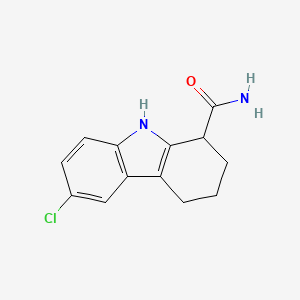
CAS Number49843-98-3
Synonyms6-Chloro-2,3,4,9-tetrahydro-1H-carbazole-1-carboxamide,racemic; 6-Chloro-2,3,4,9-tetrahydro-1H-carbazole-1-carboxamide; UNII:L19ECD5014; EX 527; 6-chloro-1,2,3,4,9-pentahydro-4aH-carbazolecarboxamide; Selisistat; 6-Chlor-1,2,3,4-tetrahydrocarbazol-1-carboxamid; 6-chloro-2,3,4,9-tetrahydro-1H-carbazole-1-carboxylic acid amide; 6-chloro-2,3,4,9-tetrahydro-1-H-carbazole-1-carboxamide; EX-527
Molecular FormulaC13H13ClN2O
Molecular Weight248.708
Purity98%%
Density1.4±0.1 g/cm3
Boiling Point531.7±38.0 °C at 760 mmHg
Melting Point179.0 to 183.0 °C
Appearancewhite to beige
Symbol
Signal WordWarning
| Chemical & Physical Properties | |
|---|---|
| CAS Number | 49843-98-3 |
| Catalog No. | 2A-1170929 |
| Chinese Name | Selisistat |
| Synonyms | 6-Chloro-2,3,4,9-tetrahydro-1H-carbazole-1-carboxamide,racemic; 6-Chloro-2,3,4,9-tetrahydro-1H-carbazole-1-carboxamide; UNII:L19ECD5014; EX 527; 6-chloro-1,2,3,4,9-pentahydro-4aH-carbazolecarboxamide; Selisistat; 6-Chlor-1,2,3,4-tetrahydrocarbazol-1-carboxamid; 6-chloro-2,3,4,9-tetrahydro-1H-carbazole-1-carboxylic acid amide; 6-chloro-2,3,4,9-tetrahydro-1-H-carbazole-1-carboxamide; EX-527 |
| Molecular Formula | C13H13ClN2O |
| Molecular Weight | 248.708 |
| Purity | 98% |
| Density | 1.4±0.1 g/cm3 |
| Boiling Point | 531.7±38.0 °C at 760 mmHg |
| Melting Point | 179.0 to 183.0 °C |
| Appearance | white to beige |
| Water Solubility | Soluble in dimethyl sulfoxide, ethanol and dimethy |
| Storage Condition | Store at +4°C |
| Application | Selisistat (EX-527) is a potent, selective SIRT1 inhibitor with an IC50 of 98 nM. |
| PubChem ID | 7580502 |
| SMILES | NC(=O)C1CCCc2c1[nH]c1ccc(Cl)cc21 |
| InChI | InChI=1S/C13H13ClN2O/c14-7-4-5-11-10(6-7)8-2-1-3-9(13(15)17)12(8)16-11/h4-6,9,16H,1-3H2,(H2,15,17) |
| InChI Key | FUZYTVDVLBBXDL-UHFFFAOYSA-N |
| Hazard Symbols | 6.1 |
| Bioactivity | Selisistat (EX-527) is a potent and selective SIRT1 inhibitor with IC50 of 98 nM. Related Catalog Signaling Pathways >> Cell Cycle/DNA Damage >> Sirtuin Signaling Pathways >> Epigenetics >> Sirtuin Research Areas >> Cancer Target SIRT1:98 nM (IC50) SIRT2:19.6 μM (IC50) SIRT3:48.7 μM (IC50) In Vitro Selisistat (EX-527) is an inhibitor of SIRT1 enzymatic activity (IC50, 98 nM), identified in a high-throughput screen using bacterially expressed human SIRT1. Selisistat (EX-527) inhibits SIRT1 in a concentration-dependent manner with an IC50 of 38 nM, in agreement with the activity on bacterially expressed SIRT1. Selisistat (EX-527) has much lower potency against SIRT2 (IC50, 19.6 μM) or SIRT3 (IC50, 48.7 μM) but does not inhibit class I/II HDAC activity at concentrations up to 100 μM[1]. Selisistat (EX-527) exerts an inhibitory effect on SIRT1 activity without affecting SIRT1 expression on both mRNA and protein levels[2]. In Vivo Selisistat (EX-527) abolishes Resveratrol (RSV)-induced attenuation of microvascular inflammation in ob/ob septic mice. Finally, ob/ob mice in Sepsis+RSV group has significantly increased 7-day survival vs. Sepsis+Vehicle group[3]. Cell Assay The immortal mouse macrophage cell line RAW264.7 are used. Cells are seeded in 96-well dishes at a density of 3 × 10³ cells/cm2 and treated with high glucose at the concentrations of 5.6, 11.1, 25 and 30 mM, alone or with SRT1720 (1 μM) or Selisistat(10 μM) for 24 h. The stock solution of SRT1720 or Selisistat is prepared by dissolving each of them (in powder form) respectively in DMSO yielding a concentration of 100 μM and then stored at -80°C. MTT solution (0.5 mg/mL) is then added to each well and cells are incubated for 4 h at 37°C in a 5% CO2 incubator. Subsequently, the supernatant is removed, the formation of farmazan is solubilized with DMSO and measured at 540 nm with a Bio-Rad Model 680 Plate Reader[2]. Animal Admin Mice[3]Mice are injected with Resveratrol (RSV) 30mg/kg (4 mL/kg) or equivalent volume of DMSO (Vehicle) (4 mL/kg) intraperitoneally 18 hours pre-sepsis. This dose of RSV in mice is as per documented literature. In one group of mice, RSV pre-treated mice receive Selisistat (10 mg/kg intraperitoneally; 4mL/kg, Vehicle: DMSO) within 10 minutes of cecal ligation and puncture. References [1]. Solomon JM, et al. Inhibition of SIRT1 catalytic activity increases p53 acetylation but does not alter cell survival following DNA damage. Mol Cell Biol. 2006 Jan;26(1):28-38. [2]. Jia Y, et al. SIRT1 is a regulator in high glucose-induced inflammatory response in RAW264.7 cells. PLoS One. 2015 Mar 20;10(3):e0120849. [3]. Wang X, et al. Resveratrol attenuates microvascular inflammation in sepsis via SIRT-1-Induced modulation of adhesion molecules in ob/ob mice. Obesity (Silver Spring). 2015 Jun;23(6):1209-17. [4]. Napper AD, et al. Discovery of indoles as potent and selective inhibitors of the deacetylase SIRT1. J Med Chem. 2005 Dec 15;48(25):8045-54. Chemical & Physical Properties Density 1.4±0.1 g/cm3 Boiling Point 531.7±38.0 °C at 760 mmHg Melting Point 179.0 to 183.0 °C Molecular Formula C13H13ClN2O Molecular Weight 248.708 Flash Point 275.4±26.8 °C Exact Mass 248.071640 PSA 58.88000 LogP 2.22 Appearance of Characters white to beige Vapour Pressure 0.0±1.4 mmHg at 25°C Index of Refraction 1.688 InChIKey FUZYTVDVLBBXDL-UHFFFAOYSA-N SMILES NC(=O)C1CCCc2c1[nH]c1ccc(Cl)cc21 Storage condition Store at +4°C Water Solubility Soluble in dimethyl sulfoxide, ethanol and dimethyl formamide. |
| Use of | Selisistat (EX-527) is a potent and selective SIRT1 inhibitor with IC50 of 98 nM. Properties Name 6-chloro-2,3,4,9-tetrahydro-1H-carbazole-1-carboxamide Synonym More Synonyms Selisistat (EX 527) Biological Activity Description Selisistat (EX-527) is a potent and selective SIRT1 inhibitor with IC50 of 98 nM. Related Catalog Signaling Pathways >> Cell Cycle/DNA Damage >> Sirtuin Signaling Pathways >> Epigenetics >> Sirtuin Research Areas >> Cancer SIRT1:98 nM (IC50) SIRT2:19.6 μM (IC50) SIRT3:48.7 μM (IC50) In Vitro Selisistat (EX-527) is an inhibitor of SIRT1 enzymatic activity (IC50, 98 nM), identified in a high-throughput screen using bacterially expressed human SIRT1. Selisistat (EX-527) inhibits SIRT1 in a concentration-dependent manner with an IC50 of 38 nM, in agreement with the activity on bacterially expressed SIRT1. Selisistat (EX-527) has much lower potency against SIRT2 (IC50, 19.6 μM) or SIRT3 (IC50, 48.7 μM) but does not inhibit class I/II HDAC activity at concentrations up to 100 μM[1]. Selisistat (EX-527) exerts an inhibitory effect on SIRT1 activity without affecting SIRT1 expression on both mRNA and protein levels[2]. In Vivo Selisistat (EX-527) abolishes Resveratrol (RSV)-induced attenuation of microvascular inflammation in ob/ob septic mice. Finally, ob/ob mice in Sepsis+RSV group has significantly increased 7-day survival vs. Sepsis+Vehicle group[3]. References [3]. Wang X, et al. Resveratrol attenuates microvascular inflammation in sepsis via SIRT-1-Induced modulation of adhesion molecules in ob/ob mice. Obesity (Silver Spring). 2015 Jun;23(6):1209-17. [4]. Napper AD, et al. Discovery of indoles as potent and selective inhibitors of the deacetylase SIRT1. J Med Chem. 2005 Dec 15;48(25):8045-54. Chemical & Physical Properties Exact Mass 248.071640 PSA 58.88000 Appearance of Characters white to beige Index of Refraction 1.688 InChIKey FUZYTVDVLBBXDL-UHFFFAOYSA-N Water Solubility Soluble in dimethyl sulfoxide, ethanol and dimethyl formamide. |
| Transport Info | Shipping Name: UN |
| MSDS Transport Info | Module 14. Shipping information 14.1 UN dangerous goods number European Dangerous Regulations for land transport: 2811 International Dangerous Regulations for sea transport: 2811 International Dangerous Regulations for air transport: 2811 14.2 United Nations shipping name European Land Transport Dangerous Regulations: TOXIC SOLID, ORGANIC, N.O.S. (6-Chloro-2,3,4,9-tetrahydro-1H-Carbazole-1- carboxamide) IMDG: TOXIC SOLID, ORGANIC, N.O.S. (6-Chloro-2,3,4,9-tetrahydro-1H-Carbazole-1- carboxamide) International air transport hazard regulations: Toxic solid, organic, n.o.s. (6-Chloro-2,3,4,9-tetrahydro-1H-Carbazole-1-carboxamide) 14.3 Transport hazard categories European Land Transport Danger Regulations: 6.1 International Maritime Transport Danger Regulations: 6.1 International Air Transport Danger Regulations: 6.1 14.4 Package group European Land Transport Danger Regulations: III International Maritime Transport Danger Regulations: III International Air Transport Danger Regulations: III 14.5 Environmental hazards European Land Transport Danger Regulations: No International Maritime Danger Regulations International Air Transport Danger Regulations: No Marine pollutants (yes/no): No 14.6 Special reminder to users No data available |
| Related Products in LED & Optoelectronic Materials | ||
|---|---|---|
| 11H-BENZO[A]CARBAZOLE | 239-01-0 | 2A-1169607 |
| 3-nitrocarbazole | 3077-85-8 | 2A-1169685 |
| 9H-Carbazole, 1-nitro- | 31438-22-9 | 2A-1169686 |
| 9H-carbazole-1,6-diamine | 91396-84-8 | 2A-1169711 |
| Zoledronic acid | 1627731-60-5 | 2A-1170705 |
| 9-ethyl-6,6-diMethyl-8-(4-Morpholinopiperidin-1-yl)-11-oxo-5a,6,11,11a-tetrahydro-5H-benzo[b]carbazole-3-carbonitrile hydrochloride | 1256589-74-8 | 2A-1170939 |
| 3,6-Dimethyl-9H-carbazole | 5599-50-8 | 2A-1171364 |
| 3,6-dibroMo-9-(2-ethylhexyl)-9H-carbazole | 173063-52-0 | 2A-1171365 |
| 9-ACETYL-3,6-DIIODOCARBAZOLE | 606129-89-9 | 2A-1171366 |
| 3-chloro-9H-carbazole | 2732-25-4 | 2A-1172347 |
| Browse all LED & Optoelectronic Materials products » | ||
Phone:
630-322-8886
630-322-8887
Email:
Office Locations:
Chicago, IL, USA
San Francisco, CA, USA


 EN
EN


 SDS
SDS