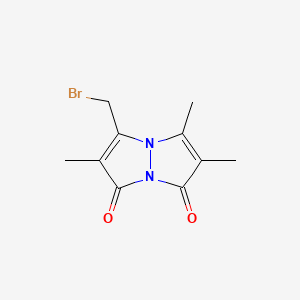
| Chemical & Physical Properties | |
|---|---|
| CAS Number | 71418-44-5 |
| Catalog No. | 2A-1170362 |
| Chinese Name | 溴二胺 |
| Synonyms | MONOBROMOBIMANE; Monobromobimane; Bromobimane |
| Molecular Formula | C10H11BrN2O2 |
| Molecular Weight | 271.11100 |
| Purity | 98% |
| Density | 1.66g/cm3 |
| Boiling Point | 327.8ºC at 760 mmHg |
| Melting Point | 152-154ºC |
| Storage Condition | -20℃ |
| Application | Bromobimanes are essentially non-fluorescent substances that, when reacting with small thiols, produce fluorescent products. |
| PubChem ID | 2541 |
| SMILES | Cc1c(C)n2c(CBr)c(C)c(=O)n2c1=O |
| InChI | InChI=1S/C10H11BrN2O2/c1-5-7(3)12-8(4-11)6(2)10(15)13(12)9(5)14/h4H2,1-3H3 |
| InChI Key | AHEWZZJEDQVLOP-UHFFFAOYSA-N |
| Hazard Symbols | transportation |
| MSDS | msds/170514_2_71418_44_5.pdf |
| Bioactivity | Bromobimane is essentially nonfluorescent and converts into fluorescent products when reacts with small thiols. Related Catalog Signaling Pathways >> Others >> Others Dye Reagents Research Areas >> Others In Vitro Bromobimanes in solution (aqueous or organic solvents of medium polarity) react with small thiols [e.g., the tripeptide thiol glutathione (GSH)], and with reactive protein thiol groups (e.g., hemoglobin). The reactions of bromobimanes with thiols are second order and dependent on pH, the active nucleophile being the thiolate anion. The reaction of bromobimane with a thiolate converts the nonfluorescent agent into water-soluble fluorescent products. The neutral agents mBBr and bBBr are moderately soluble in mediumpolarity organic solvents (acetonitrile, dichloromethane), and slightly soluble in water. The quaternary salt, qBBr, and the anionic bromobimane, SBBr, are soluble in water, but less soluble in organic solvents. Bromobimanes are yellow[1]. The highly selective, rapid reactivity of bromobimanes toward thiols, the stability and fluorescence yield of the thiol derivatives, the ease of separation of the derivatives by reversed-phase HPLC, and the availability of both cell-penetrating and nonpenetrating forms, make the use bromobimanes an extremely powerful approach to the analysis of low molecular weight biothiols[2]. Cell Assay The stock mBBr solution is prepared by weight at 100-180 mM in acetonitrile. The stock solution of SBBr is prepared by weight at 50 mM in dimethyl sulfoxide (DMSO) or at 2 mM in the 20 mM Tris-methane sulfonate. The thiol is added to a final concentration of 1 mM to a solution of 2 mM mBBr or SBBr, 20 mM Tris-methane sulfonate, pH 8.0. The mixture is incubated in the dark for 15 min at room temperature and then methanesulfonic acid is added to 25 mM from a 5 M stock solution[2]. References [1]. Kosower EM, et al. Bromobimane probes for thiols. Methods Enzymol. 1995;251:133-48. [2]. Newton GL, et al. Determination of biothiols by bromobimane labeling and high-performance liquid chromatography. Methods Enzymol. 1995;251:148-66. Chemical & Physical Properties Density 1.66g/cm3 Boiling Point 327.8ºC at 760 mmHg Melting Point 152-154ºC Molecular Formula C10H11BrN2O2 Molecular Weight 271.11100 Flash Point 152.1ºC Exact Mass 270.00000 PSA 42.96000 LogP 1.01710 Index of Refraction 1.64 InChIKey AHEWZZJEDQVLOP-UHFFFAOYSA-N SMILES Cc1c(C)n2c(CBr)c(C)c(=O)n2c1=O Storage condition -20℃ |
| Use of | Bromobimane is essentially nonfluorescent and converts into fluorescent products when reacts with small thiols. Properties Articles42 Name monobromobimane Synonym More Synonyms Bromobimane Biological Activity Description Bromobimane is essentially nonfluorescent and converts into fluorescent products when reacts with small thiols. Related Catalog Signaling Pathways >> Others >> Others Dye Reagents Research Areas >> Others In Vitro Bromobimanes in solution (aqueous or organic solvents of medium polarity) react with small thiols [e.g., the tripeptide thiol glutathione (GSH)], and with reactive protein thiol groups (e.g., hemoglobin). The reactions of bromobimanes with thiols are second order and dependent on pH, the active nucleophile being the thiolate anion. The reaction of bromobimane with a thiolate converts the nonfluorescent agent into water-soluble fluorescent products. The neutral agents mBBr and bBBr are moderately soluble in mediumpolarity organic solvents (acetonitrile, dichloromethane), and slightly soluble in water. The quaternary salt, qBBr, and the anionic bromobimane, SBBr, are soluble in water, but less soluble in organic solvents. Bromobimanes are yellow[1]. The highly selective, rapid reactivity of bromobimanes toward thiols, the stability and fluorescence yield of the thiol derivatives, the ease of separation of the derivatives by reversed-phase HPLC, and the availability of both cell-penetrating and nonpenetrating forms, make the use bromobimanes an extremely powerful approach to the analysis of low molecular weight biothiols[2]. References [1]. Kosower EM, et al. Bromobimane probes for thiols. Methods Enzymol. 1995;251:133-48. [2]. Newton GL, et al. Determination of biothiols by bromobimane labeling and high-performance liquid chromatography. Methods Enzymol. 1995;251:148-66. Chemical & Physical Properties Molecular Formula C10H11BrN2O2 Exact Mass 270.00000 PSA 42.96000 LogP 1.01710 Index of Refraction 1.64 InChIKey AHEWZZJEDQVLOP-UHFFFAOYSA-N Storage condition -20℃ |
| Transport Info | Shipping Name: UN |
| MSDS Transport Info | Module 14. Shipping information 14.1 UN dangerous goods number European Land Transport Dangerous Regulations: -International Maritime Dangerous Regulations: -International Air Transport Dangerous Regulations: - 14.2 United Nations shipping name European Land Transport Dangerous Regulations: Non-dangerous goods IMDG Code: Non-dangerous goods International air transport dangerous goods regulations: non-dangerous goods 14.3 Transport hazard categories European Land Transport Dangerous Regulations: -International Maritime Dangerous Regulations: -International Air Transport Dangerous Regulations: - 14.4 Package group European Land Transport Dangerous Regulations: -International Maritime Dangerous Regulations: -International Air Transport Dangerous Regulations: - 14.5 Environmental hazards European Land Transport Danger Regulations: No International Maritime Danger Regulations International Air Transport Danger Regulations: No Marine pollutants (yes/no): No 14.6 Special reminder to users No data available |
| Related Products in Specialty Chemicals | ||
|---|---|---|
| RQ-00203078 | 1254205-52-1 | 2A-1170353 |
| KEVETRIN | 500863-50-3 | 2A-1170354 |
| ex229 (compound 991) | 1219739-36-2 | 2A-1170355 |
| 5-FLUOROOROTIC ACID HYDRATE 98 | 220141-70-8 | 2A-1170357 |
| 1-METHYLHISTAMINE DIHYDROCHLORIDE | 6481-48-7 | 2A-1170359 |
| NSC 377967 | 84222-50-4 | 2A-1170363 |
| 1,3-Dibromo-2,3-dimethylbutane | 49623-54-3 | 2A-1170365 |
| (E)-6,6-DiMethyl-2-hepten-4-ynal | 138139-82-9 | 2A-1170366 |
| YK11 | 431579-34-9 | 2A-1170368 |
| SR9009 | 1379686-30-2 | 2A-1170369 |
| Browse all Specialty Chemicals products » | ||
Phone:
630-322-8886
630-322-8887
Email:
Office Locations:
Chicago, IL, USA
San Francisco, CA, USA


 EN
EN


 SDS
SDS