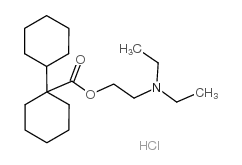
CAS Number67-92-5
Synonyms2-(diethylamino)ethyl 1-cyclohexylcyclohexane-1-carboxylate,hydrochloride; Dicyclomine, Hydrochloride
Molecular FormulaC19H36ClNO2
Molecular Weight345.94800
Purity98.00%
Boiling Point399.8ºC at 760 mmHg
Melting Point164-166ºC
Appearancepowder | off-white
Symbol
Signal WordWarning
| Chemical & Physical Properties | |
|---|---|
| CAS Number | 67-92-5 |
| Catalog No. | 2A-1166560 |
| Chinese Name | 盐酸双环维林 |
| Synonyms | 2-(diethylamino)ethyl 1-cyclohexylcyclohexane-1-carboxylate,hydrochloride; Dicyclomine, Hydrochloride |
| Molecular Formula | C19H36ClNO2 |
| Molecular Weight | 345.94800 |
| Purity | 98.00 |
| Boiling Point | 399.8ºC at 760 mmHg |
| Melting Point | 164-166ºC |
| Appearance | powder | off-white |
| Water Solubility | H2O: 50 mg/mL |
| Storage Condition | Ventilated and low temperature drying |
| Application | Dicyclomine hydrochloride is a potent orally active antagonist of muscarinic cholinergic receptors. Dicyclomine hydrochloride exhibits high affinity for both the M1 receptor subtype (Ki=5.1 nM) and th |
| SMILES | CCN(CC)CCOC(=O)C1(C2CCCCC2)CCCCC1.Cl |
| InChI | InChI=1S/C19H35NO2.ClH/c1-3-20(4-2)15-16-22-18(21)19(13-9-6-10-14-19)17-11-7-5-8-12-17;/h17H,3-16H2,1-2H3;1H |
| InChI Key | GUBNMFJOJGDCEL-UHFFFAOYSA-N |
| Hazard Symbols | transportation |
| MSDS | msds/166562_2_67_92_5.pdf |
| Bioactivity | Dicyclomine hydrochloride is a potent and orally active muscarinic cholinergic receptors antagonist. Dicyclomine hydrochloride shows high affinity for muscarinic M1 receptor subtype (Ki=5.1 nM) and M2 receptor subtype (Ki=54.6 nM) in brush-border membrane and basal plasma membranes, respectively[1]. Dicyclomine is an antispasmodic agent and relieves smooth muscle spasm of the gastrointestinal tract in vivo[2]. Related Catalog Signaling Pathways >> Neuronal Signaling >> mAChR Signaling Pathways >> GPCR/G Protein >> mAChR Research Areas >> Neurological Disease Target Ki: 5.1 nM (muscarinic M1 receptor subtype in brush-border membrane) Ki: 54.6 nM (muscarinic M2 receptor subtype in basal plasma membrane[1] In Vivo Dicyclomine hydrochloride (intraperitoneal injection; 8 mg/kg; daily) exacerbates the cognitive impairments in all the measurements. In addition, the memory impairments are worse in dicyclomine-treated 3xTg-AD mice compared to dicyclomine-treated NonTg mice[2]. Dicyclomine hydrochloride (intraperitoneal injection; 2.0, 4.0, and 8.0 mg/kg; 7 days) produces a highly significant effect on performance in the paired-associates learning (PAL) task in mice.And systemic treatment at lower doses show behavioral impairments in mice in spatial tasks[3]. Animal Model: C57Bl/6 mice[1] Dosage: 2.0, 4.0, and 8.0 mg/kg Administration: Intraperitoneal injection; daily; 7 days Result: Produced impairments due to actions of the agent outside of the hippocampus. References [1]. J Pavía,et al. Pharmacological Characterization and Distribution of Muscarinic Receptors in Human Placental Syncytiotrophoblast Brush-Border and Basal Plasma Membranes. Eur J Pharmacol. . 1997 Feb 12;320(2-3):209-14. [2]. Antonella Caccamo, et al. M1 Receptors Play a Central Role in Modulating AD-like Pathology in Transgenic Mice. 2006 Mar 2;49(5):671-82.doi: 10.1016/j.neuron.2006.01.020. [3]. Susan J Bartko,et al. A Computer-Automated Touchscreen Paired-Associates Learning (PAL) Task for Mice: Impairments Following Administration of Scopolamine or Dicyclomine and Improvements Following Donepezil.Psychopharmacology (Berl). 2011 Mar;214(2):537-48. Chemical & Physical Properties Boiling Point 399.8ºC at 760 mmHg Melting Point 164-166ºC Molecular Formula C19H36ClNO2 Molecular Weight 345.94800 Flash Point 116.5ºC Exact Mass 345.24300 PSA 29.54000 LogP 5.20420 Appearance of Characters powder | off-white InChIKey GUBNMFJOJGDCEL-UHFFFAOYSA-N SMILES CCN(CC)CCOC(=O)C1(C2CCCCC2)CCCCC1.Cl Water Solubility H2O: 50 mg/mL |
| Use of | Dicyclomine hydrochloride is a potent and orally active muscarinic cholinergic receptors antagonist. Dicyclomine hydrochloride shows high affinity for muscarinic M1 receptor subtype (Ki=5.1 nM) and M2 receptor subtype (Ki=54.6 nM) in brush-border membrane and basal plasma membranes, respectively[1]. Dicyclomine is an antispasmodic agent and relieves smooth muscle spasm of the gastrointestinal tract in vivo[2]. Properties Name dicyclomine hydrochloride Synonym More Synonyms Dicyclomine hydrochloride Biological Activity Description Dicyclomine hydrochloride is a potent and orally active muscarinic cholinergic receptors antagonist. Dicyclomine hydrochloride shows high affinity for muscarinic M1 receptor subtype (Ki=5.1 nM) and M2 receptor subtype (Ki=54.6 nM) in brush-border membrane and basal plasma membranes, respectively[1]. Dicyclomine is an antispasmodic agent and relieves smooth muscle spasm of the gastrointestinal tract in vivo[2]. Related Catalog Signaling Pathways >> Neuronal Signaling >> mAChR Signaling Pathways >> GPCR/G Protein >> mAChR Research Areas >> Neurological Disease Ki: 5.1 nM (muscarinic M1 receptor subtype in brush-border membrane) Ki: 54.6 nM (muscarinic M2 receptor subtype in basal plasma membrane[1] References [1]. J Pavía,et al. Pharmacological Characterization and Distribution of Muscarinic Receptors in Human Placental Syncytiotrophoblast Brush-Border and Basal Plasma Membranes. Eur J Pharmacol. . 1997 Feb 12;320(2-3):209-14. [3]. Susan J Bartko,et al. A Computer-Automated Touchscreen Paired-Associates Learning (PAL) Task for Mice: Impairments Following Administration of Scopolamine or Dicyclomine and Improvements Following Donepezil.Psychopharmacology (Berl). 2011 Mar;214(2):537-48. Chemical & Physical Properties Exact Mass 345.24300 PSA 29.54000 LogP 5.20420 Appearance of Characters powder | off-white InChIKey GUBNMFJOJGDCEL-UHFFFAOYSA-N |
| Transport Info | Product name: Purity: 99.0% |
| MSDS Transport Info | Module 14. Shipping information 14.1 UN dangerous goods number European Land Transport Dangerous Regulations: -International Maritime Dangerous Regulations: -International Air Transport Dangerous Regulations: - 14.2 Names specified by the United Nations (UN) European Land Transport Dangerous Regulations: Non-dangerous goods IMDG Code: Non-dangerous goods International air transport dangerous goods regulations: non-dangerous goods 14.3 Transport hazard categories European Land Transport Dangerous Regulations: -International Maritime Dangerous Regulations: -International Air Transport Dangerous Regulations: - 14.4 Package group European Land Transport Dangerous Regulations: -International Maritime Dangerous Regulations: -International Air Transport Dangerous Regulations: - 14.5 Environmental hazards European Land Transport Dangerous Regulations: No International Maritime Transport Dangerous Regulations Maritime Pollutants: No International Air Transport Risk Regulations: No 14.6 Special reminder to users No data available |
| Related Products in Specialty Chemicals | ||
|---|---|---|
| scutellaria lateriflora extract | 90106-67-5 | 2A-1166550 |
| 1,2-oxazol-3-ylMethanaMine hydrochloride | 1187933-48-7 | 2A-1166551 |
| Poly(oxy-1,2-ethanediyl), .alpha.-sulfo-.omega.-hydroxy-, C10-16-alkyl ethers, ammonium salts | 67762-19-0 | 2A-1166553 |
| (1,5-DIMETHYL-1H-PYRROL-2-YL)METHYLAMINE | 118799-24-9 | 2A-1166556 |
| FidaxoMicin | 873857-62-6 | 2A-1166557 |
| Tetraphosphorus decasulfide | 12066-62-5 | 2A-1166562 |
| α-Hydroxy Olopatadine | 1331822-32-2 | 2A-1166565 |
| Meta-Fexofenadine | 479035-75-1 | 2A-1166567 |
| DL-Norepinephrine 4-Sulfate | 35538-87-5 | 2A-1166574 |
| cis-1-[(3,4-Dimethoxyphenyl)methyl]-1,2,3,4-tetrahydro-6,7-dimethoxy-2-methyl-2-[3-oxo-3-[[5-[(1-oxo-2-propenyl)oxy]pentyl]oxy]propyl]-isoquinolinium Benzenesulfonate | 155913-31-8 | 2A-1166581 |
| Browse all Specialty Chemicals products » | ||
Phone:
630-322-8886
630-322-8887
Email:
Office Locations:
Chicago, IL, USA
San Francisco, CA, USA


 EN
EN


 SDS
SDS