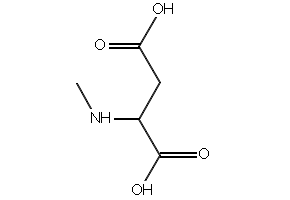
CAS Number17833-53-3
SynonymsN-Methylaspartic acid; N-methyl-D,L-aspartate; N-methyl-D,L-aspartic acid; DL-Aspartic acid,N-methyl; N-Methyl-DL-Aspartic acid; DL-2-METHYLAMINOSUCCINIC ACID; N-methylaminosuccinic acid; L-Aspartic acid,N-methyl; UNII:EU52DFC4WJ; N-Methyl aspartic acid; Aspartic acid,N-methyl
Molecular FormulaC5H9O4N1
Molecular Weight147.13
Purity96+%
Density1.3±0.1 g/cm3
Boiling Point258.2±30.0 °C at 760 mmHg
Appearancewhite powder
EINECS0
Symbol
Signal WordWarning
| Chemical & Physical Properties | |
|---|---|
| CAS Number | 17833-53-3 |
| Catalog No. | 2A-0162708 |
| Chinese Name | 甲基天冬氨酸 |
| Synonyms | N-Methylaspartic acid; N-methyl-D,L-aspartate; N-methyl-D,L-aspartic acid; DL-Aspartic acid,N-methyl; N-Methyl-DL-Aspartic acid; DL-2-METHYLAMINOSUCCINIC ACID; N-methylaminosuccinic acid; L-Aspartic acid,N-methyl; UNII:EU52DFC4WJ; N-Methyl aspartic acid; Aspartic acid,N-methyl |
| Molecular Formula | C5H9O4N1 |
| Molecular Weight | 147.13 |
| Purity | 96+ |
| Density | 1.3±0.1 g/cm3 |
| Boiling Point | 258.2±30.0 °C at 760 mmHg |
| Appearance | white powder |
| Water Solubility | H2O: 25 mg/mL, clear, colorless |
| Storage Condition | room temperature |
| Application | N-Methyl-DL-aspartate is a glutamate analogue and a potent neuronal stimulant. N-Methyl-DL-aspartate is an NMDA receptor agonist and can be used in neurological disease research [1][2]. |
| EINECS | 0 |
| HTC | 2922499990 |
| UN(IATA) | 0 |
| MDL Number | MFCD00065918 |
| SMILES | CNC(CC(=O)O)C(=O)O |
| InChI | InChI=1S/C5H9NO4/c1-6-3(5(9)10)2-4(7)8/h3,6H,2H2,1H3,(H,7,8)(H,9,10) |
| InChI Key | HOKKHZGPKSLGJE-UHFFFAOYSA-N |
| Hazard Symbols | transportation |
| MSDS | msds/162708_1_17833_53_3.pdf |
| Bioactivity | N-Methyl-DL-aspartic acid is a glutamate analogue and acts as a potent neuronal excitant. N-Methyl-DL-aspartic acid is a NMDA receptor agonist and can be used for neurological diseases research[1][2]. Related Catalog Signaling Pathways >> Neuronal Signaling >> iGluR Research Areas >> Neurological Disease Signaling Pathways >> Membrane Transporter/Ion Channel >> iGluR References [1]. G R Lauretti, et al. The activity of opioid analgesics in seizure models utilizing N-methyl-DL-aspartic acid, kainic acid, bicuculline and pentylenetetrazole. Neuropharmacology. 1994 Feb;33(2):155-60. [2]. S J Czuczwar, et al. Antagonism of N-methyl-D,L-aspartic acid-induced convulsions by antiepileptic drugs and other agents. Eur J Pharmacol. 1985 Feb 5;108(3):273-80 Chemical & Physical Properties Density 1.3±0.1 g/cm3 Boiling Point 258.2±30.0 °C at 760 mmHg Molecular Formula C5H9NO4 Molecular Weight 147.129 Flash Point 110.0±24.6 °C Exact Mass 147.053162 PSA 86.63000 LogP -0.44 Vapour Pressure 0.0±1.1 mmHg at 25°C Index of Refraction 1.494 InChIKey HOKKHZGPKSLGJE-UHFFFAOYSA-N SMILES CNC(CC(=O)O)C(=O)O Water Solubility H2O: 25 mg/mL, clear, colorless |
| Use of | N-Methyl-DL-aspartic acid is a glutamate analogue and acts as a potent neuronal excitant. N-Methyl-DL-aspartic acid is a NMDA receptor agonist and can be used for neurological diseases research[1][2]. Properties Name 2-(methylamino)butanedioic acid Synonym More Synonyms UNII:EU52DFC4WJ Biological Activity Description N-Methyl-DL-aspartic acid is a glutamate analogue and acts as a potent neuronal excitant. N-Methyl-DL-aspartic acid is a NMDA receptor agonist and can be used for neurological diseases research[1][2]. Related Catalog Signaling Pathways >> Neuronal Signaling >> iGluR Research Areas >> Neurological Disease Signaling Pathways >> Membrane Transporter/Ion Channel >> iGluR References [1]. G R Lauretti, et al. The activity of opioid analgesics in seizure models utilizing N-methyl-DL-aspartic acid, kainic acid, bicuculline and pentylenetetrazole. Neuropharmacology. 1994 Feb;33(2):155-60. [2]. S J Czuczwar, et al. Antagonism of N-methyl-D,L-aspartic acid-induced convulsions by antiepileptic drugs and other agents. Eur J Pharmacol. 1985 Feb 5;108(3):273-80 Chemical & Physical Properties Molecular Formula C5H9NO4 Exact Mass 147.053162 PSA 86.63000 LogP -0.44 Index of Refraction 1.494 InChIKey HOKKHZGPKSLGJE-UHFFFAOYSA-N SMILES CNC(CC(=O)O)C(=O)O |
| Tax Rebate | 9.0% |
| Supervision | A. Customs clearance form for inbound goods B. Customs clearance form for outbound goods |
| Inspection | P. Quarantine of entry animals, plants, and animal and plant products Q. Quarantine of exit animals, plants, and animal and plant products R. Hygiene supervision and inspection of imported food S. Hyg |
| Transport Info | Product name: Purity: 98.0% |
| MSDS Transport Info | Module 14. Shipping information 14.1 UN dangerous goods number European Land Transport Dangerous Regulations: -International Maritime Dangerous Regulations: -International Air Transport Dangerous Regulations: - 14.2 Names specified by the United Nations (UN) European Land Transport Dangerous Regulations: Non-dangerous goods IMDG Code: Non-dangerous goods International air transport dangerous goods regulations: non-dangerous goods 14.3 Transport hazard categories European Land Transport Dangerous Regulations: -International Maritime Dangerous Regulations: -International Air Transport Dangerous Regulations: - 14.4 Package group European Land Transport Dangerous Regulations: -International Maritime Dangerous Regulations: -International Air Transport Dangerous Regulations: - 14.5 Environmental hazards European Land Transport Dangerous Regulations: No International Maritime Transport Dangerous Regulations Maritime Pollutants: No International Air Transport Risk Regulations: No 14.6 Special reminder to users No data available |
| Related Products in Specialty Chemicals | ||
|---|---|---|
| N-METHYL-4-(METHYLSULFONYL)ANILINE HYDROCHLORIDE | 1263378-01-3 | 2A-0162682 |
| N-METHYL-4-(METHYLTHIO)BENZAMIDE | 53551-23-8 | 2A-0162683 |
| N-METHYL-4-(TRIFLUOROMETHOXY)ANILINE | 41419-59-4 | 2A-0162685 |
| N-METHYL-5-NITROQUINOLIN-6-AMINE | 14204-97-8 | 2A-0162698 |
| N-METHYL-5-NITROQUINOLIN-8-AMINE | 152810-27-0 | 2A-0162699 |
| N-METHYL-L-ASPARTIC ACID | 4226-18-0 | 2A-0162710 |
| N-METHYL-N-((5-METHYL-1H-PYRAZOL-3-YL)METHYL)-4-(1-PHENYL-1H-PYRAZOL-4-YL)PYRIMIDIN-2-AMINE | 1285374-91-5 | 2A-0162715 |
| N-METHYL-N-(2-METHYLCYCLOHEXYL)PIPERIDIN-4-AMINE | 1119452-90-2 | 2A-0162734 |
| N-METHYL-N-(METHYLSULFONYL)GLYCINE | 115665-52-6 | 2A-0162737 |
| N-METHYL-N-(PYRIDIN-2-YL)PIVALAMIDE | 96830-03-4 | 2A-0162746 |
| Browse all Specialty Chemicals products » | ||
Phone:
630-322-8886
630-322-8887
Email:
Office Locations:
Chicago, IL, USA
San Francisco, CA, USA


 EN
EN


 SDS
SDS