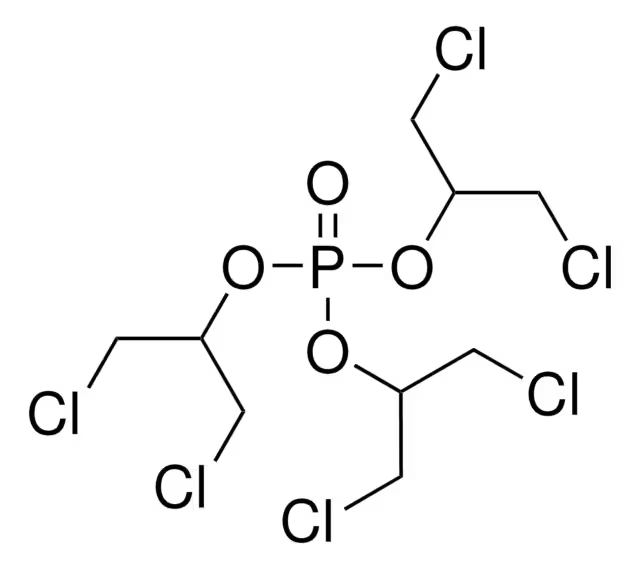
CAS Number13674-87-8
SynonymsPhosphoric Acid Tris(1,3-dichloro-2-propyl) Ester; Tris(1,3-dichloro-2-propanyl) phosphate; Tri(β,β'-dichloroisopropyl) phosphate; MFCD00083121; Tris(1,3-dichloropropan-2-yl) phosphate; TDCPP; Tris(1,3-dichloroisopropyl) phosphate; EINECS 237-159-2; Tris(1,3-dichloro-2-propyl) phosphate; 1,3-Dichloro-2-propanol phosphate (3:1); Phosphoric acid, tris(1,3-dichloro-2-propyl) ester; G1Y1GOPO&OY1G1G&OY1G1G; 1,3-Dichloro-2-propanol phosphate (Phosphoric acid tris(1,3-dichloro-2-propyl ester); Tris(2,2′-dichloroisopropyl) phosphate
Molecular FormulaC9H15Cl6O4P
Molecular Weight430.90
Purity98.00%
Density1.5±0.1 g/cm3
Boiling Point457.4±40.0 °C at 760 mmHg
Melting Point-64°C
Appearancecolorless viscous liquid
EINECS237-159-2
Symbol
Signal WordWarning
| Chemical & Physical Properties | |
|---|---|
| CAS Number | 13674-87-8 |
| Catalog No. | 2A-9016051 |
| Chinese Name | 磷酸三(1,3-二氯-2-丙基)酯 |
| Synonyms | Phosphoric Acid Tris(1,3-dichloro-2-propyl) Ester; Tris(1,3-dichloro-2-propanyl) phosphate; Tri(β,β'-dichloroisopropyl) phosphate; MFCD00083121; Tris(1,3-dichloropropan-2-yl) phosphate; TDCPP; Tris(1,3-dichloroisopropyl) phosphate; EINECS 237-159-2; Tris(1,3-dichloro-2-propyl) phosphate; 1,3-Dichloro-2-propanol phosphate (3:1); Phosphoric acid, tris(1,3-dichloro-2-propyl) ester; G1Y1GOPO&OY1G1G&OY1G1G; 1,3-Dichloro-2-propanol phosphate (Phosphoric acid tris(1,3-dichloro-2-propyl ester); Tris(2,2′-dichloroisopropyl) phosphate |
| Molecular Formula | C9H15Cl6O4P |
| Molecular Weight | 430.90 |
| Purity | 98.00 |
| Density | 1.5±0.1 g/cm3 |
| Boiling Point | 457.4±40.0 °C at 760 mmHg |
| Melting Point | -64°C |
| Appearance | colorless viscous liquid |
| Water Solubility | <0.1 g/100 mL at 24 ºC |
| Storage Condition | Room Temperature |
| Application | TDCPP is a chlorinated analog of tris(2,3-dibromopropyl)phosphate (Tris), one of the most frequently detected organophosphorus flame retardants (OPFRs) in the environment. |
| EINECS | 237-159-2 |
| HTC | 2919900090 |
| PubChem ID | 329754406 |
| MDL Number | MFCD00083121 |
| SMILES | ClCC(CCl)OP(=O)(OC(CCl)CCl)OC(CCl)CCl |
| InChI | 1S/C9H15Cl6O4P/c10-1-7(2-11)17-20(16,18-8(3-12)4-13)19-9(5-14)6-15/h7-9H,1-6H2 |
| InChI Key | ASLWPAWFJZFCKF-UHFFFAOYSA-N |
| NACRES Code | NA.24 |
| UNSPSC | 41116107 |
| Hazard Symbols | Transport |
| MSDS | msds/16051_1_13674_87_8.pdf |
| Bioactivity | TDCPP is a chlorinated analog of tris(2,3-dibromopropyl)phosphate (Tris) which is one of the most detected organophosphorus flame retardants (OPFRs) in the environment. Related Catalog Signaling Pathways >> Others >> Others Research Areas >> Cancer In Vitro Exposure to TDCPP does not significantly affect cell viability until at concentration >68 μg/mL. HCECs show a 16% cell viability loss after exposing to 136 μg/mL TDCPP. Moreover, TDCPP induces a sharp decrease in viable cells (87%) after exposing to ≥272 μg/mL TDCPP. Based on cell viability, the LC50 value for TDCPP is 202 μg/mL using a nonlinear regression. Compare to controls, TDCPP-exposed cells exhibit a concentration-dependent increase in apoptosis. Anti-apoptotic Bcl-2 protein expression is increased to 1.4 fold after exposing to 2 μg/mL TDCPP, 1.2-folds at 20 μg/mL but dynamically decreased to 0.4 fold at 200 μg/mL compare to control. The caspase-3 activity is increased to 2.1 folds of the control at 200 μg/mL TDCPP[1]. TDCPP inhibits cell growth at lower concentrations (IC50 of 27 μM), while cell viability and toxicity are affected at higher concentrations (IC50 of 171 μM and 168 μM, respectively)[2]. Kinase Assay The cellular ATP contents are determined in HCECs grown in DMEM containing 0, 2, 20, or 200 μg/mL TDCPP using a luciferase-based ATP assay kit according to the manufacturer's guideline. Briefly, after 24 h exposure, HCECs are lysed with lysis buffer. Lysates are then centrifuged at 12,000 g at 4°C for 5 min. Then, 100 μL of supernatant is mixed with 100 μL ATP detection working dilution. Luminance is examined by an fluorescence microplate reader[1]. Cell Assay To examine the effects of TDCPP on cell viability, HCECs are planted into 96-well plate (100 μL/well) at density of 1×10⁵ cells/mL overnight. Then, the medium is changed into fresh medium containing 0.034, 0.34, 3.4, 34, 68, 136, 272, or 340 μg/mL of TDCPP and solvent vehicle (0.1%, v/v) and incubated for 24 h. Cell viability is detected using CCK-8 cell viability assay kit according to the manufacturer's instructions. After exposure, cellular morphology is observed and recorded by an inverted microscopy[1]. References [1]. Xiang P, et al. Effects of organophosphorus flame retardant TDCPP on normal human corneal epithelial cells: Implications for human health. Environ Pollut. 2017 Nov;230:22-30. [2]. Killilea DW, et al. Flame retardant tris(1,3-dichloro-2-propyl)phosphate (TDCPP) toxicity is attenuated by N-acetylcysteine in human kidney cells. Toxicol Rep. 2017 May 17;4:260-264. Chemical & Physical Properties Density 1.5±0.1 g/cm3 Boiling Point 457.4±40.0 °C at 760 mmHg Melting Point -64°C Molecular Formula C9H15Cl6O4P Molecular Weight 430.905 Flash Point 377.7±35.0 °C Exact Mass 427.883911 PSA 54.57000 LogP 1.79 Vapour Pressure 0.0±1.1 mmHg at 25°C Index of Refraction 1.497 InChIKey ASLWPAWFJZFCKF-UHFFFAOYSA-N SMILES O=P(OC(CCl)CCl)(OC(CCl)CCl)OC(CCl)CCl Water Solubility <0.1 g/100 mL at 24 ºC |
| Use of | TDCPP is a chlorinated analog of tris(2,3-dibromopropyl)phosphate (Tris) which is one of the most detected organophosphorus flame retardants (OPFRs) in the environment. Properties Name Phosphoric Acid Tris(1,3-Dichloro-2-Propyl) Ester Synonym More Synonyms TDCPP Biological Activity Description TDCPP is a chlorinated analog of tris(2,3-dibromopropyl)phosphate (Tris) which is one of the most detected organophosphorus flame retardants (OPFRs) in the environment. Related Catalog Signaling Pathways >> Others >> Others Research Areas >> Cancer In Vitro Exposure to TDCPP does not significantly affect cell viability until at concentration >68 μg/mL. HCECs show a 16% cell viability loss after exposing to 136 μg/mL TDCPP. Moreover, TDCPP induces a sharp decrease in viable cells (87%) after exposing to ≥272 μg/mL TDCPP. Based on cell viability, the LC50 value for TDCPP is 202 μg/mL using a nonlinear regression. Compare to controls, TDCPP-exposed cells exhibit a concentration-dependent increase in apoptosis. Anti-apoptotic Bcl-2 protein expression is increased to 1.4 fold after exposing to 2 μg/mL TDCPP, 1.2-folds at 20 μg/mL but dynamically decreased to 0.4 fold at 200 μg/mL compare to control. The caspase-3 activity is increased to 2.1 folds of the control at 200 μg/mL TDCPP[1]. TDCPP inhibits cell growth at lower concentrations (IC50 of 27 μM), while cell viability and toxicity are affected at higher concentrations (IC50 of 171 μM and 168 μM, respectively)[2]. References [1]. Xiang P, et al. Effects of organophosphorus flame retardant TDCPP on normal human corneal epithelial cells: Implications for human health. Environ Pollut. 2017 Nov;230:22-30. [2]. Killilea DW, et al. Flame retardant tris(1,3-dichloro-2-propyl)phosphate (TDCPP) toxicity is attenuated by N-acetylcysteine in human kidney cells. Toxicol Rep. 2017 May 17;4:260-264. Chemical & Physical Properties Exact Mass 427.883911 PSA 54.57000 Index of Refraction 1.497 InChIKey ASLWPAWFJZFCKF-UHFFFAOYSA-N SMILES O=P(OC(CCl)CCl)(OC(CCl)CCl)OC(CCl)CCl |
| Tax Rebate | 9.0% |
| Supervision | A. Customs clearance form for inbound goods B. Customs clearance form for outbound goods |
| Inspection | R. Imported food hygiene supervision and inspection S. Export food hygiene supervision and inspection M. Imported commodity inspection N. Exported commodity inspection |
| Transport Info | Shipping Name: UN |
| MSDS Transport Info | Module 14. Shipping information 14.1 UN dangerous goods number European Land Transport Danger Regulations: 3082 International Maritime Danger Regulations: 3082 International Air Transport Danger Regulations: 3082 14.2 United Nations shipping name European land transport hazard regulations: ENVIRONMENTALLY HAZARDOUS SUBSTANCE, LIQUID, N.O.S. (Tris[2-chloro-1- (chloromethyl)ethyl] phosphate) IMDG: ENVIRONMENTALLY HAZARDOUS SUBSTANCE, LIQUID, N.O.S. (Tris[2-chloro-1- (chloromethyl)ethyl] phosphate) International air transport hazard regulations: Environmentally hazardous substance, liquid, n.o.s. (Tris[2-chloro-1-(chloromethyl)ethyl] phosphate) 14.3 Transport hazard categories European land transport Dangerous Regulations: 9 International sea transport Dangerous Regulations: 9 International air transport Dangerous Regulations: 9 14.4 Package group European Land Transport Danger Regulations: III International Maritime Transport Danger Regulations: III International Air Transport Danger Regulations: III 14.5 Environmental hazards European Land Transport Dangerous Regulations: Yes International Maritime Transport Dangerous Regulations International Air Transport Dangerous Regulations: Yes Marine Pollutants (Yes/No): Yes 14.6 Special reminder to users further information Dangerous goods are individually packaged, with liquids exceeding 5 liters or solids exceeding 5 kilograms. The outer packaging of each independent package and the combined independent inner package must have EHS on it. Identification (according to European ADR Regulation 2.2.9.1.10, IMDG Regulation 2.10.3), |
| Related Products in Specialty Chemicals | ||
|---|---|---|
| Tri-n-butylamine | 102-82-9 | 2A-9016040 |
| Tri-n-octylamine | 116-76-3 | 2A-9016041 |
| Tri-n-propylamine | 102-69-2 | 2A-9016042 |
| 1,3,5-trioxane | 110-88-3 | 2A-9016043 |
| Tri-potassium phosphate trihydrate | 22763-03-7 | 2A-9016050 |
| Tris(1-chloro-2-propyl) phosphate | 13674-84-5 | 2A-9016052 |
| Tris(2-ethylhexyl)phosphate | 78-42-2 | 2A-9016054 |
| Tri-sodium phosphate hexahydrate | 15819-50-8 | 2A-9016056 |
| Tungsten boride | 12007-10-2 | 2A-9016057 |
| Tungsten boride | 12007-09-9 | 2A-9016058 |
| Browse all Specialty Chemicals products » | ||
Phone:
630-322-8886
630-322-8887
Email:
Office Locations:
Chicago, IL, USA
San Francisco, CA, USA


 EN
EN


 SDS
SDS