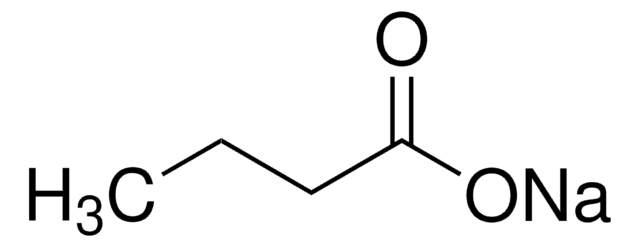
CAS Number156-54-7
SynonymsMFCD00002816; Butyrate sodium salt; Natriumbutyrat; Na butyrate; EINECS 205-857-6; SODIUM BUTYRATE pure; NAB; BUTYRIC ACID NA; Sodium butanoate; SODIUM N-BUTYLATE; SODIUMBUTYRATE,USP; Sodium Butyrate; sodium n-butyrate; butyratesodium; butyric acid sodium salt
Molecular FormulaCH3CH2CH2COONa
Molecular Weight110.09
Purity98%
Density0.987g/cm3
Boiling Point164.3ºC at 760 mmHg
Melting Point250-253 °C (lit.)
Appearancepowder
EINECS205-857-6
Symbol
Signal WordWarning
| Chemical & Physical Properties | |
|---|---|
| CAS Number | 156-54-7 |
| Catalog No. | 2A-9015653 |
| Chinese Name | 丁酸钠 |
| Synonyms | MFCD00002816; Butyrate sodium salt; Natriumbutyrat; Na butyrate; EINECS 205-857-6; SODIUM BUTYRATE pure; NAB; BUTYRIC ACID NA; Sodium butanoate; SODIUM N-BUTYLATE; SODIUMBUTYRATE,USP; Sodium Butyrate; sodium n-butyrate; butyratesodium; butyric acid sodium salt |
| Molecular Formula | CH3CH2CH2COONa |
| Molecular Weight | 110.09 |
| Purity | 98 |
| Density | 0.987g/cm3 |
| Boiling Point | 164.3ºC at 760 mmHg |
| Melting Point | 250-253 °C (lit.) |
| Appearance | powder |
| Water Solubility | soluble |
| Storage Condition | Store in a sealed, cool and dry place. |
| Application | Sodium Butyrate is a short-chain fatty acid that inhibits histone deacetylase. |
| EINECS | 205-857-6 |
| HTC | 2915600000 |
| PubChem ID | 24858121 |
| MDL Number | MFCD00002816 |
| SMILES | [Na+].CCCC([O-])=O |
| InChI | 1S/C4H8O2.Na/c1-2-3-4(5)6;/h2-3H2,1H3,(H,5,6);/q;+1/p-1 |
| InChI Key | MFBOGIVSZKQAPD-UHFFFAOYSA-M |
| Beilstein/REAXYS | 3629439 |
| NACRES Code | NA.22 |
| UNSPSC | 12352100 |
| Hazard Symbols | Transport |
| MSDS | msds/15653_1_156_54_7.pdf |
| Bioactivity | Butyric acid is a histone deacetylase (HDAC) inhibitor, with anti-tumor effects in several cancers. Related Catalog Signaling Pathways >> Autophagy >> Autophagy Signaling Pathways >> Cell Cycle/DNA Damage >> HDAC Signaling Pathways >> Epigenetics >> HDAC Research Areas >> Cancer Target HDAC In Vitro Sodium Butyrate induces morphological changes, inhibits cell proliferation and impairs cell viability in NPC cells. Sodium Butyrate (1, 5, 10 mM) is cytotoxic to NPC cells, inducing a dose- and time-dependent decrease in cell viability, in both 5-8F and 6-10B cells. Sodium Butyrate induces nasopharyngeal carcinoma cell apoptosis by activating the mitochondrial apoptotic axis. Moreover, SOCE inhibition and disruption of the CRAC channel can attenuate the apoptosis induced by Sodium Butyrate[1]. Sodium butyrate significantly decreases cell viability, accompanied by reduced levels of p-mTOR and PCNA protein. Sodium butyrate, in a dose-dependent manner, induces cell cycle arrest in G0/G1 phase and reduces the numbers of cells in S phase. In addition, relative expression of p21, p27, and pro-apoptosis bak genes, and protein levels of p21Waf1/Cip1, p27Kip1, cyclinD3, CDK4, and Cleave-caspase3 are increased by higher concentrations of sodium butyrate (1, 5, 10 mM), and the levels of cyclinD1 and CDK6 are reduced by 5 and 10 mM butyrate[3]. In Vivo Sodium Butyrate (300 mg/kg, s.c.) administration immediately after HI provided almost complete neuroprotection in comparison with non-treated animals. Sodium butyrate administration results in an increased number of microglial cells to 150% of vehicle-treated animals in the ipsilateral side. Sodium butyrate promotes the polarization of microglia from M1- to M2-like phenotype after neonatal hypoxia-ischemia[2]. Sodium butyrate (300 mg/kg, s.c.) in combination with AK-7 (20 mg/kg, i.p.) significantly alleviates this reduction of the time spent exploring new objects, ameliorates the reduction of the number of Ki67-positive cells and DCX-immunoreactive neuroblasts in the dentate gyrus of the mice. In addition, sodium butyrate reverses SIRT2-related age phenotypes[4]. Cell Assay Cells are seeded at a density of 2,000 cells/well in 96-well plates with 200 µL culture medium containing Sodium Butyrate at different concentrations. Then, the cells are consecutively cultured for 72 h. Every 24 h, 20 µL 5 mg/mL MTT solution is added into the corresponding well, and the cells are cultured for another 4 h. Then, the solution is replaced with 150 µL dimethylsulfoxide, followed by gentle agitation of the plates for 15 min at room temperature. Finally, the absorbance at 492 nm is measured to represent the cell viability. Animal Admin Seven-day-old rat pups are subjected to unilateral carotid artery ligation followed by 60 min of hypoxia (7.6% O2). Sodium Butyrate (300 mg/kg) is administered in a 5-day regime with the first injection given immediately after hypoxic exposure. The damage of the ipsilateral hemisphere is evaluated by hematoxylin-eosin staining 6 days after the insult. Samples are collected at 24 and 48 h and 6 days. References [1]. Huang W, et al. Inhibition of store-operated Ca2+ entry counteracts the apoptosis of nasopharyngeal carcinoma cells induced by sodium butyrate. Oncol Lett. 2017 Feb;13(2):921-929 [2]. Jaworska J, et al. The potential neuroprotective role of a histone deacetylase inhibitor, sodium butyrate, after neonatal hypoxia-ischemia. J Neuroinflammation. 2017 Feb 10;14(1):34 [3]. Qiu Y, et al. Effect of sodium butyrate on cell proliferation and cell cycle in porcine intestinal epithelial (IPEC-J2) cells. In Vitro Cell Dev Biol Anim. 2017 Jan 27 [4]. Jung HY, et al. Sirtuin-2 inhibition affects hippocampal functions and sodium butyrate ameliorates the reduction in novel object memory, cell proliferation, and neuroblast differentiation. Lab Anim Res. 2016 Dec;32(4):224-230 [5]. Wang P, et al. Sodium butyrate triggers a functional elongation of microglial process via Akt-small RhoGTPase activation and HDACs inhibition. Neurobiol Dis. 2017 Dec 14;111:12-25. Chemical & Physical Properties Density 0.987g/cm3 Boiling Point 164.3ºC at 760 mmHg Melting Point 250-253 °C(lit.) Molecular Formula C4H7NaO2 Molecular Weight 110.087 Flash Point 69.7ºC Exact Mass 110.034370 PSA 40.13000 Vapour Pressure 1.35mmHg at 25°C InChIKey MFBOGIVSZKQAPD-UHFFFAOYSA-M SMILES CCCC(=O)[O-].[Na+] Stability Stable. Incompatible with strong acids. Water Solubility soluble |
| Use of | Butyric acid is a histone deacetylase (HDAC) inhibitor, with anti-tumor effects in several cancers. Properties Articles145 Name sodium butyrate Synonym More Synonyms Sodium butyrate Biological Activity Description Butyric acid is a histone deacetylase (HDAC) inhibitor, with anti-tumor effects in several cancers. Related Catalog Signaling Pathways >> Autophagy >> Autophagy Signaling Pathways >> Cell Cycle/DNA Damage >> HDAC Signaling Pathways >> Epigenetics >> HDAC Research Areas >> Cancer References [1]. Huang W, et al. Inhibition of store-operated Ca2+ entry counteracts the apoptosis of nasopharyngeal carcinoma cells induced by sodium butyrate. Oncol Lett. 2017 Feb;13(2):921-929 [2]. Jaworska J, et al. The potential neuroprotective role of a histone deacetylase inhibitor, sodium butyrate, after neonatal hypoxia-ischemia. J Neuroinflammation. 2017 Feb 10;14(1):34 [3]. Qiu Y, et al. Effect of sodium butyrate on cell proliferation and cell cycle in porcine intestinal epithelial (IPEC-J2) cells. In Vitro Cell Dev Biol Anim. 2017 Jan 27 [4]. Jung HY, et al. Sirtuin-2 inhibition affects hippocampal functions and sodium butyrate ameliorates the reduction in novel object memory, cell proliferation, and neuroblast differentiation. Lab Anim Res. 2016 Dec;32(4):224-230 [5]. Wang P, et al. Sodium butyrate triggers a functional elongation of microglial process via Akt-small RhoGTPase activation and HDACs inhibition. Neurobiol Dis. 2017 Dec 14;111:12-25. Chemical & Physical Properties Molecular Formula C4H7NaO2 Exact Mass 110.034370 PSA 40.13000 InChIKey MFBOGIVSZKQAPD-UHFFFAOYSA-M SMILES CCCC(=O)[O-].[Na+] Stability Stable. Incompatible with strong acids. Water Solubility soluble |
| Tax Rebate | 9.0% |
| Supervision | None MFN tariff: 5.5% Ordinary tariff: 30.0% |
| Transport Info | Shipping Name: UN |
| MSDS Transport Info | Module 14. Shipping information 14.1 UN dangerous goods number European Land Transport Dangerous Regulations: -International Maritime Dangerous Regulations: -International Air Transport Dangerous Regulations: - 14.2 United Nations shipping name European Land Transport Dangerous Regulations: Non-dangerous goods IMDG Code: Non-dangerous goods International air transport dangerous goods regulations: non-dangerous goods 14.3 Transport hazard categories European Land Transport Dangerous Regulations: -International Maritime Dangerous Regulations: -International Air Transport Dangerous Regulations: - 14.4 Package group European Land Transport Dangerous Regulations: -International Maritime Dangerous Regulations: -International Air Transport Dangerous Regulations: - 14.5 Environmental hazards European Land Transport Danger Regulations: No International Maritime Danger Regulations International Air Transport Danger Regulations: No Marine pollutants (yes/no): No 14.6 Special reminder to users No data available |
| Related Products in Specialty Chemicals | ||
|---|---|---|
| Sodium bichromate | 7789-12-0 | 2A-9015647 |
| Sodium bisulfate | 7681-38-1 | 2A-9015648 |
| Sodium bisulfite | 7631-90-5 | 2A-9015649 |
| Sodium bromate | 7789-38-0 | 2A-9015651 |
| Sodium bromide | 7647-15-6 | 2A-9015652 |
| Sodium chlorate | 7775-09-9 | 2A-9015655 |
| Sodium chlorite | 7758-19-2 | 2A-9015657 |
| Sodium chromate | 7775-11-3 | 2A-9015658 |
| Trisodium citrate dihydrate | 6132-04-3 | 2A-9015659 |
| Sodium cyanide | 143-33-9 | 2A-9015661 |
| Browse all Specialty Chemicals products » | ||
Phone:
630-322-8886
630-322-8887
Email:
Office Locations:
Chicago, IL, USA
San Francisco, CA, USA


 EN
EN


 SDS
SDS