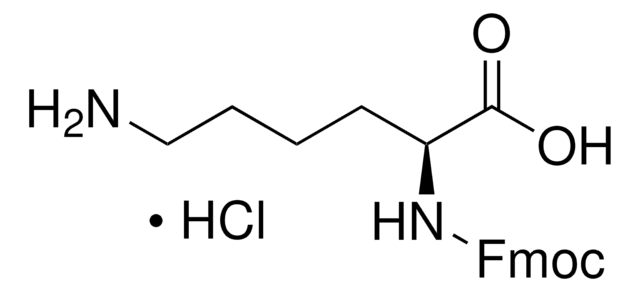
CAS Number139262-23-0
SynonymsNalpha-Fmoc-L-lysinehydrochloride; (S)-2-((((9H-Fluoren-9-yl)methoxy)carbonyl)amino)-6-aminohexanoic acid hydrochloride; Fmoc-Lys-OH hydrochloride; Nα-[(9H-Fluoren-9-ylmethoxy)carbonyl]-L-lysine Hydrochloride; Fmoc-Lys-OH.HCl; Fmoc-L-lysine HCl; N2-Fmoc-L-lysine HCl; MFCD00190889; Fmoc-L-lysine hydrochloride; Nalpha-Fmoc-L-Lysine Hydrochloride; L-Lysine, N-[(9H-fluoren-9-ylmethoxy)carbonyl]-, hydrochloride (1:1); Nalpha-[(9H-Fluoren-9-ylMethoxy)carbonyl]-L-lysine Hydrochloride; Fmoc-Lys-OH inverted exclamation mark currencyHCl; N-[(9H-Fluoren-9-ylmethoxy)carbonyl]-L-lysine hydrochloride (1:1); Nα-Fmoc-L-lysine Hydrochloride
Molecular FormulaC21H25ClN2O4
Molecular Weight404.89
Purity96+%
Boiling Point607.6ºC at 760 mmHg
AppearanceSolid;White to Almost white powder to crystal
EINECS0
Symbol
Signal WordWarning
| Chemical & Physical Properties | |
|---|---|
| CAS Number | 139262-23-0 |
| Catalog No. | 2A-0155813 |
| Chinese Name | Fmoc-L-赖氨酸盐酸盐 |
| Synonyms | Nalpha-Fmoc-L-lysinehydrochloride; (S)-2-((((9H-Fluoren-9-yl)methoxy)carbonyl)amino)-6-aminohexanoic acid hydrochloride; Fmoc-Lys-OH hydrochloride; Nα-[(9H-Fluoren-9-ylmethoxy)carbonyl]-L-lysine Hydrochloride; Fmoc-Lys-OH.HCl; Fmoc-L-lysine HCl; N2-Fmoc-L-lysine HCl; MFCD00190889; Fmoc-L-lysine hydrochloride; Nalpha-Fmoc-L-Lysine Hydrochloride; L-Lysine, N-[(9H-fluoren-9-ylmethoxy)carbonyl]-, hydrochloride (1:1); Nalpha-[(9H-Fluoren-9-ylMethoxy)carbonyl]-L-lysine Hydrochloride; Fmoc-Lys-OH inverted exclamation mark currencyHCl; N-[(9H-Fluoren-9-ylmethoxy)carbonyl]-L-lysine hydrochloride (1:1); Nα-Fmoc-L-lysine Hydrochloride |
| Molecular Formula | C21H25ClN2O4 |
| Molecular Weight | 404.89 |
| Purity | 96+ |
| Boiling Point | 607.6ºC at 760 mmHg |
| Appearance | Solid;White to Almost white powder to crystal |
| Water Solubility | Soluble in: methanol |
| Storage Condition | 2-8°C |
| Application | Fmoc-Lys-OH hydrochloride is a cleavable ADC linker for the synthesis of antibody drug conjugates (ADC). Fmoc Lys OH hydrochloride is also a PROTAC linker based on alkyl chains and can be used to synt |
| EINECS | 0 |
| HTC | 2924299090 |
| UN(IATA) | 0 |
| PubChem ID | 57647629 |
| MDL Number | MFCD00190889 |
| SMILES | Cl.NCCCCC(NC(=O)OCC1c2ccccc2-c2ccccc21)C(=O)O |
| InChI | InChI=1S/C21H24N2O4.ClH/c22-12-6-5-11-19(20(24)25)23-21(26)27-13-18-16-9-3-1-7-14(16)15-8-2-4-10-17(15)18;/h1-4,7-10,18-19H,5-6,11-13,22H2,(H,23,26)(H,24,25);1H/t19-;/m0./s1 |
| InChI Key | MVMZFAIUUXYFGY-FYZYNONXSA-N |
| Beilstein/REAXYS | 8663370 |
| NACRES Code | NA.26 |
| UNSPSC | 12352202 |
| Hazard Symbols | transportation |
| Bioactivity | Fmoc-Lys-OH hydrochloride is a cleavable ADC linker used in the synthesis of antibody-drug conjugates (ADCs). Fmoc-Lys-OH hydrochloride is also a alkyl chain-based PROTAC linker that can be used in the synthesis of PROTACs[1][2]. Related Catalog Research Areas >> Cancer Signaling Pathways >> Antibody-drug Conjugate >> ADC Linker Signaling Pathways >> PROTAC >> PROTAC Linker Target Non-cleavable In Vitro ADCs are comprised of an antibody to which is attached an ADC cytotoxin through an ADC linker[1]. PROTACs contain two different ligands connected by a linker; one is a ligand for an E3 ubiquitin ligase and the other is for the target protein. PROTACs exploit the intracellular ubiquitin-proteasome system to selectively degrade target proteins[2]. References [1]. Beck A, et al. Strategies and challenges for the next generation of antibody-drug conjugates. Nat Rev Drug Discov. 2017;16(5):315-337. [2]. Nalawansha DA, et al. PROTACs: An Emerging Therapeutic Modality in Precision Medicine. Cell Chem Biol. 2020;27(8):998-985. Chemical & Physical Properties Boiling Point 607.6ºC at 760 mmHg Molecular Formula C21H25ClN2O4 Molecular Weight 404.887 Flash Point 321.3ºC Exact Mass 404.150299 PSA 101.65000 LogP 5.00050 Vapour Pressure 1.29E-15mmHg at 25°C Index of Refraction -11.0 ° (C=1, DMF) InChIKey MVMZFAIUUXYFGY-FYZYNONXSA-N SMILES Cl.NCCCCC(NC(=O)OCC1c2ccccc2-c2ccccc21)C(=O)O Storage condition 2-8°C |
| Use of | Fmoc-Lys-OH hydrochloride is a cleavable ADC linker used in the synthesis of antibody-drug conjugates (ADCs). Fmoc-Lys-OH hydrochloride is also a alkyl chain-based PROTAC linker that can be used in the synthesis of PROTACs[1][2]. Properties Name (2S)-6-amino-2-(9H-fluoren-9-ylmethoxycarbonylamino)hexanoic acid,hydrochloride Synonym More Synonyms Fmoc-Lys-OH hydrochloride Biological Activity Description Fmoc-Lys-OH hydrochloride is a cleavable ADC linker used in the synthesis of antibody-drug conjugates (ADCs). Fmoc-Lys-OH hydrochloride is also a alkyl chain-based PROTAC linker that can be used in the synthesis of PROTACs[1][2]. Related Catalog Research Areas >> Cancer Signaling Pathways >> Antibody-drug Conjugate >> ADC Linker Signaling Pathways >> PROTAC >> PROTAC Linker Non-cleavable In Vitro ADCs are comprised of an antibody to which is attached an ADC cytotoxin through an ADC linker[1]. PROTACs contain two different ligands connected by a linker; one is a ligand for an E3 ubiquitin ligase and the other is for the target protein. PROTACs exploit the intracellular ubiquitin-proteasome system to selectively degrade target proteins[2]. References [1]. Beck A, et al. Strategies and challenges for the next generation of antibody-drug conjugates. Nat Rev Drug Discov. 2017;16(5):315-337. [2]. Nalawansha DA, et al. PROTACs: An Emerging Therapeutic Modality in Precision Medicine. Cell Chem Biol. 2020;27(8):998-985. Chemical & Physical Properties Exact Mass 404.150299 PSA 101.65000 LogP 5.00050 InChIKey MVMZFAIUUXYFGY-FYZYNONXSA-N |
| Tax Rebate | 13.0% |
| Supervision | None. MFN tariff: 6.5%. Ordinary tariff: 30.0% |
| Transport Info | Shipping Name: UN |
| MSDS Transport Info | Module 14. Shipping information 14.1 UN dangerous goods number European Land Transport Dangerous Regulations: -International Maritime Dangerous Regulations: -International Air Transport Dangerous Regulations: - 14.2 United Nations shipping name European Land Transport Dangerous Regulations: Non-dangerous goods IMDG Code: Non-dangerous goods International air transport dangerous goods regulations: non-dangerous goods 14.3 Transport hazard categories European Land Transport Dangerous Regulations: -International Maritime Dangerous Regulations: -International Air Transport Dangerous Regulations: - 14.4 Package group European Land Transport Dangerous Regulations: -International Maritime Dangerous Regulations: -International Air Transport Dangerous Regulations: - 14.5 Environmental hazards European Land Transport Danger Regulations: No International Maritime Danger Regulations International Air Transport Danger Regulations: No Marine pollutants (yes/no): No 14.6 Special reminder to users No data available |
| Related Products in Biotechnology & Diagnostics | ||
|---|---|---|
| FMOC-LYS(BOC)-OSU | 132307-50-7 | 2A-0155800 |
| FMOC-LYS(DDE)-OH | 150629-67-7 | 2A-0155801 |
| FMOC-LYS(ME2)-OH.HCL | 252049-10-8 | 2A-0155806 |
| FMOC-LYS(ME3)-OH | 761383-10-2 | 2A-0155807 |
| FMOC-LYS(MTT)-OH | 167393-62-6 | 2A-1155809 |
| FMOC-METHR(BZL)-OH | 198561-81-8 | 2A-0155816 |
| FMOC-METRP-OH | 112913-63-0 | 2A-0155817 |
| FMOC-N-ME-D-ALA-OH | 138774-92-2 | 2A-0155821 |
| FMOC-N-ME-D-PHE-OH | 138775-05-0 | 2A-0155823 |
| FMOC-N-ME-ILE-OH | 138775-22-1 | 2A-0155826 |
| Browse all Biotechnology & Diagnostics products » | ||
Phone:
630-322-8886
630-322-8887
Email:
Office Locations:
Chicago, IL, USA
San Francisco, CA, USA


 EN
EN


 SDS
SDS