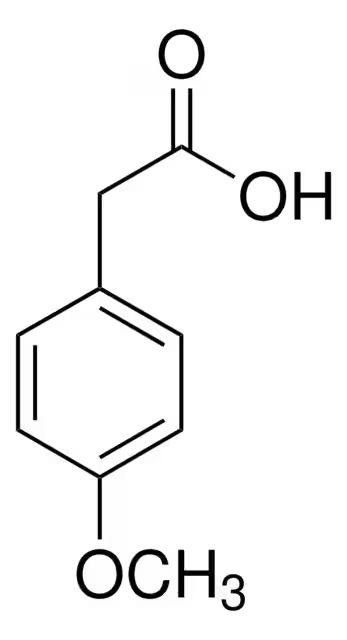
CAS Number104-01-8
Synonyms2-(4-methoxyphenyl)acetic acid; 4-Methoxyphenylacetic acid; EINECS 203-166-4; (4-Methoxyphenyl)acetic acid; QV1R DO1; Homoanisic Acid; MFCD00004345
Molecular FormulaCH3OC6H4CH2CO2H
Molecular Weight166.17
Purity99%
Density1.2±0.1 g/cm3
Boiling Point140 °C/3 mmHg (lit.)
Melting Point84-86 °C (lit.)
AppearanceWhite to off-white powder
EINECS203-166-4
Symbol
Signal WordWarning
| Chemical & Physical Properties | |
|---|---|
| CAS Number | 104-01-8 |
| Catalog No. | 2A-9015330 |
| Chinese Name | 4-甲氧基苯乙酸 |
| Synonyms | 2-(4-methoxyphenyl)acetic acid; 4-Methoxyphenylacetic acid; EINECS 203-166-4; (4-Methoxyphenyl)acetic acid; QV1R DO1; Homoanisic Acid; MFCD00004345 |
| Molecular Formula | CH3OC6H4CH2CO2H |
| Molecular Weight | 166.17 |
| Purity | 99 |
| Density | 1.2±0.1 g/cm3 |
| Boiling Point | 140 °C/3 mmHg (lit.) |
| Melting Point | 84-86 °C (lit.) |
| Appearance | White to off-white powder |
| Water Solubility | 6 g/L (20 ºC) |
| Storage Condition | Store in a cool, ventilated warehouse. Keep away f |
| Application | 2-(4-Methoxyphenyl)acetic acid is a plasma metabolite with high sensitivity and specificity that can be used as a biomarker to differentiate between non-small cell carcinoma patients and healthy contr |
| EINECS | 203-166-4 |
| HTC | 29189090 |
| PubChem ID | 24896588 |
| MDL Number | MFCD00004345 |
| SMILES | COc1ccc(CC(O)=O)cc1 |
| InChI | 1S/C9H10O3/c1-12-8-4-2-7(3-5-8)6-9(10)11/h2-5H,6H2,1H3,(H,10,11) |
| InChI Key | NRPFNQUDKRYCNX-UHFFFAOYSA-N |
| Beilstein/REAXYS | 1101737 |
| NACRES Code | NA.22 |
| UNSPSC | 12352100 |
| Hazard Symbols | Transport |
| MSDS | msds/15330_1_104_01_8.pdf |
| Bioactivity | 2-(4-Methoxyphenyl)acetic acid is a plasma metabolite, with high sensitivity and specificity value as a biomarker for discriminating between NSCLC and healthy controls. Related Catalog Natural Products >> Acids and Aldehydes Research Areas >> Cancer Target Human Endogenous Metabolite In Vitro 2-(4-Methoxyphenyl)acetic acid (4-methoxyphenylacetic acid) is a plasma metabolite, with high sensitivity and specificity values as a biomarker for discriminating between NSCLC and healthy controls. 2-(4-Methoxyphenyl)acetic acid may play a protective role to prevent the development of lung cancer[1]. References [1]. Xiang C, et al. Cortisol, cortisone, and 4-methoxyphenylacetic acid as potential plasma biomarkers for early detection of non-small cell lung cancer. Int J Biol Markers. 2018 Aug;33(3):314-320. Chemical & Physical Properties Density 1.2±0.1 g/cm3 Boiling Point 306.0±17.0 °C at 760 mmHg Melting Point 84-86 °C(lit.) Molecular Formula C9H10O3 Molecular Weight 166.174 Flash Point 124.3±14.4 °C Exact Mass 166.062988 PSA 46.53000 LogP 1.42 Vapour Pressure 0.0±0.7 mmHg at 25°C Index of Refraction 1.538 InChIKey NRPFNQUDKRYCNX-UHFFFAOYSA-N SMILES COc1ccc(CC(=O)O)cc1 Water Solubility 6 g/L (20 ºC) |
| Use of | 2-(4-Methoxyphenyl)acetic acid is a plasma metabolite, with high sensitivity and specificity value as a biomarker for discriminating between NSCLC and healthy controls. Properties Name 4-methoxyphenylacetic acid Synonym More Synonyms 4-Methoxyphenylacetic acid Biological Activity Description 2-(4-Methoxyphenyl)acetic acid is a plasma metabolite, with high sensitivity and specificity value as a biomarker for discriminating between NSCLC and healthy controls. Related Catalog Natural Products >> Acids and Aldehydes Research Areas >> Cancer Human Endogenous Metabolite In Vitro 2-(4-Methoxyphenyl)acetic acid (4-methoxyphenylacetic acid) is a plasma metabolite, with high sensitivity and specificity values as a biomarker for discriminating between NSCLC and healthy controls. 2-(4-Methoxyphenyl)acetic acid may play a protective role to prevent the development of lung cancer[1]. References [1]. Xiang C, et al. Cortisol, cortisone, and 4-methoxyphenylacetic acid as potential plasma biomarkers for early detection of non-small cell lung cancer. Int J Biol Markers. 2018 Aug;33(3):314-320. Chemical & Physical Properties Molecular Formula C9H10O3 Exact Mass 166.062988 PSA 46.53000 Index of Refraction 1.538 InChIKey NRPFNQUDKRYCNX-UHFFFAOYSA-N |
| Tax Rebate | 13.0% |
| Supervision | None. MFN tariff: 6.5%. Ordinary tariff: 30.0% |
| Transport Info | Shipping Name: UN |
| MSDS Transport Info | Module 14. Shipping information 14.1 UN dangerous goods number European Land Transport Dangerous Regulations: -International Maritime Dangerous Regulations: -International Air Transport Dangerous Regulations: - 14.2 United Nations shipping name European Land Transport Dangerous Regulations: Non-dangerous goods IMDG Code: Non-dangerous goods International air transport dangerous goods regulations: non-dangerous goods 14.3 Transport hazard categories European Land Transport Dangerous Regulations: -International Maritime Dangerous Regulations: -International Air Transport Dangerous Regulations: - 14.4 Package group European Land Transport Dangerous Regulations: -International Maritime Dangerous Regulations: -International Air Transport Dangerous Regulations: - 14.5 Environmental hazards European Land Transport Danger Regulations: No International Maritime Danger Regulations International Air Transport Danger Regulations: No Marine pollutants (yes/no): No 14.6 Special reminder to users No data available |
| Related Products in Specialty Chemicals | ||
|---|---|---|
| Platinum | 7440-06-4 | 2A-9015325 |
| Platinum potassium cyanide | 14323-36-5 | 2A-9015326 |
| Platinum(II) cyanide | 592-06-3 | 2A-9015327 |
| Platinum(IV) iodide | 7790-46-7 | 2A-9015328 |
| Platinum(IV) sulfide | 12038-21-0 | 2A-9015329 |
| p-Methylbenzyl chloride | 104-82-5 | 2A-9015331 |
| p-n-Butylacetophenone | 37920-25-5 | 2A-9015333 |
| p-Nitrobenzyl chloroformate | 4457-32-3 | 2A-9015334 |
| p-Nitrophenylacetonitrile | 555-21-5 | 2A-9015337 |
| Polyaluminum chloride hydroxide sulfate | 39290-78-3 | 2A-9015338 |
| Browse all Specialty Chemicals products » | ||
Phone:
630-322-8886
630-322-8887
Email:
Office Locations:
Chicago, IL, USA
San Francisco, CA, USA


 EN
EN


 SDS
SDS