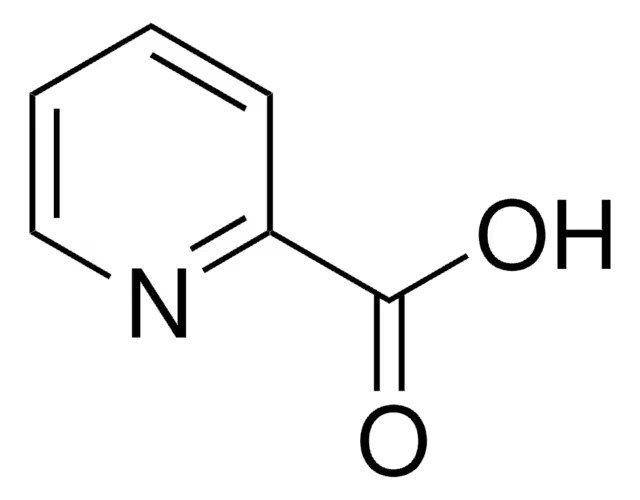
CAS Number98-98-6
Synonyms2-pyridinecarboxylic acid; Picolinic acid; pyridine-2-carboxylic acid; acidepicolique; EINECS 202-719-7; 2-Carboxypyridine; MFCD00006293; 2-acid pyridine; 2-Picolinic acid; PCL 016
Molecular FormulaC6H5NO2
Molecular Weight123.11
Purity99%
Density1.3±0.1 g/cm3
Boiling Point292.5±13.0 °C at 760 mmHg
Melting Point139-142 °C (lit.)
Appearancecrystals
EINECS202-719-7
Symbol
Signal WordWarning
| Chemical & Physical Properties | |
|---|---|
| CAS Number | 98-98-6 |
| Catalog No. | 2A-9015317 |
| Chinese Name | 2-吡啶甲酸 |
| Synonyms | 2-pyridinecarboxylic acid; Picolinic acid; pyridine-2-carboxylic acid; acidepicolique; EINECS 202-719-7; 2-Carboxypyridine; MFCD00006293; 2-acid pyridine; 2-Picolinic acid; PCL 016 |
| Molecular Formula | C6H5NO2 |
| Molecular Weight | 123.11 |
| Purity | 99 |
| Density | 1.3±0.1 g/cm3 |
| Boiling Point | 292.5±13.0 °C at 760 mmHg |
| Melting Point | 139-142 °C (lit.) |
| Appearance | crystals |
| Water Solubility | 887 g/L (20 ºC) |
| Storage Condition | Store in a cool, ventilated warehouse. Keep away f |
| Application | PCL 016 is a topical antiviral drug found to inhibit adenovirus replication in rabbits. |
| EINECS | 202-719-7 |
| HTC | 29333999 |
| PubChem ID | 24898523 |
| MDL Number | MFCD00006293 |
| SMILES | OC(=O)c1ccccn1 |
| InChI | 1S/C6H5NO2/c8-6(9)5-3-1-2-4-7-5/h1-4H,(H,8,9) |
| InChI Key | SIOXPEMLGUPBBT-UHFFFAOYSA-N |
| Beilstein/REAXYS | 109595 |
| NACRES Code | NA.22 |
| UNSPSC | 12352100 |
| Hazard Symbols | Transport |
| MSDS | msds/15317_1_98_98_6.pdf |
| Bioactivity | PCL 016 is a topical antiviral agent, which inhibits adenovirus replication in rabbit. Related Catalog Natural Products >> Others Research Areas >> Infection Target Human Endogenous Metabolite In Vivo Topical 1.5% PCL, 0.8% PCL, 0.369% PCL (pH7), 0.369% PCL (pH4) and 0.5% CDV are significantly more effective than the Control in reducing Ad Positive Cultures/Total (Days 1-14) and the Duration of Ad Shedding in the Ad5/NZW rabbit ocular model. Although not statistically significant, there appears to be a trend toward concentration-dependent efficacy of PCL 016 on the Duration of Ad Shedding. There is no apparent ocular toxicity associated with PCL 016 concentrations[1]. Animal Admin Rabbits[1] 25 NZW rabbits are topically inoculated in both eyes, following corneal scarification, with 1.5 x 10⁶ pfu/eye of Ad5. On day 1, the rabbits are divided into 6 topical treatment groups: I - 1.5% PCL 016 pH 7.0 (n=4); II - 0.8% PCL 016 pH 7.0 (n=4); III - 0.369% PCL 016 pH 7.0 (n=4); IV - 0.369% PCL 016 pH 4.0 (n=4); V - 0.5% Cidofovir (CDV) (n=4); VI - Control (saline) (n=5). PCL 016 and control rabbits are treated in both eyes 4 times daily for 7 days, while CDV rabbits are treated in both eyes twice daily for 7 days. All eyes are cultured for virus on days 0, 1, 3, 4, 5, 7, 9, 11, and 14[1]. References [1]. E.G. Romanowski, et al. A Novel Topical Antiviral Agent, PCL-016 (Picolinic Acid), Inhibits Adenovirus Replication in the Ad5/NZW Rabbit Ocular Model. ARVO Annual Meeting Abstract. May 2005 Volume 46, Issue 13. Chemical & Physical Properties Density 1.3±0.1 g/cm3 Boiling Point 292.5±13.0 °C at 760 mmHg Melting Point 139-142 °C(lit.) Molecular Formula C6H5NO2 Molecular Weight 123.109 Flash Point 130.7±19.8 °C Exact Mass 123.032028 PSA 50.19000 LogP -0.10 Vapour Pressure 0.0±0.6 mmHg at 25°C Index of Refraction 1.571 InChIKey SIOXPEMLGUPBBT-UHFFFAOYSA-N SMILES O=C(O)c1ccccn1 Storage condition Store at RT. Water Solubility 887 g/L (20 ºC) |
| Use of | PCL 016 is a topical antiviral agent, which inhibits adenovirus replication in rabbit. Properties Articles57 Name picolinic acid Synonym More Synonyms 2-Picolinic acid Biological Activity Description PCL 016 is a topical antiviral agent, which inhibits adenovirus replication in rabbit. Related Catalog Natural Products >> Others Research Areas >> Infection Human Endogenous Metabolite Animal Admin Rabbits[1] 25 NZW rabbits are topically inoculated in both eyes, following corneal scarification, with 1.5 x 10⁶ pfu/eye of Ad5. On day 1, the rabbits are divided into 6 topical treatment groups: I - 1.5% PCL 016 pH 7.0 (n=4); II - 0.8% PCL 016 pH 7.0 (n=4); III - 0.369% PCL 016 pH 7.0 (n=4); IV - 0.369% PCL 016 pH 4.0 (n=4); V - 0.5% Cidofovir (CDV) (n=4); VI - Control (saline) (n=5). PCL 016 and control rabbits are treated in both eyes 4 times daily for 7 days, while CDV rabbits are treated in both eyes twice daily for 7 days. All eyes are cultured for virus on days 0, 1, 3, 4, 5, 7, 9, 11, and 14[1]. References Chemical & Physical Properties Molecular Formula C6H5NO2 Exact Mass 123.032028 PSA 50.19000 LogP -0.10 Index of Refraction 1.571 InChIKey SIOXPEMLGUPBBT-UHFFFAOYSA-N Storage condition Store at RT. |
| Transport Info | Shipping Name: UN |
| MSDS Transport Info | Module 14. Shipping information 14.1 UN dangerous goods number European Land Transport Dangerous Regulations: -International Maritime Dangerous Regulations: -International Air Transport Dangerous Regulations: - 14.2 United Nations shipping name European Land Transport Dangerous Regulations: Non-dangerous goods IMDG Code: Non-dangerous goods International air transport dangerous goods regulations: non-dangerous goods 14.3 Transport hazard categories European Land Transport Dangerous Regulations: -International Maritime Dangerous Regulations: -International Air Transport Dangerous Regulations: - 14.4 Package group European Land Transport Dangerous Regulations: -International Maritime Dangerous Regulations: -International Air Transport Dangerous Regulations: - 14.5 Environmental hazards European Land Transport Danger Regulations: No International Maritime Danger Regulations International Air Transport Danger Regulations: No Marine pollutants (yes/no): No 14.6 Special reminder to users No data available |
| Related Products in Specialty Chemicals | ||
|---|---|---|
| Phosphoryl fluoride | 13478-20-1 | 2A-9015309 |
| Phosphoryl trichloride | 10025-87-3 | 2A-9015310 |
| Phthalide | 87-41-2 | 2A-9015312 |
| Phthalimide | 85-41-6 | 2A-9015313 |
| Phthalimide potassium salt | 1074-82-4 | 2A-9015314 |
| p-Isopropylaniline | 99-88-7 | 2A-9015320 |
| Pivalic acid | 75-98-9 | 2A-9015322 |
| dipotassium tetrachloroplatinate | 10025-99-7 | 2A-9015323 |
| Platinous sulfide | 2A-402318 | 2A-9015324 |
| Platinum | 7440-06-4 | 2A-9015325 |
| Browse all Specialty Chemicals products » | ||
Phone:
630-322-8886
630-322-8887
Email:
Office Locations:
Chicago, IL, USA
San Francisco, CA, USA


 EN
EN


 SDS
SDS