CAS Number7558-79-4
SynonymsDisodium hydrogenorthophosphate; EINECS 231-448-7; disodium,hydrogen phosphate; MFCD00003496
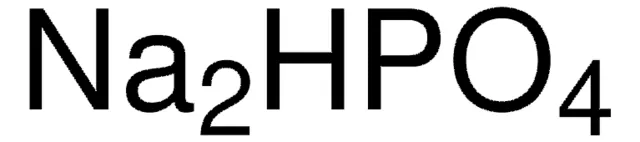
Molecular FormulaNa2HPO4
Molecular Weight141.96
Purity≥99.0%
Density1.064 g/mL at 20 °C
Boiling Point158ºC at 760 mmHg
Melting Point243-245 °C
Appearancepowder
EINECS231-448-7
Symbol
Signal WordWarning
| Chemical & Physical Properties | |
|---|---|
| CAS Number | 7558-79-4 |
| Catalog No. | 2A-9014334 |
| Chinese Name | 磷酸氢二钠 |
| Synonyms | Disodium hydrogenorthophosphate; EINECS 231-448-7; disodium,hydrogen phosphate; MFCD00003496 |
| Molecular Formula | Na2HPO4 |
| Molecular Weight | 141.96 |
| Purity | ≥99.0 |
| Density | 1.064 g/mL at 20 °C |
| Boiling Point | 158ºC at 760 mmHg |
| Melting Point | 243-245 °C |
| Appearance | powder |
| Water Solubility | ≥10 g/100 mL at 20 ºC |
| Storage Condition | 1. It should be stored in a cool, ventilated and d |
| Application | Disodium phosphate, also known as Na2HPO4, is used to adjust the pH of liquids. Disodium phosphate can be used as an excipient, such as buffering agent, chelating agent, etc. Pharmaceutical excipients |
| EINECS | 231-448-7 |
| HTC | 2835220000 |
| PubChem ID | 329824633 |
| MDL Number | MFCD00003496 |
| SMILES | [Na+].[Na+].[H]OP([O-])([O-])=O |
| InChI | 1S/2Na.H3O4P/c;;1-5(2,3)4/h;;(H3,1,2,3,4)/q2*+1;/p-2 |
| InChI Key | BNIILDVGGAEEIG-UHFFFAOYSA-L |
| NACRES Code | NA.21 |
| eCl@ss | 38070211 |
| UNSPSC | 12352302 |
| Hazard Symbols | Transport |
| MSDS | msds/14334_1_7558_79_4.pdf |
| Bioactivity | Disodium phosphate is also known as Na2HPO4 to adjust pH of liquid. Disodium phosphate can be used as an excipient, such as buffer, chelating agent. Pharmaceutical excipients, or pharmaceutical auxiliaries, refer to other chemical substances used in the pharmaceutical process other than pharmaceutical ingredients. Pharmaceutical excipients generally refer to inactive ingredients in pharmaceutical preparations, which can improve the stability, solubility and processability of pharmaceutical preparations. Pharmaceutical excipients also affect the absorption, distribution, metabolism, and elimination (ADME) processes of co-administered drugs[1][2]. Related Catalog Research Areas >> Others Signaling Pathways >> Others >> Others References [1]. Baldus M, et al. Structure investigation on anhydrous disodium hydrogen phosphate using solid-state NMR and X-ray techniques[J]. Journal of the American Chemical Society, 1995, 117(18): 5141-5147. [2]. Elder DP, et al. Pharmaceutical excipients - quality, regulatory and biopharmaceutical considerations. Eur J Pharm Sci. 2016 May 25;87:88-99. Chemical & Physical Properties Density 1.064 g/mL at 20 °C Boiling Point 158ºC at 760 mmHg Melting Point 243-245 °C Molecular Formula HNa2O4P Molecular Weight 141.96 Exact Mass 141.940781 PSA 93.23000 Vapour density 4.9 (vs air) InChIKey BNIILDVGGAEEIG-UHFFFAOYSA-L SMILES O=P([O-])([O-])O.[Na+].[Na+] Storage condition Store at RT. Stability Stable. Incompatible with strong acids. Hygroscopic. Water Solubility ≥10 g/100 mL at 20 ºC |
| Use of | Disodium phosphate is also known as Na2HPO4 to adjust pH of liquid. Disodium phosphate can be used as an excipient, such as buffer, chelating agent. Pharmaceutical excipients, or pharmaceutical auxiliaries, refer to other chemical substances used in the pharmaceutical process other than pharmaceutical ingredients. Pharmaceutical excipients generally refer to inactive ingredients in pharmaceutical preparations, which can improve the stability, solubility and processability of pharmaceutical preparations. Pharmaceutical excipients also affect the absorption, distribution, metabolism, and elimination (ADME) processes of co-administered drugs[1][2]. Properties Articles416 Name disodium hydrogenphosphate Synonym More Synonyms Disodium hydrogenorthophosphate Biological Activity Description Disodium phosphate is also known as Na2HPO4 to adjust pH of liquid. Disodium phosphate can be used as an excipient, such as buffer, chelating agent. Pharmaceutical excipients, or pharmaceutical auxiliaries, refer to other chemical substances used in the pharmaceutical process other than pharmaceutical ingredients. Pharmaceutical excipients generally refer to inactive ingredients in pharmaceutical preparations, which can improve the stability, solubility and processability of pharmaceutical preparations. Pharmaceutical excipients also affect the absorption, distribution, metabolism, and elimination (ADME) processes of co-administered drugs[1][2]. Related Catalog Research Areas >> Others Signaling Pathways >> Others >> Others References [1]. Baldus M, et al. Structure investigation on anhydrous disodium hydrogen phosphate using solid-state NMR and X-ray techniques[J]. Journal of the American Chemical Society, 1995, 117(18): 5141-5147. [2]. Elder DP, et al. Pharmaceutical excipients - quality, regulatory and biopharmaceutical considerations. Eur J Pharm Sci. 2016 May 25;87:88-99. Chemical & Physical Properties Molecular Formula HNa2O4P Exact Mass 141.940781 PSA 93.23000 Vapour density 4.9 (vs air) InChIKey BNIILDVGGAEEIG-UHFFFAOYSA-L SMILES O=P([O-])([O-])O.[Na+].[Na+] Storage condition Store at RT. Stability Stable. Incompatible with strong acids. Hygroscopic. |
| Transport Info | Shipping Name: UN |
| MSDS Transport Info | Module 14. Shipping information 14.1 UN dangerous goods number European Land Transport Dangerous Regulations: -International Maritime Dangerous Regulations: -International Air Transport Dangerous Regulations: - 14.2 United Nations shipping name European Land Transport Dangerous Regulations: Non-dangerous goods IMDG Code: Non-dangerous goods International air transport dangerous goods regulations: non-dangerous goods 14.3 Transport hazard categories European Land Transport Dangerous Regulations: -International Maritime Dangerous Regulations: -International Air Transport Dangerous Regulations: - 14.4 Package group European Land Transport Dangerous Regulations: -International Maritime Dangerous Regulations: -International Air Transport Dangerous Regulations: - 14.5 Environmental hazards European Land Transport Danger Regulations: No International Maritime Danger Regulations International Air Transport Danger Regulations: No Marine pollutants (yes/no): No 14.6 Special reminder to users No data available |
| Related Products in Specialty Chemicals | ||
|---|---|---|
| Diphenylselenium dichloride | 2217-81-4 | 2A-9014327 |
| Diphosphoric tetrachloride; Diphosphoryl chloride | 13498-14-1 | 2A-9014329 |
| Di-Potassium hydrogen orthophosphate | 7758-11-4 | 2A-9014330 |
| Di-potassium hydrogen orthophosphate 3-hydrate | 16788-57-1 | 2A-9014331 |
| Disodium chromate | 10034-82-9 | 2A-9014333 |
| Di-sodium peroxide | 1313-60-6 | 2A-9014335 |
| Di-sodium tin trioxide | 12058-66-1 | 2A-9014336 |
| Ditungsten pentaboride | 12007-98-6 | 2A-9014338 |
| Divinyl sulphone | 77-77-0 | 2A-9014339 |
| Divinylbenzene | 1321-74-0 | 2A-9014340 |
| Browse all Specialty Chemicals products » | ||
Phone:
630-322-8886
630-322-8887
Email:
Office Locations:
Chicago, IL, USA
San Francisco, CA, USA


 EN
EN


 SDS
SDS